

Sazavis prisca was a small Cretaceous bird from the region now occupied by the Kyzylkum Desert in Uzbekistan. The species was named from the lower end of a tibiotarsus, the main bone of the lower leg. The fossil measures 4.5 mm across. The shape of the joint supports its assignment to the enantiornithines, with closer relationships still uncertain.
Quick facts
| Group | Enantiornithines |
|---|---|
| Age | Late Cretaceous (Turonian) |
| Region | Asia (Kyzylkum Desert, Uzbekistan) |
| Diet | No direct evidence |
| Type species | Sazavis prisca |
| Holotype | ZIN PO 3472 |
| Preserved bone | Lower end of a tibiotarsus, 4.5 mm across |
| Formation | Bissekty Formation |
What can the fossils tell us?
Two rounded articular projections differ in size and shape. Their form and the surrounding bone support a comparison with enantiornithines.
The joint is 4.5 mm wide. The full length of the bone and dimensions of the rest of the skeleton are unknown.
The bone comes from site CBI-14 in the Kyzylkum. Recent stratigraphic work assigns the fossil-bearing deposits to the middle to late Turonian.
A species based on one joint
Lev Nesov and Alexander Yarkov published the name in 1989. The type specimen, ZIN PO 3472, came from Dzharakuduk. It preserves the joint end of the tibiotarsus, a bone formed by the tibia and fused parts of the upper ankle.
One of the two rounded joint surfaces is broader and more bulbous than the other. The size and shape of these surfaces, together with a small prominence on the front of the bone, support the identification as an enantiornithine. Like Nanantius from Australia, Sazavis was named from the lower leg. The preserved fragments leave few characters for a more detailed comparison.
Isolated bones from the same beds
Other small bird remains from Dzharakuduk include bones from the shoulder girdle. Some are similar in size and come from the same fossil deposits. Their relationship to Sazavis would be easier to test with matching parts of the skeleton or bones found together in articulation.
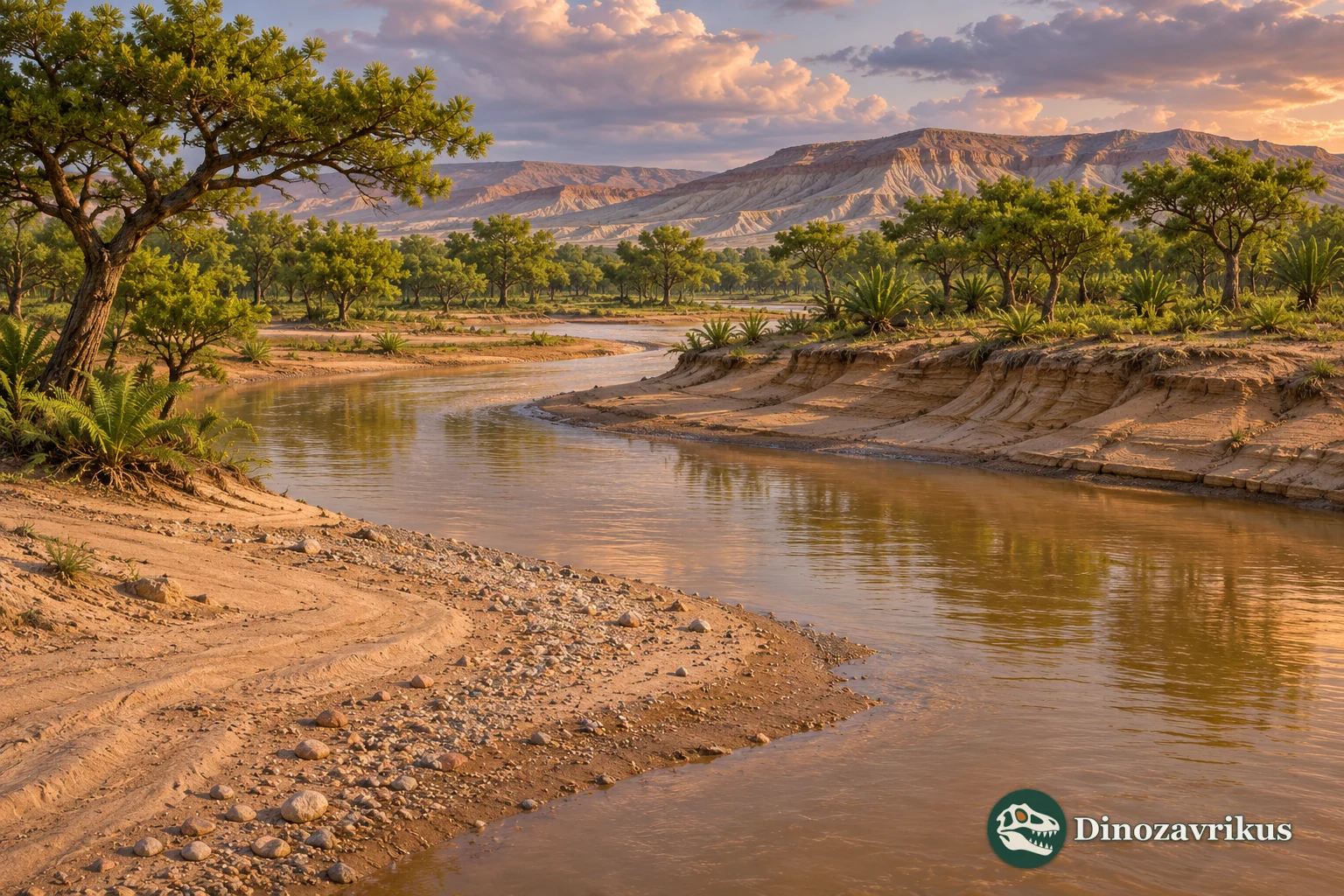
Early publications gave a Coniacian age for the site. Subsequent research treats the fossiliferous Bissekty Formation at Dzharakuduk as middle to late Turonian. River deposits preserved a mixture of aquatic and land vertebrates.
Frequently asked questions
What remains of Sazavis?
The joint end of a lower leg bone, held in the Zoological Institute collection under ZIN PO 3472.
What does the 4.5 mm measurement describe?
It is the width across the ankle end of the fossil, which is only part of the shin bone.
How was its group identified?
The shapes of the two rounded joint surfaces and a small prominence on the front of the bone support its assignment to Enantiornithes.
Is anything known about its diet?
The preserved joint records the form of the lower leg. Jaws, teeth or food remains would provide evidence about diet.