

Scandiavis is an Early Eocene bird important for understanding the origin of Charadriiformes, the group containing shorebirds, gulls and their relatives. It was initially described from an associated partial skeleton in Denmark. A separate three-dimensional skull later allowed researchers to investigate its interior using computed tomography, while English discoveries added previously unknown wing bones.
Quick facts
| Group | Early branch of Charadriiformes |
|---|---|
| Age | Early Eocene, approximately 55 million years ago |
| Records | Denmark; later also England |
| Holotype | Partial skeleton FU171x |
| Named by | Sara Bertelli and colleagues, 2013 |
What can the fossils tell us?
The holotype retains the head, spine, pelvis and hind limbs. Its wings are absent; an unrelated bone from the same deposits cannot simply fill that gap.
A three-dimensional model was built from the interior of a separate skull. It approximates the brain’s outer shape but is not preserved neural tissue.
English remains added evidence from the humerus. Some identifications carry an explicit comparative qualification rather than an unquestioned assignment to the same species.
Bent Mikkelsen’s discovery
Sara Bertelli, Bent Lindow, Gareth Dyke and Gerald Mayr named Scandiavis mikkelseni in 2013. The genus means Scandinavian bird, while the species honours Bent Søe Mikkelsen, who discovered the holotype. Specimen FU171x came from the coastal cliff at Ejerslev on the Danish island of Mors.
The holotype represents an adult. The head, vertebral column, ribs, pelvis and legs remain associated, but the forelimbs are absent. The tarsometatarsus is relatively short, no longer than the femur, and the hind toe is also short. Features of the pelvis and legs recalled charadriiform birds, whereas the skull and vertebrae did not match any living family of that order in every detail.
Why the skull remained three-dimensional
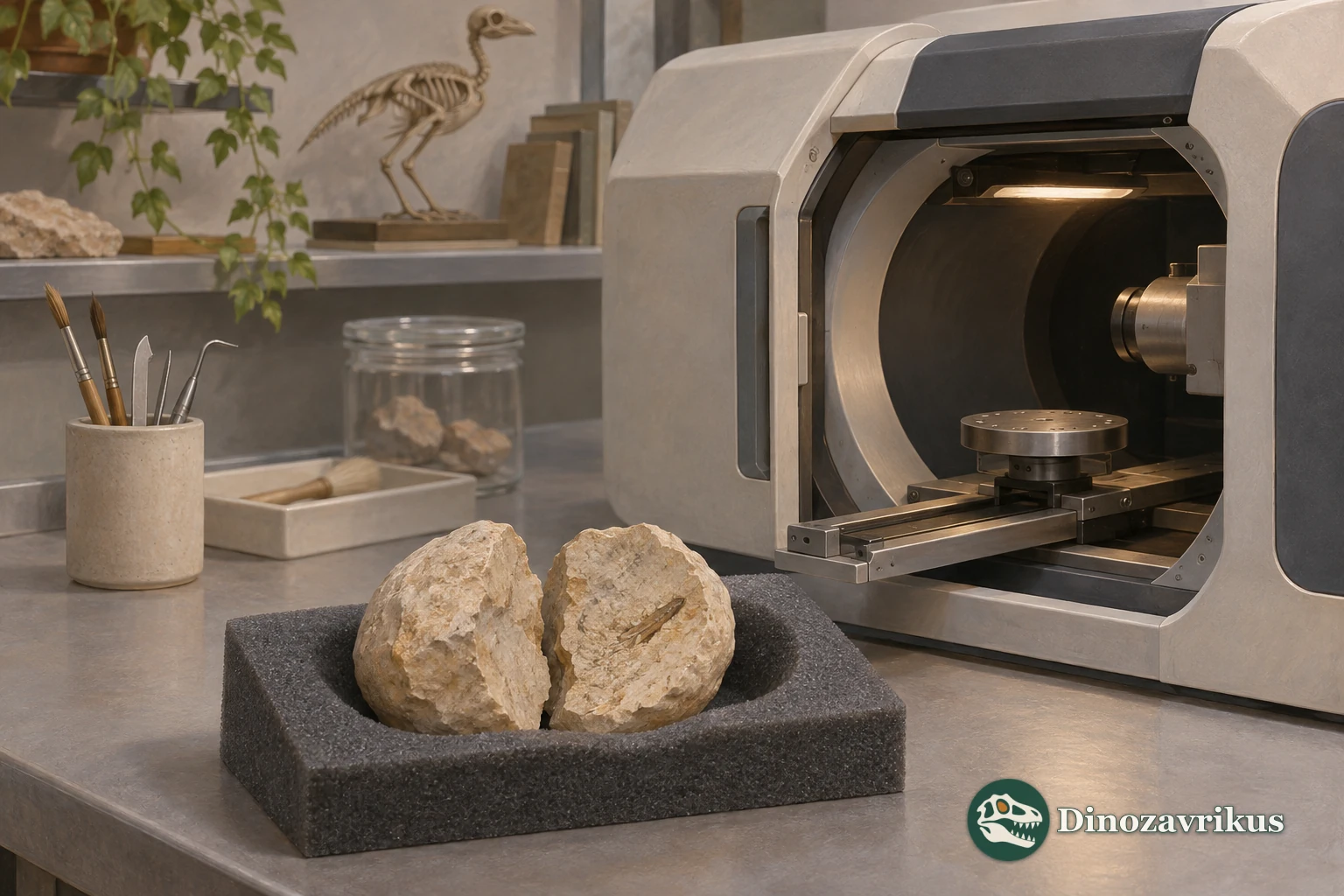
A second important specimen, NHMD 625345, is a nearly complete skull from Skarrehage Quarry on the same island. It is enclosed within a carbonate concretion, a dense mineral body that protected the bones against compression. The rock was split along the skull’s median plane, producing two halves. Its cranial cavity remained free of secondary sediment.
Both Danish specimens are associated with the Fur Formation, which contains diatomaceous sediments and numerous volcanic ash layers. The skull came from around ash layer +15, below layer +19, dated to approximately 55.4 million years ago. This provides a stratigraphic reference point rather than a direct numerical measurement of the bone’s age.
Fur Formation sediments accumulated in an offshore marine setting. A bird’s presence in those sediments does not establish that it lived at sea: the place of burial and the habitat occupied during life can differ.
What tomography revealed
In a 2021 study, Miriam Heingård and colleagues placed the two concretion halves together for micro-CT scanning at Lund University. The reconstructed three-dimensional grid had a voxel width of 53.3 micrometres. The scans revealed the bones and the internal cranial cavity without requiring all the surrounding stone to be removed.
The reconstructed endocast had a volume of 1.09 millilitres. The authors treated this as a minimum because the olfactory bulbs and optic nerve were incompletely reconstructed. An endocast is a digital cast of the space inside the braincase, not a fossilised brain.
The model’s overall proportions resemble those of certain living plovers and other shorebirds. The floccular region, associated with the cerebellum, is comparatively large and elongated in Scandiavis. Its size should not be converted into a claim of exceptionally agile flight: the researchers themselves noted that this feature is an unreliable standalone indicator of flying ability.
English fossils and the avian family tree
A 2023 study reported associated limb bones of two individuals from the London Clay of Walton-on-the-Naze as Scandiavis cf. mikkelseni. The abbreviation cf. signals a qualified comparative identification. Remains of two additional individuals were tentatively assigned to the genus.
A projection on the humerus corroborates charadriiform affinities. At the same time, primitive anatomy around the tendon passages of the tarsometatarsus points to a position outside the group containing all living charadriiforms. The 2021 skull analysis also most often placed Scandiavis on an early branch of this order; earlier work had considered possible gruiform relationships.
Birds associated with water can have quite different evolutionary origins. The Eocene Presbyornis, which also resembled a long-legged shorebird, belongs to the anseriform lineage. For Scandiavis, specific skeletal characters carry more information than a general waterside silhouette.
Neither the scans nor the foot bones establish its exact diet, migratory behaviour or colour. The reconstruction depicts one possible appearance for an early shorebird relative; the feather pattern is an artistic choice.
Frequently asked questions
Was the brain of Scandiavis preserved?
No. A cavity was preserved inside a three-dimensional skull. Tomography allowed that cavity to be modelled digitally, approximating the outer form of the brain.
What does the 1.09 millilitre volume mean?
It is a minimum estimate for the reconstructed endocast of one skull. Some regions were incomplete, so it should not be treated as an exact measurement of the entire brain.
Why are the wings missing from the first skeleton?
This reflects incomplete preservation of the holotype. Missing fossil wings do not establish that the living bird was wingless or flightless.
Was Scandiavis the ancestor of all modern shorebirds?
No direct ancestry has been established. Studies usually treat it as an early branch near the base of Charadriiformes, combining features not found together in living families.