

Scelidotherium was a large South American ground sloth with a long narrow muzzle and powerful limbs. Its history begins with a partial skeleton collected by Charles Darwin in Argentina. Later fossils allow comparison with other mylodontids and tests of possible digging behavior, while exact diet and late survival remain more difficult questions.
The genus appears in the ice-age animal catalogue. Its narrower snout contrasts with the broad-snouted Glossotherium; similar limb strength alone does not make them the same taxon.
Quick facts
| Type species | Scelidotherium leptocephalum Owen, 1839 |
|---|---|
| Other accepted species | S. bravardi in the 2014 revision |
| Family | Mylodontidae, ground sloths |
| Type locality | Punta Alta, Buenos Aires Province |
| Type material | Darwin's partial juvenile skeleton |
| Repository | Natural History Museum, London |
What can the fossils tell us?
The partial juvenile skeleton from Punta Alta underlies the original description. It records cranial and limb anatomy but cannot preserve coat color.
Comparisons use the premaxillae, nasal opening and cheek teeth. Feeding mechanics support plant consumption but cannot list every food item.
A Río Cuarto fossil yielded 7550 ± 60 uncalibrated radiocarbon years BP. Possible contamination by younger carbon has been raised, so one date does not settle survival into the mid-Holocene.
Darwin's Punta Alta specimen
Darwin collected a partial skeleton near Punta Alta, Buenos Aires Province, in 1833 during the voyage of the Beagle. Richard Owen described it as Scelidotherium leptocephalum in the serialized Fossil Mammalia publication in 1839. London's Natural History Museum lists parts of NHMUK PV M 82206 as holotype. Some museum records give 1840 as the authority year because the parts of the series appeared over more than one year.
Owen emphasized a slender skull compared with the heavy pelvis and thigh bone. The specimen was not fully grown, so its proportions cannot simply be scaled into an exact adult size. Later Argentine material helped fill gaps in the original skull.

A narrow skull and two species
A 2014 systematic revision retained two species, S. leptocephalum and S. bravardi, among many historical names. The latter is associated mainly with older Pleistocene deposits around Buenos Aires, while the former is especially well represented in middle and late Pleistocene material. Isolated bones do not always permit species-level identification.
S. leptocephalum has an elongated, low cranium and relatively narrow nasal opening. Compared with Glossotherium robustum, its muzzle is slimmer and its tooth rows differ. The narrow head does not imply a lightly built body. One biomechanical model estimated approximately 850 kg from a scale reconstruction; it is a model result, not a direct weight for every individual.
Feeding, digging and late dates
Sloth cheek teeth lack ordinary enamel and continued to grow. Masticatory analysis suggests Scelidotherium was a mixed or selective plant feeder relative to the broad-snouted bulk-feeding Glossotherium. Strong forelimbs and resistance to bending support digging-capable movements. Large Pampas burrows could have involved more than one mylodontid; without an associated skeleton, none belongs to this genus by default.
A bone from the La Invernada Formation near Río Cuarto produced a collagen date of 7550 ± 60 radiocarbon years BP, uncalibrated. It was published as evidence of very late persistence. Later discussions questioned whether young humic or fulvic carbon could have affected such results. Independent replication is needed before treating this number as a secure extinction boundary.
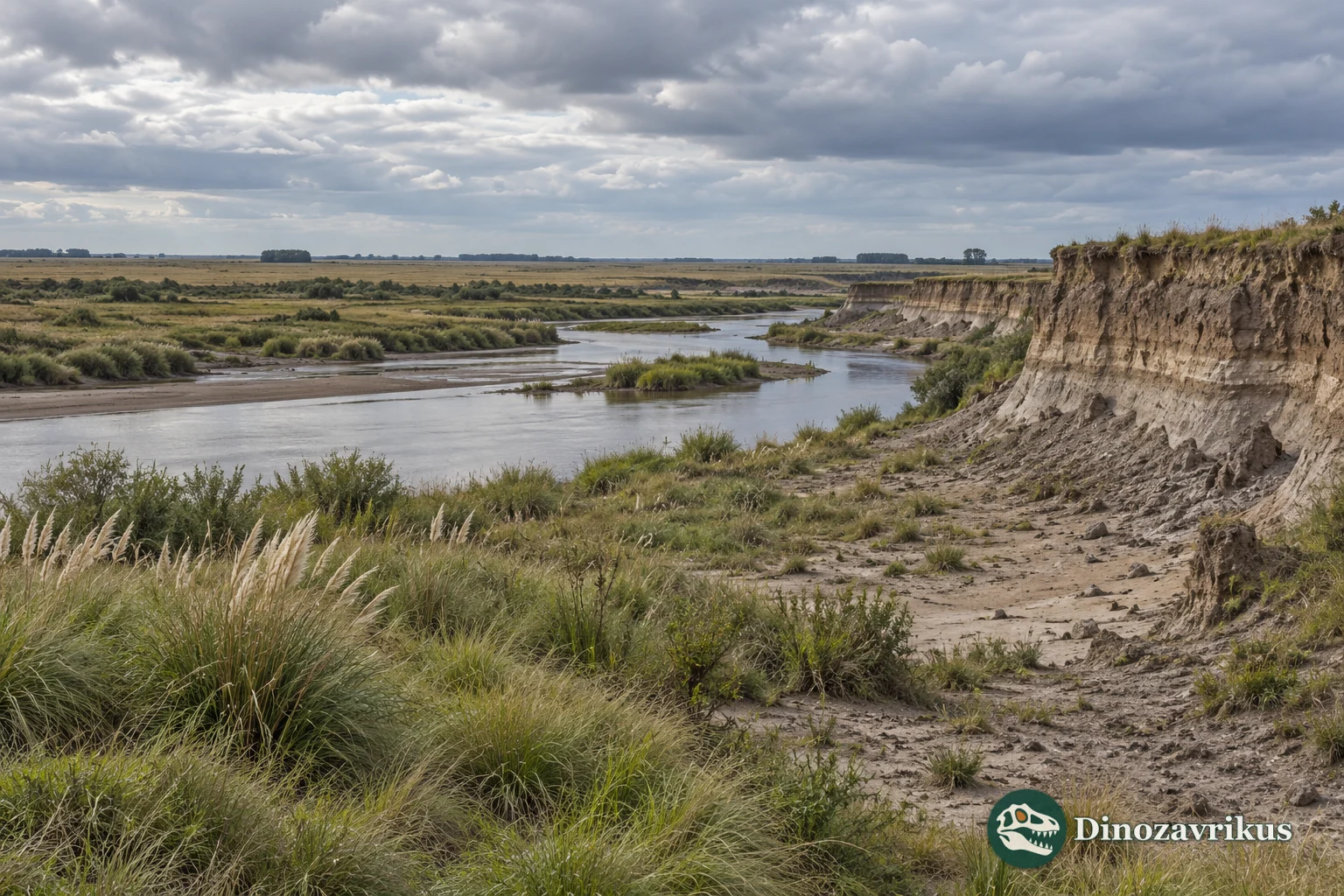
The cover's long muzzle and heavy limbs draw on fossils. Coat texture, color, stance and evening light are artistic choices. The landscape image suggests a broad Pampas setting rather than a photograph of Darwin's collecting site.
Frequently asked questions
Who collected the type skeleton?
Charles Darwin collected it near Punta Alta in Argentina in 1833; Richard Owen later described it.
How many species did the 2014 revision retain?
Two: S. leptocephalum and S. bravardi. Several older names were judged doubtful or invalid.
Did Scelidotherium make the giant Pampas burrows?
Its limbs support digging ability, but a particular burrow cannot be assigned to it without directly associated evidence.
Does the 7550 BP date prove Holocene survival?
No. The uncalibrated date comes from one specimen and possible younger-carbon contamination has been discussed.