

Scirrotherium was an extinct pampathere, a relative of armadillos. The type species, S. hondaensis, lived in what is now Colombia during the Middle Miocene. Skull bones, a jaw, limb elements and armor plates are known, although they do not form one complete skeleton. Pampatheres had large shoulder and pelvic shields joined by flexible bands of bony plates.
The genus appears in the ancient mammal catalogue. The later Holmesina offers a comparison of pampathere skulls, while Glyptotherium represents a different branch of extinct armored cingulates.
Quick facts
| Scientific name | Scirrotherium Edmund and Theodor, 1997 |
|---|---|
| Type species | S. hondaensis |
| Family | Pampatheriidae, an extinct cingulate lineage |
| Type specimen | UCMP 40201, incomplete skull and left mandible |
| Type locality | Villavieja, Huila, Colombia |
| Age | Middle Miocene in Colombia; another species in the Late Miocene |
| Other species in the 2020 revision | S. antelucanus from Costa Rica |
What can the fossils tell us?
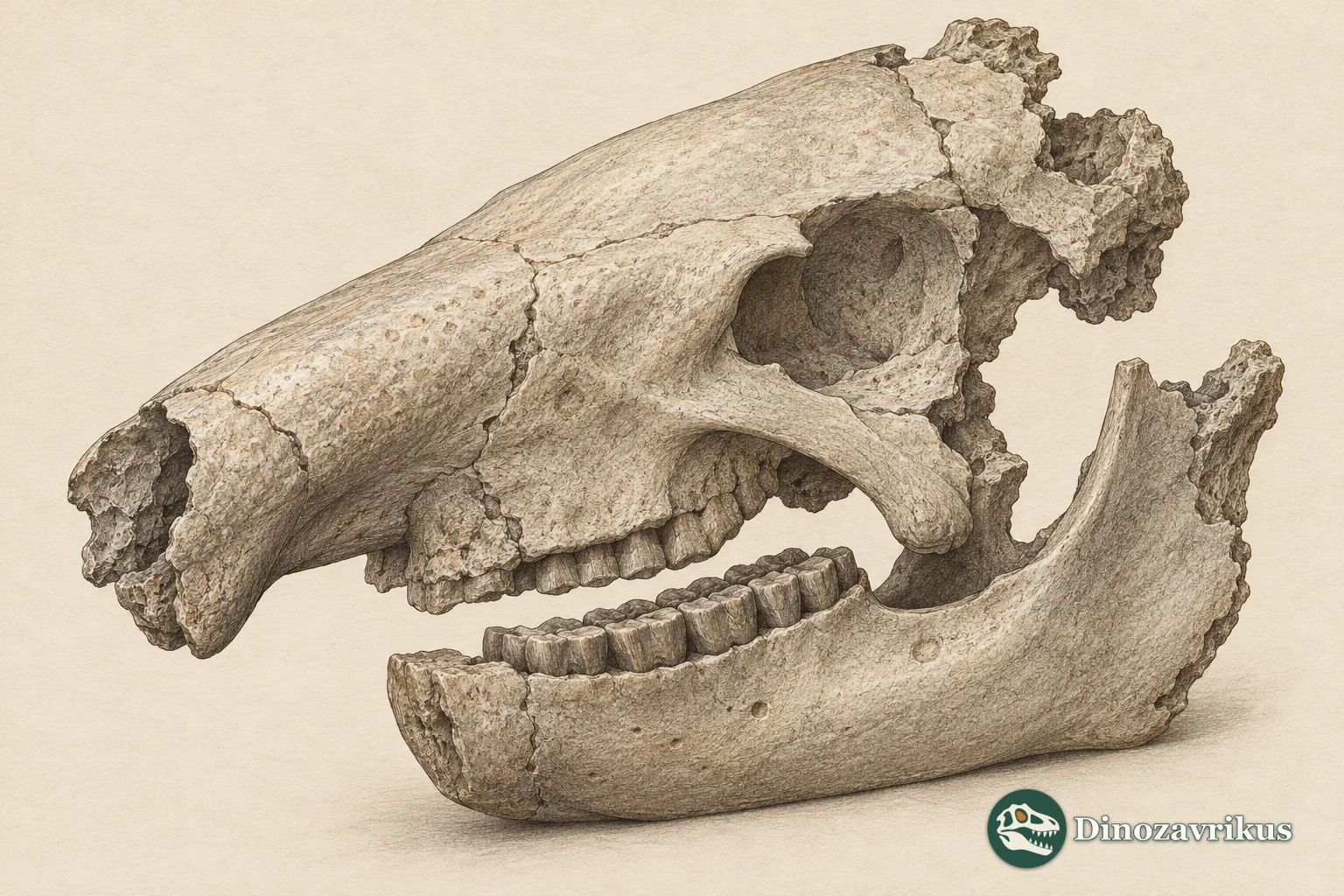
UCMP 40201 came from the La Victoria Formation. Large parts of the skull are missing; other specimens add evidence for its shape.
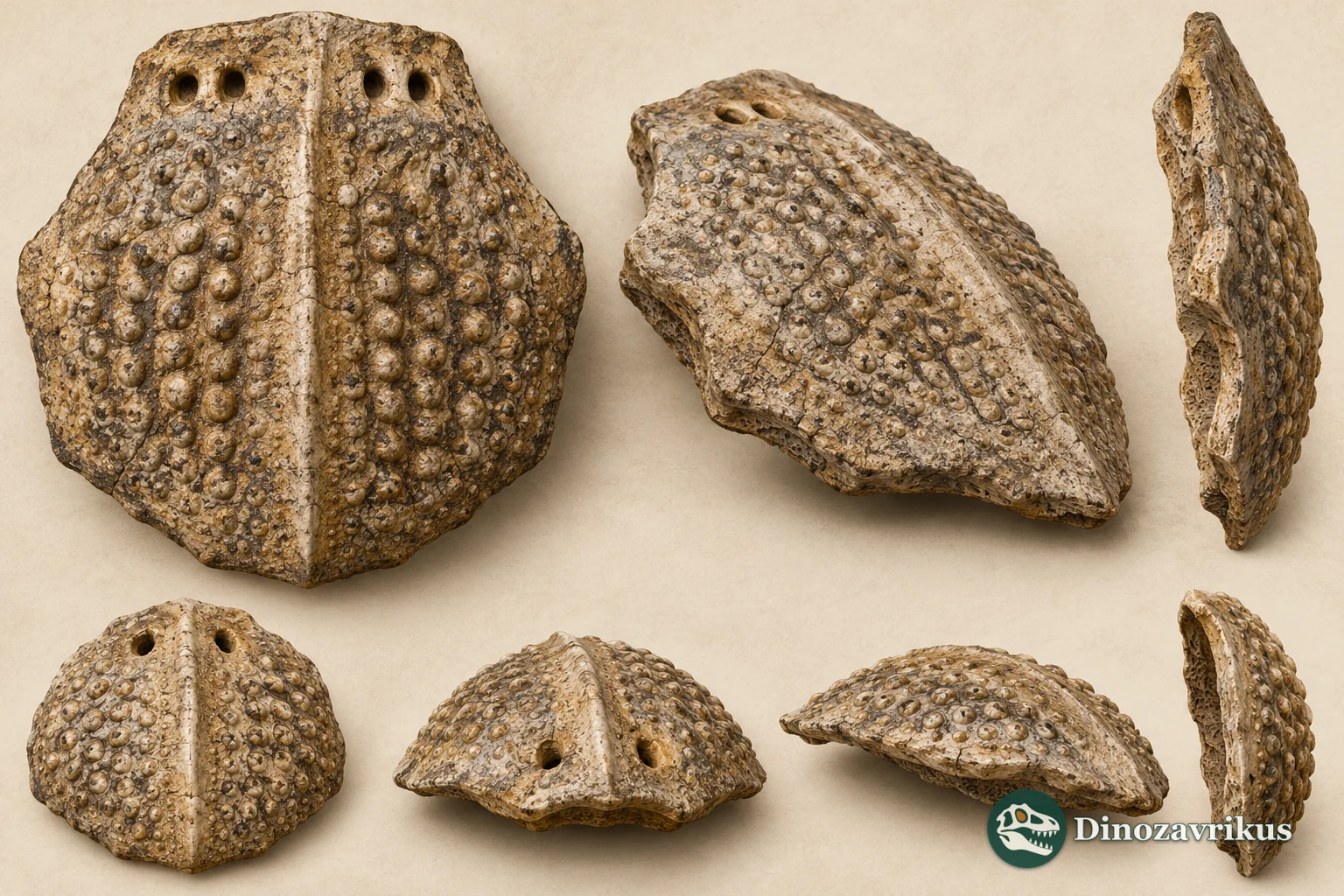
Thickness, the longitudinal ridge and anterior openings help distinguish pampatheres. Plate shape varies across the carapace.
A 2020 morphological analysis retained S. hondaensis and S. antelucanus in Scirrotherium and transferred the former S. carinatum.
Discovery and type material
Alan Edmund and Jessica Theodor named Scirrotherium hondaensis in 1997 from the La Venta fauna. Its holotype, UCMP 40201, combines an incomplete skull and the left half of a lower jaw from the La Victoria Formation near Villavieja. The snout tip, much of the orbit, braincase and back of the skull are absent, so the type alone cannot establish the proportions of a complete head.
Kevin Jiménez-Lara's 2020 revision described the additional skull VPPLT 706. It preserves more of the front of the skull, though its nasal bones and part of a cheek arch remain missing. Other specimens from the La Victoria and Villavieja formations include limb and girdle fragments, vertebrae and numerous osteoderms. Their separate collection numbers and horizons matter: they are not pieces of one individual.
Armor plates and diagnosis
Fixed shoulder and pelvic shields were linked by flexible bands. Each bony plate, or osteoderm, has a surface relief and openings that can be compared with other pampatheres. The revised genus diagnosis describes relatively thin fixed plates, about 3.5–7 mm thick, with a narrow central longitudinal elevation and usually one anterior row of large openings. The published count is six to eleven in that row, but one number is not a certain identification by itself.
Relief on plates assigned to S. hondaensis is generally stronger than in the Costa Rican S. antelucanus but weaker than in some Kraglievichia. Plates differ even between parts of the same carapace. Associated series are more informative than one worn or isolated plate.
Species and changing names
The Costa Rican species S. antelucanus was described in 2013 from the upper Curré Formation. Its holotype, CFM-2867, is a movable osteoderm; other armor and postcranial pieces were reported. It extended the geographical record of the genus beyond Colombia.
A second name published in 2013, Scirrotherium carinatum, was based on Late Miocene South American osteoderms. Jiménez-Lara's 2020 comparison of armor features and phylogenetic characters instead placed it in Kraglievichia, producing Kraglievichia carinatum. Older species lists preserve the previous combination; the transfer is the conclusion of a specific revision.
Age and way of life
The Colombian S. hondaensis material is associated with Serravallian deposits of the Middle Miocene. Fossils from different levels of the La Victoria and Villavieja formations do not represent one instant in a local ecosystem. S. antelucanus records are Late Miocene. Other Colombian isolated plates have been assigned only tentatively to a comparable form.
Armor and limb remains show a terrestrial quadruped. Pampatheres are generally interpreted as plant eaters from their teeth and chewing anatomy, but no stomach contents identify the precise food of Scirrotherium. Speed, color, coat and social behavior cannot be read from these fossils. The cover is a life reconstruction, with soft tissue and habitat details chosen artistically.
Frequently asked questions
What bones make up the S. hondaensis holotype?
UCMP 40201 comprises an incomplete skull and the left half of a lower jaw from Colombia's La Victoria Formation.
Why is one armor plate hard to identify?
Osteoderm shape varies across a carapace, and isolated plates may be damaged. Associated plates and bones allow a stronger comparison.
Is S. carinatum still included in this genus?
It was originally named in Scirrotherium. A 2020 revision transferred it to Kraglievichia carinatum.
Do we know its exact food?
No. Herbivory follows comparisons of pampathere teeth and chewing anatomy, but no specific food remains are known for Scirrotherium.