

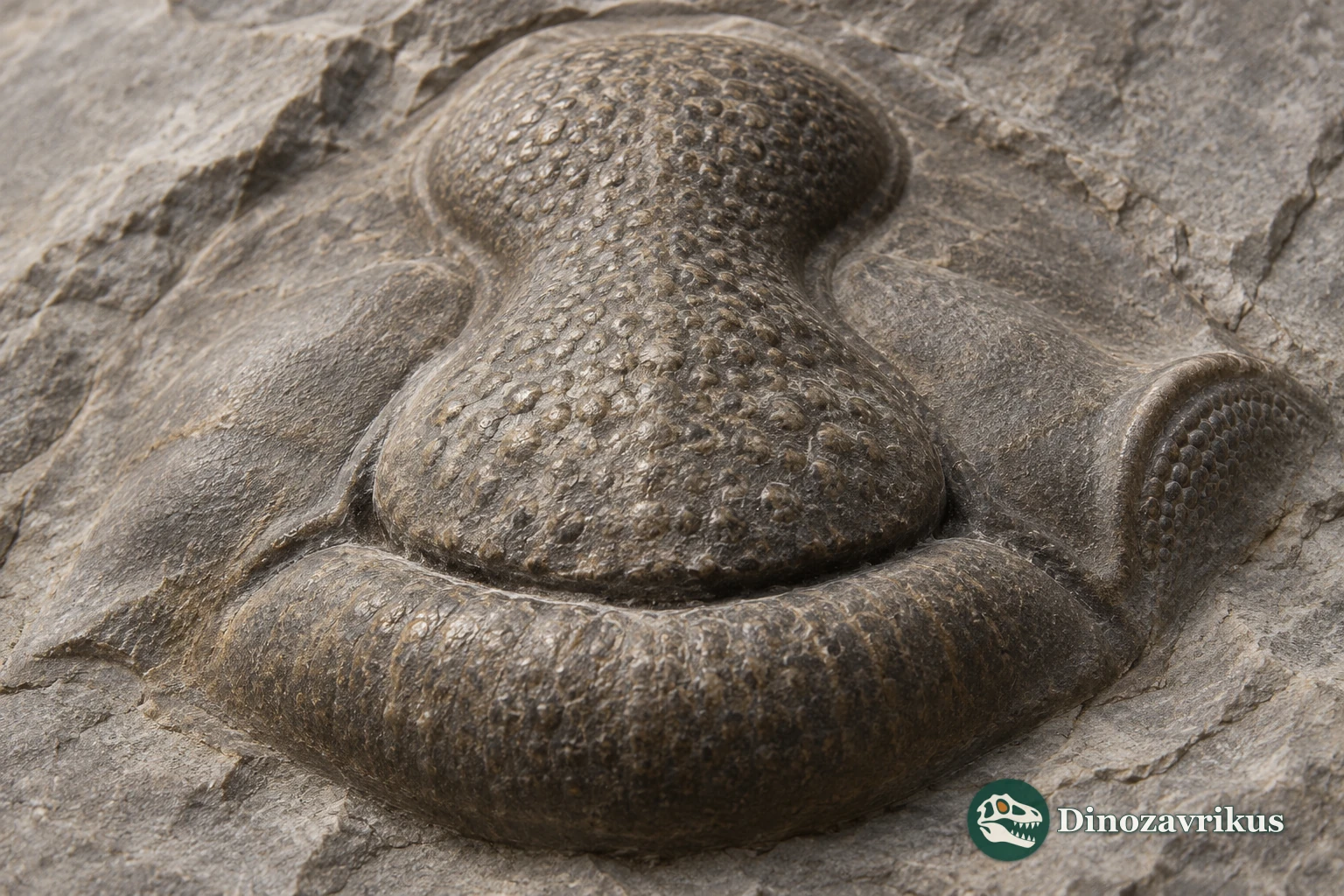
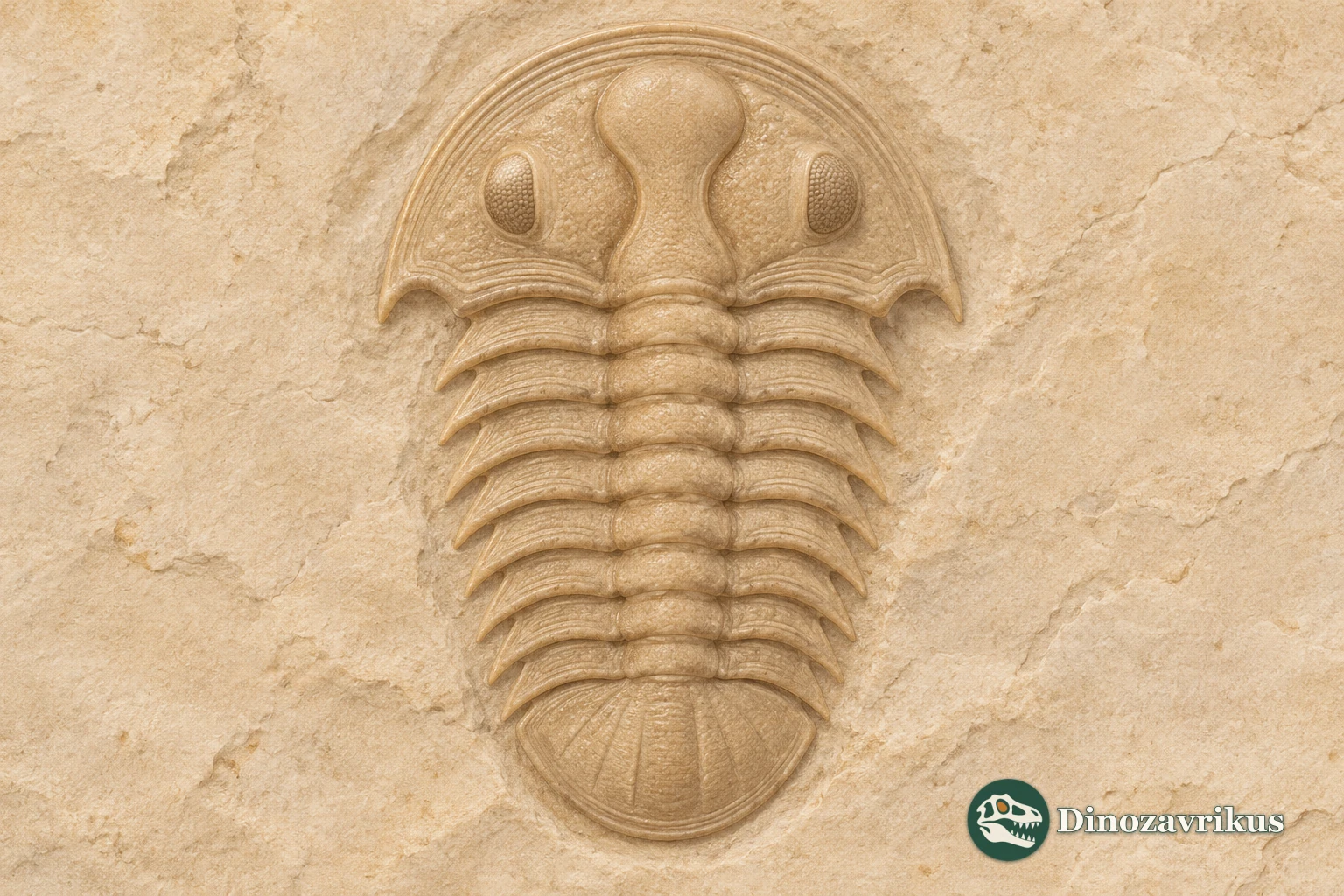
Sculptoproetus was a Devonian trilobite with nine freely jointed thoracic segments. Its head has a short, strongly raised front margin and a furrow immediately behind it. The glabella narrows about halfway along its length. Fossils from the type locality preserve the margin especially well.
Quick facts
| Group | Trilobita, Proetidae |
|---|---|
| Age of the type species | Early Emsian, Devonian |
| Genus established | Erben, 1951 |
| Type species | Sculptoproetus sculptus |
| Type locality | Hostím, Czech Republic |
| Free thoracic segments | Nine |
What can the fossils tell us?
They are counted between the head and tail shields. Many other cornuproetines have ten.
The feature is less clear in the holotype cast. Comparing several fossils helps distinguish its shape from variation in preservation.
The large eyes, terrace ridges and five well-defined rings on the tail axis are documented in this separate species.
From Proetus to a distinct genus
Joachim Barrande named the type species as Proetus sculptus in 1846. Erben erected Sculptoproetus in 1951. The original combination reflects the older, broader use of the genus Proetus, when fewer specimens were available for comparison.
Van Viersen and Lerouge studied the cast of the complete holotype, SMF 79534, alongside three specimens from the same locality. The material is from the early Emsian Zlíchov Formation at Hostím in the Czech Republic.
A raised margin and nine joints
Specimens from the type locality have a short, strongly domed anterior border with a clearly impressed furrow behind it. The middle of the glabella has a waist, giving an outline likened to a violin. There is little or no flat space between the glabella and the border furrow.
Nine thoracic segments distinguish these shells from many other cornuproetines. Several related genera also have nine, so the count is assessed alongside the head outline and margin. Similarities in the margin led the authors to propose that Macroblepharum and Sculptoproetus should be treated as synonyms.
A large-eyed specimen from Morocco
The uppermost Emsian beds south of Rissani yielded the complete holotype of S. raki, IRSNB a13414. Its eyes are large, and the shell carries fine terrace ridges. Granules accompany the ridges on parts of the glabella and on axial rings.
The Moroccan specimen has five well-defined axial rings and three visible pairs of ribs on the tail shield. These features allow comparisons with species from other beds. The shell alone gives no direct evidence of diet or of the depth at which the animal lived.
Frequently asked questions
How many thoracic segments did Sculptoproetus have?
Nine. Articulated shells preserve them between the head and tail shields.
Where was the type species found?
In the early Emsian Zlíchov Formation at Hostím, Czech Republic.
What do specimens from the type locality add?
They preserve the strongly convex anterior border more clearly than the holotype.
Which species was described from Morocco?
Sculptoproetus raki. Its complete holotype comes from beds south of Rissani.