

Seminobatrachus boltyschkensis is a small fossil frog described from drill cores near Boltyshka in central Ukraine. The material is unusually substantial for a fossil amphibian from this setting: fourteen skeletons were reported, including one nearly complete individual and thirteen incomplete specimens.
The animal appears in the ancient amphibian catalogue. Its gills and incompletely ossified wrist and ankle bones have been interpreted as signs of neoteny, but its age is broadly constrained and its exact position among frogs remains unresolved.
Quick facts
| Scientific name | Seminobatrachus boltyschkensis |
|---|---|
| Group | Anuran; exact phylogenetic position unresolved |
| Age | Late Paleocene–early Eocene, broadly constrained |
| Locality | Drill cores near Boltyshka, central Ukraine |
| Material | 14 skeletons, including one nearly complete individual |
| Estimated length | About 10–12 cm in the original description |
| Notable anatomy | External gills and incompletely ossified wrist and ankle |
What can the fossils tell us?
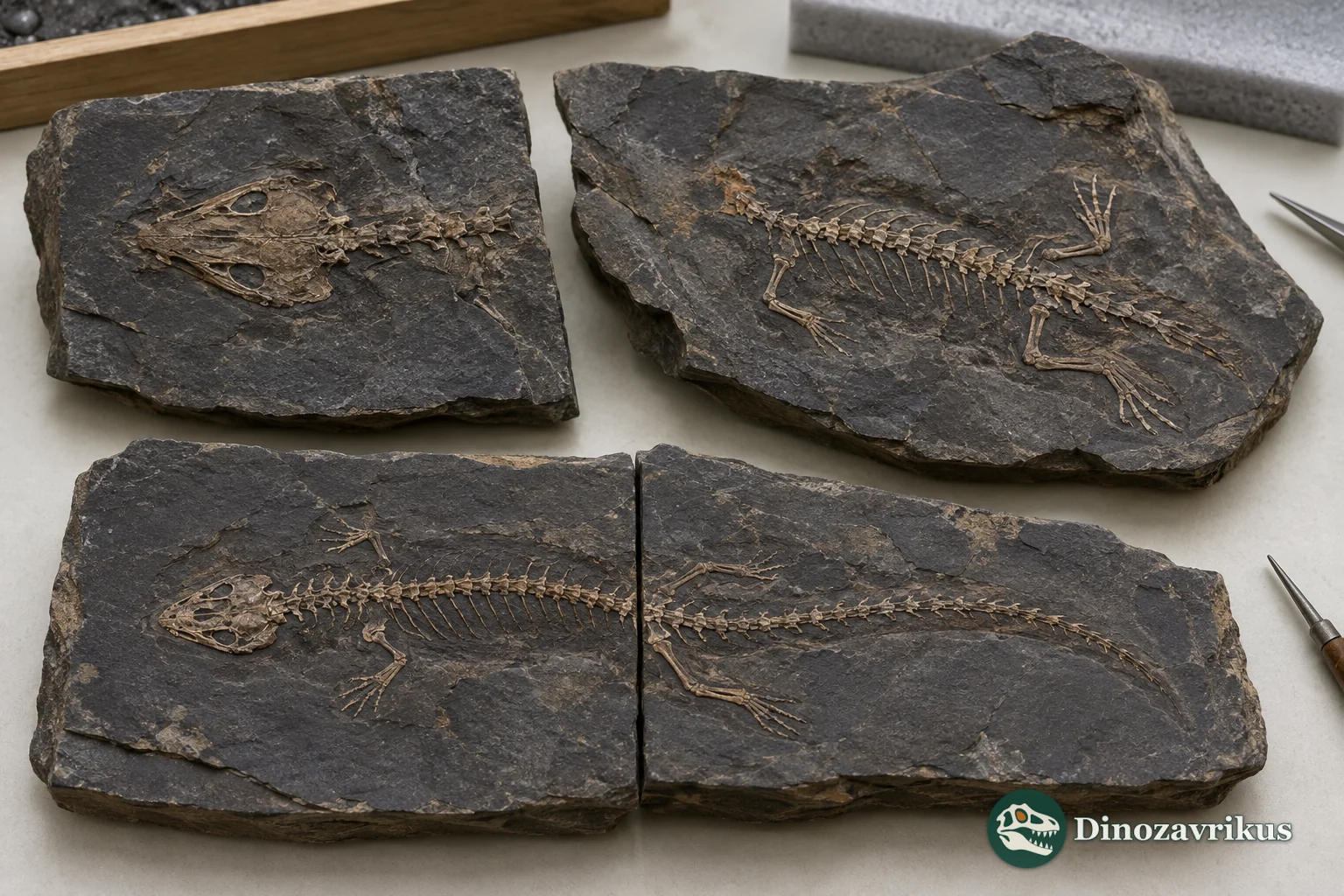
PIN 3991/9a,b consists of a part and counterpart preserving the skull and anterior vertebral region. The slab preserves a fossil individual, not every aspect of its soft tissues or life history.
The material provides variation across more than one individual. Completeness differs, and the series should not be described as fourteen complete skeletons.
The original authors interpreted these features alongside an ossified quadrate and pedicellate teeth as evidence of neoteny. Gill preservation can be affected by fossilization, so the developmental interpretation is not equally certain for every feature.
Associated molluscs, ostracods, insects and fishes support a late Paleocene–early Eocene age, without a precise date. The frog’s phylogenetic position is uncertain; its affinities should not be made more precise than the evidence allows.
A fossil frog found in drill cores
Geologist A. Semin recovered the fossils in 1967 from drill cores near Boltyshka. The specimens came from a sapropelite layer, an organic-rich sediment deposited in quiet water. The holotype, PIN 3991/9a,b, is preserved as a slab and counterpart bearing the skull and front part of the vertebral column. A second individual, PIN 3991/14, is nearly complete; the other twelve skeletons are incomplete.
Core recovery gives a different kind of context from a surface excavation. The fossils came from known layers underground, but the original collecting setting cannot be presented as a photographed open trench. Their geological context is tied to the drill record and associated fossil assemblage.
Fourteen skeletons, with different levels of preservation
The series matters because it shows more than one isolated bone, but its completeness should not be overstated. One skeleton preserves much of the body, while the holotype slab focuses on the skull and anterior vertebrae. Other individuals add comparative anatomy, yet missing parts and the limits of core recovery still constrain a full reconstruction.
The original description estimated a body length of roughly 10–12 centimetres. This is a published estimate based on the fossil material, not a measurement from a perfectly articulated, complete skeleton. The modest size is useful context, while precise mass and population-wide variation are not established.
Neoteny: an interpretation from anatomy
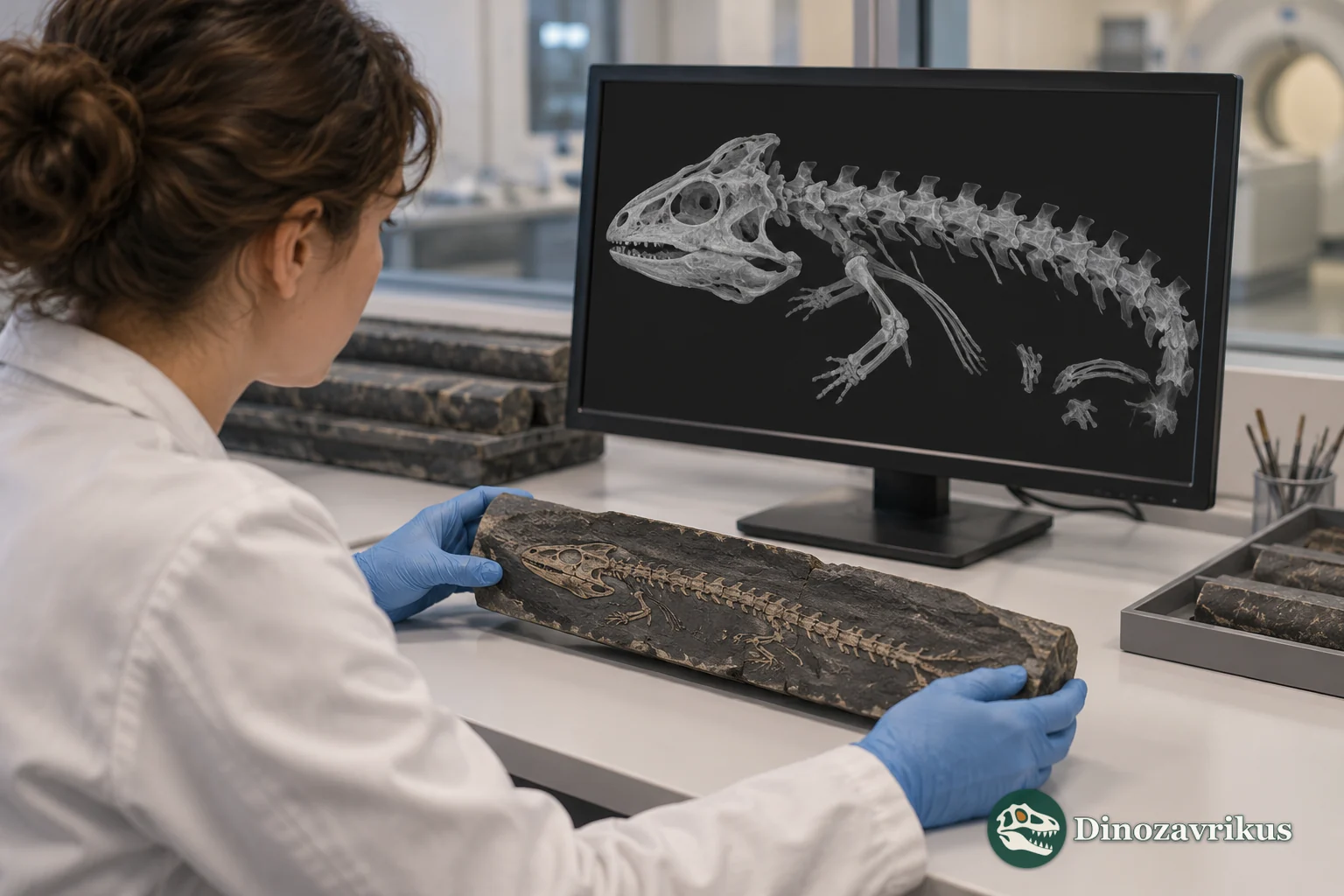
The authors identified external gills and incompletely ossified carpals and tarsals, alongside features they regarded as adult-like, including an ossified quadrate and pedicellate teeth. They interpreted this combination as neoteny: retention of larval or juvenile characteristics into a sexually mature stage.
That interpretation is plausible but rests on how the preserved anatomy is read. Delicate gills can be affected by decay, transport and preservation, and an unossified element alone does not establish an individual's reproductive maturity. The combination of traits is more informative than any one feature, but it does not give a direct observation of breeding or development.
An age bracket rather than a precise date
The fossil-bearing lower sapropelite unit is assigned broadly to the late Paleocene–early Eocene using associated molluscs, ostracods, insects and fishes. This evidence constrains the age to an interval, but it does not establish a precise year or a narrow stage boundary for every skeleton.
The Boltysh impact structure is a nearby geological landmark, but proximity alone does not show that Seminobatrachus lived immediately after the impact. The fossil layer's age and its relationship to the crater event must be assessed from stratigraphy and dating, not inferred from the place name.
Why its family tree remains open
The original description proposed amphibian affinities, but later reviews emphasize that the phylogenetic position is uncertain. The available skeletons preserve useful anatomical characters, yet a small set of traits can support several competing placements. It is safer to call Seminobatrachus a fossil anuran with unresolved precise affinities than to assign it confidently to a modern frog family.
The fossils support a small-bodied frog, probably associated with aquatic sedimentary environments. They do not preserve skin colour, vocalizations, exact diet or a witnessed behaviour. Those details belong to interpretation unless additional direct evidence is found.
Frequently asked questions
How many Seminobatrachus skeletons are known?
The original description reported fourteen individuals: one nearly complete skeleton and thirteen incomplete ones.
How large was Seminobatrachus?
The original study estimated a body length of about 10–12 centimetres; a precise mass is not established.
Was it neotenic?
The authors proposed neoteny from external gills and incompletely ossified extremities together with other features. It remains an interpretation of preserved anatomy.
When did Seminobatrachus live?
Associated fossils support a broad late Paleocene–early Eocene age for the lower sapropelite unit, not a precise date.