

Articulated Serrodiscus fossils show three short segments between the head and tail. This early Cambrian eodiscid is known from several palaeogeographic regions. The Spanish collections preserve complete shells as well as detached shields of different sizes.
Quick facts
| Group | Trilobita, Eodiscida |
|---|---|
| Age | Early Cambrian, Series 2 |
| Genus established | Rudolf and Emma Richter, 1941 |
| Original type species | Serrodiscus serratus |
| Type area | Cala, Huelva, Spain |
| Material | Complete exoskeletons and detached shields |
What can the fossils tell us?
A complete specimen at Pico Noez distinguishes the three thoracic segments from the numerous rings of the pygidium.
The number visible depends on preservation. A damaged margin may retain only a few of the original nodes.
The comparison used the central head lobe, the occipital spine, and the strong rings and nodes along the tail axis.
Three segments between the head and tail
Specimen MPZ2021/337 from Pico Noez near Toledo preserves a cephalon, a three-segment thorax and a pygidium. The three thoracic segments account for about 15% of the shell’s length along its centreline. The pygidium of S. bellimarginatus has nine axial rings and a terminal piece, with nodes down the middle that diminish towards the rear.
The head shield of this species shows no eyes. Another small eodiscid, Pagetia, did have them. A small shell and short thorax therefore tell us little about how this group saw. Serrodiscus had a raised head border and an occipital spine at the rear of the head.
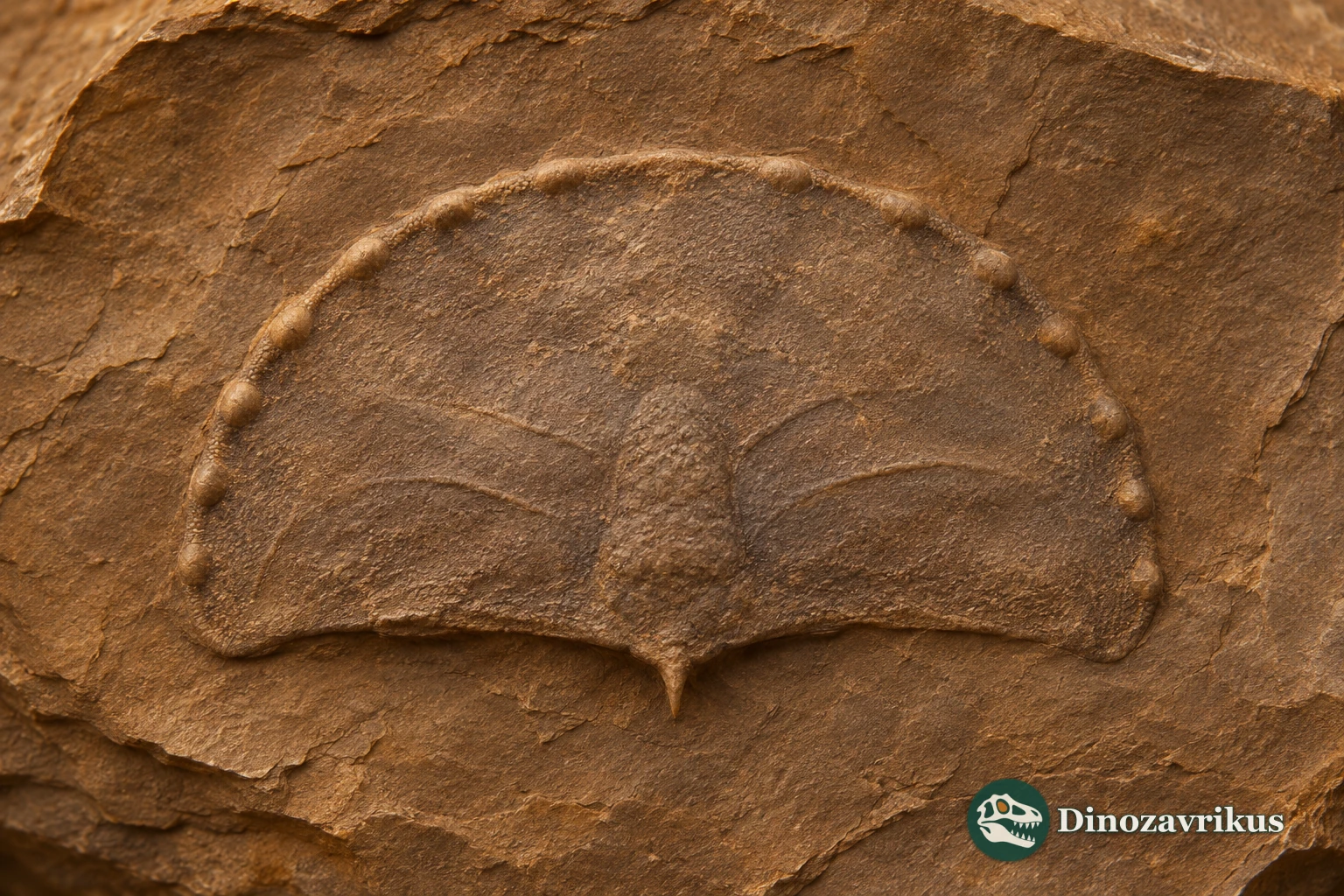
How preservation changes a shield
The Iberian revision compared fossils from the same sites and beds. On large S. bellimarginatus head shields, six to eight pairs of nodes may be visible along the sides of the margin. On smaller heads the nodes are faint or absent, and on one shield preservation differs between the two sides.
Rock deformation can change the outline of the front of the glabella. Compression can also broaden the furrow behind the head’s front margin. Counting nodes or comparing the outline of a single damaged shield can therefore give a misleading species distinction.
Why the species names changed
Rudolf and Emma Richter established the genus in 1941 from material around Cala and designated Eodiscus (Serrodiscus) serratus as the type. Luis Collantes and colleagues re-examined the fossils in 2022. The Iberian specimens and S. bellimarginatus, whose name was published earlier, had corresponding glabellar structure, an occipital spine and strong nodes along the tail axis.
In that treatment S. serratus is a junior synonym of S. bellimarginatus. S. silesius, S. llarenai and S. coloi were also treated as synonyms. The original designation of serratus remains part of the nomenclatural history of the genus.
Comparing rocks that contain Serrodiscus
The first appearance of Serrodiscus in the studied Iberian sections marks the start of the upper Marianian in the regional sequence. The revision grouped records outside Iberia as well, with bellimarginatus forms along the Avalonian and western Gondwanan margins, speciosus forms in Laurentia and daedalus forms in places including Australia and North China. The groups draw on shell characters together with geography and age.
Frequently asked questions
How many segments formed the thorax?
Three movable segments lay between the head and tail shields.
Where was complete specimen 337 found?
Pico Noez, near Toledo in Spain. The full collection number is MPZ2021/337.
Why is serratus often listed under another name?
The 2022 revision treated it as the same species as the earlier-named bellimarginatus.
What interval does its first appearance mark in Iberia?
In the studied sections it marks the base of the upper Marianian, an Iberian regional interval.