

Simurghia robusta was described from one incomplete right humerus in the latest Cretaceous phosphates of Morocco. Its broad shoulder crest and an unusual process near the elbow distinguish it from other nyctosaurids. No skull or full wing belongs to the type specimen. The flying animal on the cover is a restrained comparison with relatives, not a reconstruction fixed by a Simurghia skeleton.
Quick facts
| Named species | Simurghia robusta, Longrich, Martill and Andres, 2018 |
|---|---|
| Holotype | FSAC-OB 7, incomplete right humerus |
| Repository | Faculté des Sciences Aïn Chock, Hassan II University, Casablanca |
| Locality | Sidi Daoui, Ouled Abdoun Basin, Morocco |
| Rock unit | Middle Couche III of the phosphates |
| Geological age | Late Maastrichtian |
| Classification | Nyctosauridae in the original analysis |
| Humerus length | Approximately 165 mm when restored |
| Wingspan | Not reliably established |
What can the fossils tell us?
FSAC-OB 7 preserves the right upper-arm bone. It supplies no direct skull, jaw, vertebral or distal wing anatomy for the genus.
The short broad deltopectoral crest and enlarged supracondylar process support its diagnosis, not a particular head shape or hunting method.
Both ends are damaged. The authors estimated the complete humerus at around 165 mm; that is not a measured wingspan.
Middle Couche III at Sidi Daoui is late Maastrichtian, close to the end-Cretaceous boundary. It does not date the individual's death to a precise year.
A name from myth, a fossil from phosphate
Nicholas Longrich, David Martill and Brian Andres named Simurghia robusta in 2018. The genus honours the Simurgh of Persian mythology and the species name means robust. The holotype, FSAC-OB 7, is an incomplete right upper-arm bone held at the Faculté des Sciences Aïn Chock of Hassan II University in Casablanca. A skull, complete wing and associated body are not part of its original diagnosis.
The bone came from Middle Couche III at Sidi Daoui in Morocco's Ouled Abdoun Basin. The phosphate beds also yield many marine vertebrates. Biostratigraphy and isotope evidence place Couche III in the latest Maastrichtian, within roughly one million years of the Cretaceous-Paleogene boundary. This is an age for the deposit, not an exact date of death.
How the humerus differs
The deltopectoral crest on a pterosaur humerus was a muscle attachment. In Simurghia it is proportionately short and broad, with a strongly expanded, fan-shaped tip. A ridge on its underside lies nearer the proximal margin than in several other nyctosaurids. An unusually large triangular supracondylar process sits toward the distal end. These features together, rather than size alone, diagnose the named form.
The authors placed Simurghia among Nyctosauridae using the crest's shape and other humeral features. A later phylogenetic study explored a narrower grouping of related pteranodontians; such placements depend on which fragmentary characters can be compared.
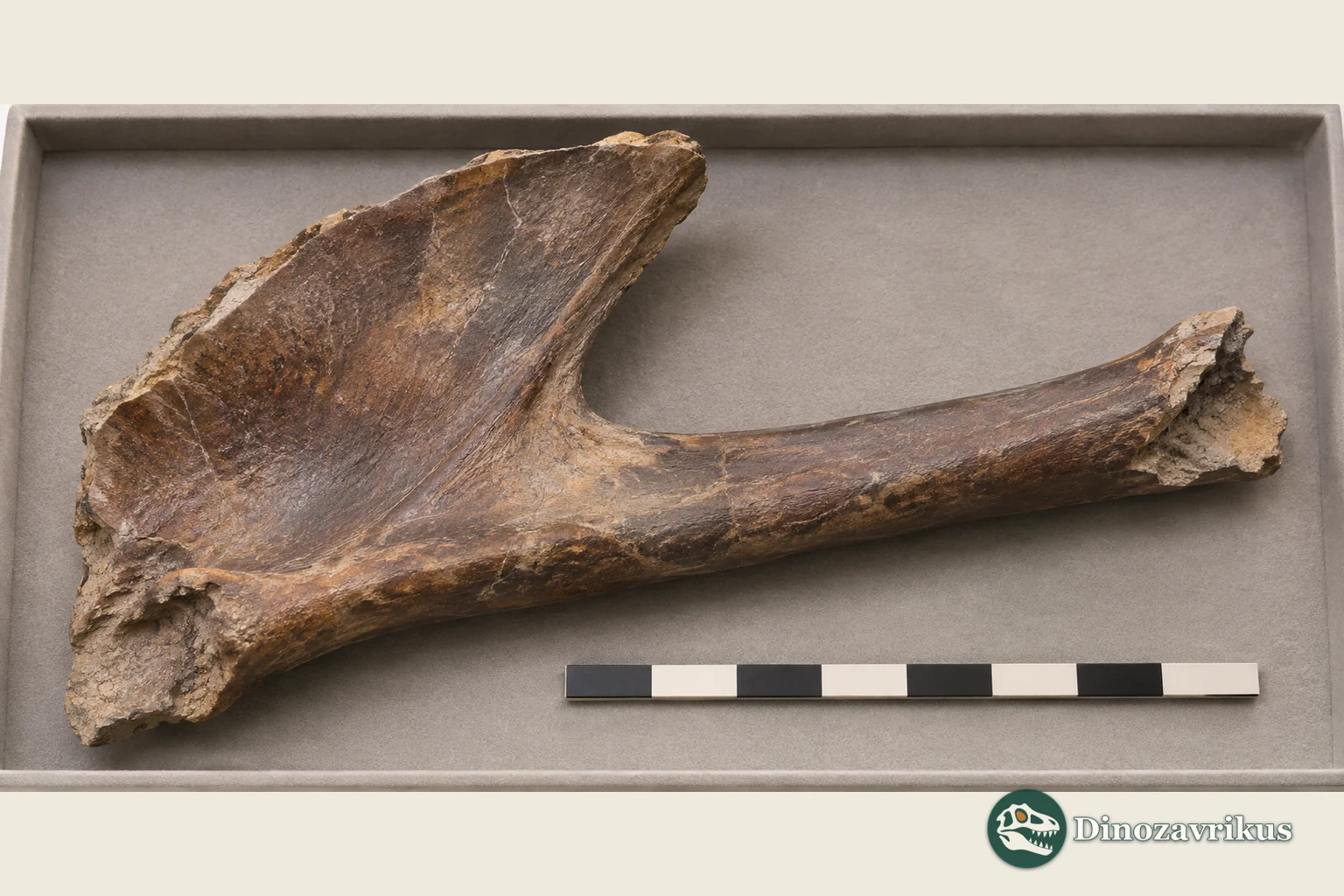
Larger than Alcione, different from Barbaridactylus
The published complete-length estimate for the damaged humerus is about 165 mm. In the 2018 comparison, Alcione humeri average 93 mm. The authors argued that Simurghia is unlikely to be just an adult Alcione because the sampled Alcione bones already show maturity indicators and the crest shape also differs. The estimate of 165 mm is for the missing-ended bone, not a direct measurement of an intact one.
Barbaridactylus also occurs in the late Moroccan phosphates but has a different humeral crest. Their shared geological setting does not make them one species. Nor can an incomplete humerus be scaled into a precise wingspan without the remainder of the wing and justified proportional assumptions.
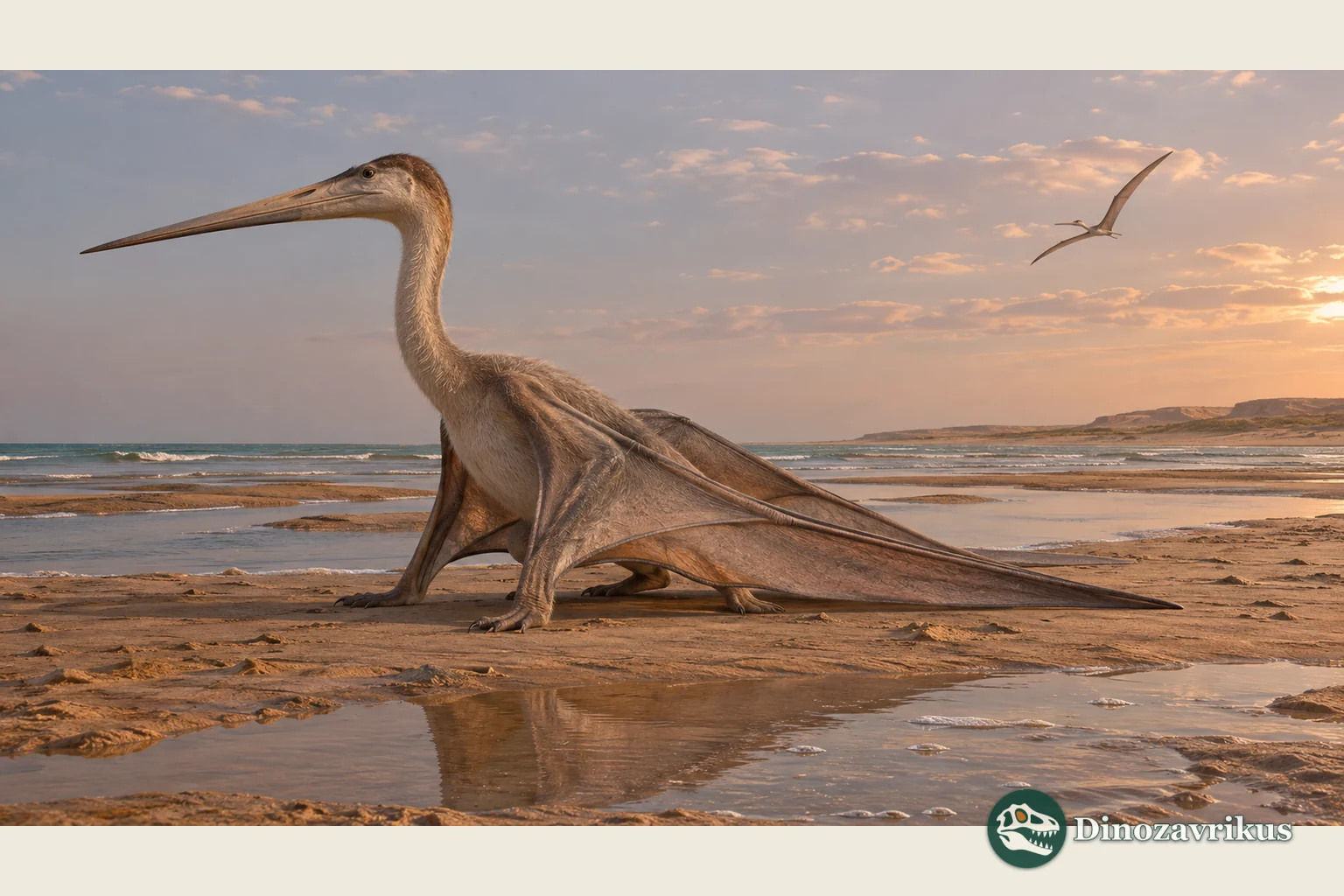
What the living animal could have been
The original fossil cannot tell us whether Simurghia had a cranial crest, the exact shape of its beak, its body mass, growth history or its prey. The marine deposits give a broad coastal context, but they cannot establish a particular flight style or feeding act. Full-body images therefore borrow general nyctosaurid proportions and make visible artistic choices.
The bone-tray image below is an interpretive model of the kind of evidence available, not a photograph or exact copy of FSAC-OB 7. The standing coastal scene likewise depicts a possibility rather than a documented individual.
Frequently asked questions
What fossil defines Simurghia?
The holotype FSAC-OB 7 is one incomplete right humerus; its skull and complete wing are not known.
Why was it placed among nyctosaurids?
The 2018 authors compared the broad fan-shaped deltopectoral crest and other humeral projections with bones of that family.
Do we know its wingspan?
No reliable span follows from the fossil. About 165 mm is the estimated complete length of its damaged humerus.
When did it live?
Its bone came from a late Maastrichtian Moroccan phosphate bed laid down close to the end of the Cretaceous.