

Sinomastodon was an extinct gomphothere proboscidean recorded mainly from China. Its cheek teeth had large rounded cusps, while its lower jaw was shorter than in many earlier gomphotheres. It was neither an Asian elephant nor Stegodon; broad similarities in outline conceal different teeth and ancestry. The cover is an artistic life reconstruction, not a photograph of known skin or soft tissue.
The best evidence combines a relatively complete skull and jaw from one cave with molars from other southern Chinese sites. The fossils cover a longer interval than the life of any single species.
Quick facts
| Group | Gomphotheriidae, Proboscidea |
|---|---|
| Type species | Sinomastodon intermedius, Pliocene China |
| Renzidong | Skull, mandible and teeth of S. jiangnanensis in Anhui |
| Sanhe | S. yangziensis molars in Guangxi, about 1.6–1.2 Ma |
| Key anatomy | Short lower jaw without lower tusks; upper tusks present |
| Diet evidence | Dental microwear in studied southern Chinese specimens supports browsing |
What can the fossils tell us?
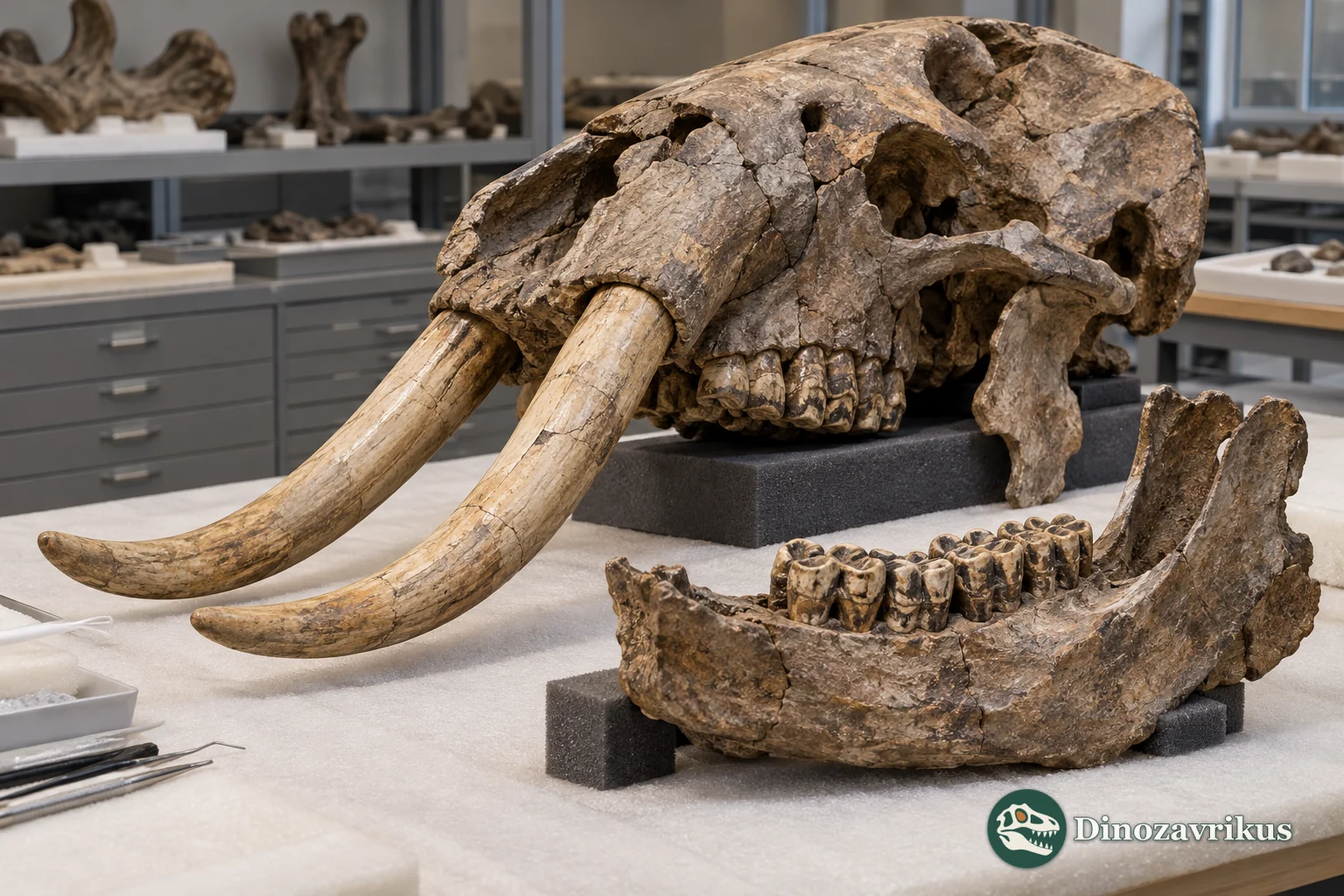
The skull, mandible and dentition of S. jiangnanensis permit a combined comparison of the rostrum and molars. This is unusually complete for Quaternary Sinomastodon but is not an entire skeleton.
Bunodont molars of S. yangziensis come from karst cave deposits correlated to roughly 1.6–1.2 Ma. Their shape aids identification; wear records aspects of individual diets.
The Pliocene type species and Pleistocene forms differ. Proposed dispersal and extinction histories remain interpretations of the uneven record.
A skull from Renzidong
Researchers described S. jiangnanensis from Renzidong Cave in Anhui Province. A relatively complete skull, lower jaw and dentition made it possible to compare cranial and dental anatomy together, whereas earlier Chinese Quaternary finds often consisted of isolated teeth. These are parts of a specimen, not a complete body skeleton or a direct measurement of its mass.
Its rostrum was shortened, with no lower tusks and with upper tusks present. Intermediate molars had three transverse rows of rounded cusps. The authors contrasted its skull and jaw with Pliocene S. intermedius and S. hanjiangensis, while noting that molars of later S. yangziensis were more modified. A sequence of traits does not prove a simple line of direct ancestors.
The 2012 study placed Renzidong material in the Early Pleistocene. A palaeomagnetic correlation around 2.15 Ma has been proposed for the fossil-bearing deposits, but cave chronology has been discussed subsequently. That number is an interpretation of sediment age, not a direct date on the skull to hundredth-of-a-million-year precision. The site falls within the Quaternary; the genus began earlier.
Sanhe molars and a changing fauna
Bunodont S. yangziensis molars were described from Sanhe Cave in Guangxi. Associated palaeomagnetic evidence places the deposits around 1.6–1.2 Ma. The 2014 authors revised the species diagnosis using cusp size and shape, and regarded Sanhe as one of the southernmost Chinese records of the genus. An isolated molar cannot reconstruct the exact skull of its owner.
The authors proposed distinguishing this Early Pleistocene southern Chinese assemblage from the later panda and Stegodon association. Gigantopithecus is among the names associated with the regional fauna. Such a list does not establish that every animal met in the same cave at one moment; cave deposits can accumulate over long intervals.

Reading diet from worn enamel
Researchers compared microscopic wear textures on Sinomastodon, Stegodon and Elephas teeth from southern China. In the studied sample, Sinomastodon and Stegodon wear was more consistent with browsing, whereas Elephas suggested mixed feeding. This is an inference about sampled diets, not a list of plant species eaten by one animal. Molar shape and microwear provide different types of evidence.
A tooth row cannot establish a single migration route, exact climate or cause of extinction. The wooded setting on the cover is plausible illustration rather than a record of the animal's behavior.
Frequently asked questions
Was Sinomastodon an elephant?
No. It belonged to the gomphotheres, a different proboscidean lineage with distinctive skull and molar anatomy.
Why is it called short-jawed?
The described S. jiangnanensis has a shortened front of the lower jaw without lower tusks.
When did it live?
Chinese records span the Pliocene and Pleistocene. Sanhe molars are associated with deposits about 1.6–1.2 Ma old.
How is its plant diet inferred?
Its cusped molars describe the chewing apparatus, while microwear on studied southern Chinese teeth supports substantial browsing.