

Spitrasaurus is a genus of plesiosaur from Upper Jurassic deposits on Spitsbergen. Its two named species are based on different incomplete juvenile skeletons: one preserves an articulated postcranial series with 60 cervical vertebrae, while the other includes skull and jaw fragments and part of a second neck series. These fossils document anatomy, but do not establish a reliable total length, exact swimming style or species-specific diet.
Quick facts
| Type species | Spitrasaurus wensaasi and Spitrasaurus larseni |
|---|---|
| Group | Plesiosaur; finer placement varies among phylogenetic analyses |
| Age | Middle Volgian, Upper Jurassic |
| Formation | Slottsmøya Member, Agardhfjellet Formation |
| Locality | Janusfjellet, Spitsbergen |
| Holotype of S. wensaasi | PMO 219.718, articulated juvenile postcranial skeleton |
| Holotype of S. larseni | SVB 1450, disarticulated juvenile with skull fragments and 31 cervical vertebrae |
| Total length | Not established from the incomplete material |
Evidence guide
Holotype PMO 219.718 includes the axial skeleton from the atlas-axis through the twelfth dorsal, ribs, gastralia, the pectoral girdle and much of the forelimbs. The skull is absent.
Holotype SVB 1450 is disarticulated. It includes fragments of the braincase, jaw and teeth, a cervical series through the 31st vertebra and part of a forelimb.
Both holotypes are from the Slottsmøya Member of the Agardhfjellet Formation. The 2012 authors correlated Middle Volgian with the Tithonian, while noting that regional subdivisions do not align perfectly.
Dark marine mudstones formed in an open marine setting with oxygen deficiency at the seafloor. This is evidence about sediment deposition, not the plesiosaur’s respiratory physiology.
Two discoveries at Janusfjellet
The fossils come from the Janusfjellet area of Spitsbergen. University of Oslo Natural History Museum researchers and volunteers excavated an initial partial plesiosaur in 2004; a second, more complete specimen was recovered in summer 2010. The 2012 description established two species from separate type specimens rather than combining the bones into one composite skeleton.
The name Spitrasaurus wensaasi honours volunteer Tommy Wensås, and S. larseni honours volunteer Stig Larsen. Those names record contributions to fieldwork. They do not describe anatomical features of the animals.
Two different juvenile skeletons
Holotype PMO 219.718, assigned to Spitrasaurus wensaasi, is articulated from the atlas-axis complex through the twelfth dorsal vertebra. The specimen also preserves ribs, gastralia, the complete pectoral girdle and much of the forelimbs. The skull is missing. Its juvenile status was based on skeletal immaturity, not inferred from the animal’s apparent size.
Holotype SVB 1450, assigned to S. larseni, is disarticulated and preserves fragments of the braincase, jaw and teeth, along with the cervical column from the atlas through the 31st vertebra and part of a forelimb. It too represents an immature individual. For a comparison with other long-necked plesiosaurs, see Colymbosaurus and the Cretaceous Libonectes; those comparisons do not imply direct ancestry.
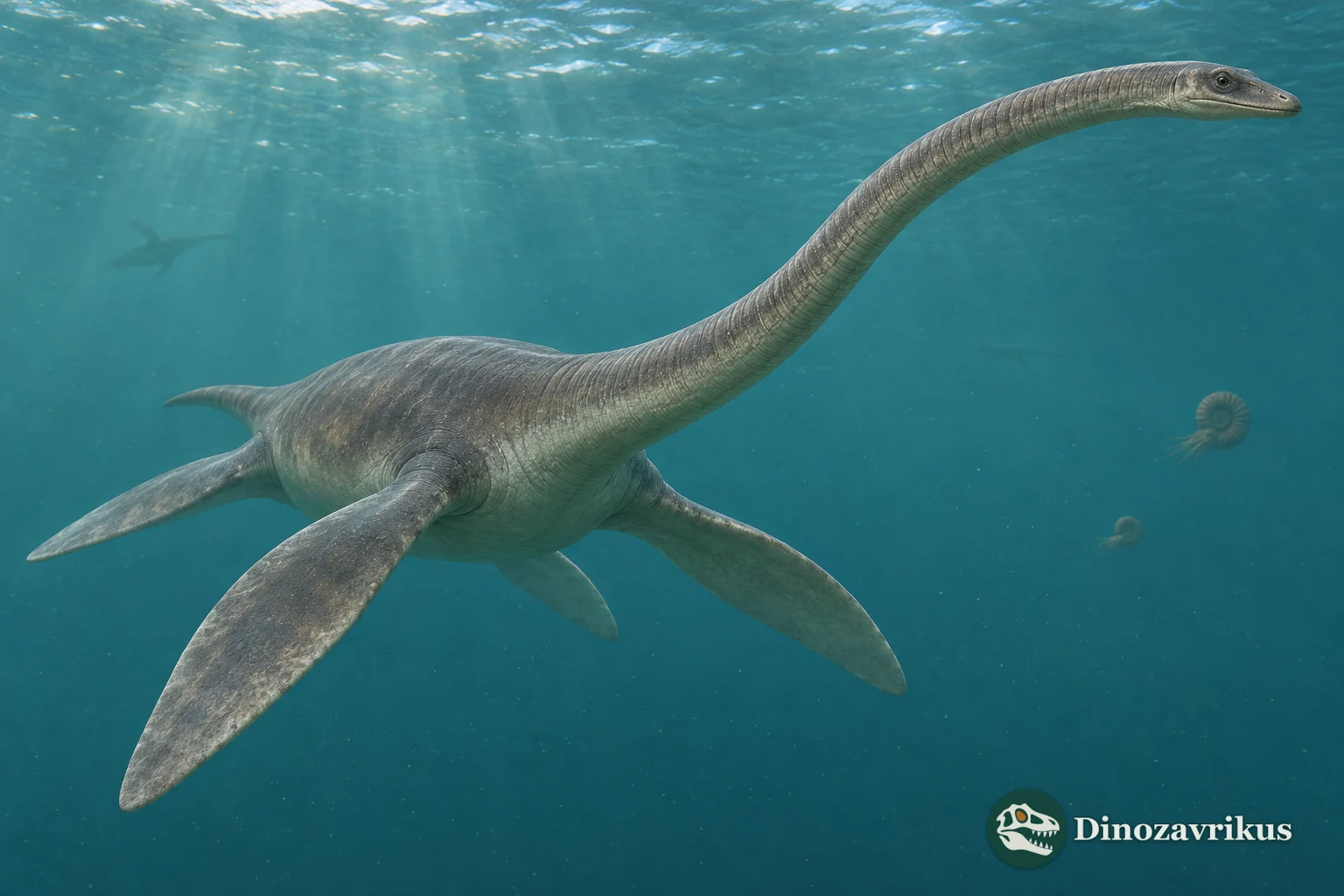
What the vertebrae show
The wensaasi holotype preserves a sequence of 60 cervical vertebrae. The larseni holotype preserves part of a different sequence, reaching the 31st cervical. These counts belong to separate, incomplete specimens. They do not provide a direct measurement of the total neck length or of the whole animal, and the shorter preserved series does not mean that S. larseni had a shorter neck.
The 2012 diagnosis also notes lateral ridges on cervical vertebrae and accessory ossicles in the material. These are skeletal observations used for comparison. They do not establish how far the neck bent, how quickly the animal swam, or whether it used a particular hunting technique.
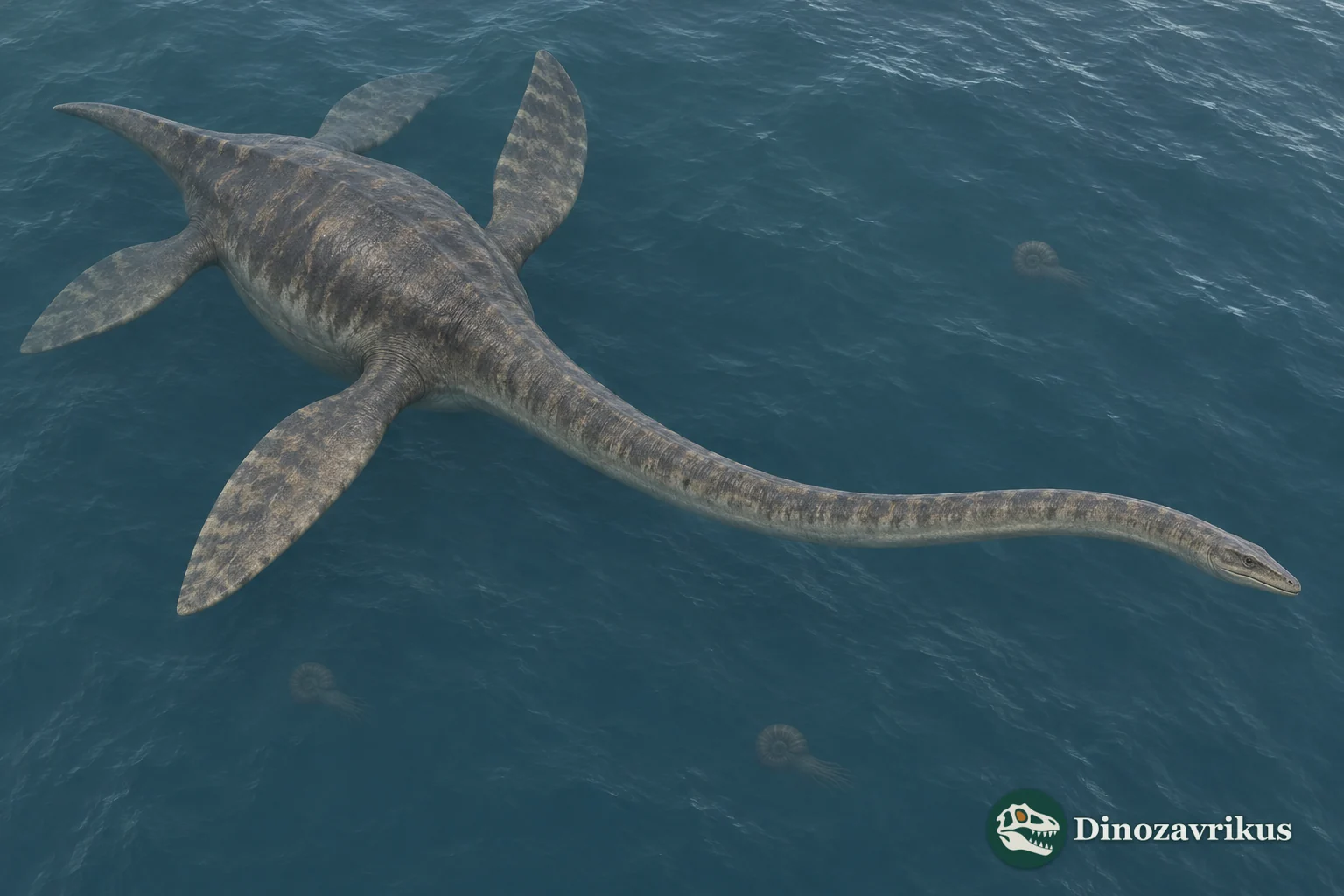
Age and the Slottsmøya environment
Both type specimens come from the Slottsmøya Member of the Agardhfjellet Formation. The 2012 paper assigns them to the Middle Volgian. The authors correlated this regional stage with the Tithonian of the international scale while noting that precise correlations between regional subdivisions can be difficult.
The Slottsmøya deposits include dark marine mudstones formed in open water where bottom conditions were oxygen-poor. That description concerns the sedimentary environment and preservation. It is not evidence that Spitrasaurus itself breathed oxygen-poor water or was adapted to an anoxic habitat.
Classification and what remains unknown
The original study placed Spitrasaurus within Plesiosauroidea. Later phylogenetic analyses have grouped it among or near cryptoclidids and colymbosaurines in some trees. The exact position depends on the characters and taxa in each analysis; it is an inferred relationship, not a settled lineage or proof that one named genus descended directly from another.
Neither juvenile holotype is complete enough to establish total body length or mass. The teeth and jaw fragments of S. larseni do not identify a particular prey, and no stomach contents or feeding traces are reported for the genus. Skin colour, soft tissues, swimming speed, reproductive biology and social behaviour are also unknown. The illustrated animals are palaeoart, not portraits of the preserved fossils.
Frequently asked questions
Where was Spitrasaurus found?
The fossils come from the Slottsmøya Member of the Agardhfjellet Formation near Janusfjellet on Spitsbergen.
How many neck vertebrae are known?
The S. wensaasi holotype preserves a sequence of 60 cervical vertebrae. The separate S. larseni holotype preserves a partial series through the 31st cervical.
How large was Spitrasaurus?
A reliable total body length is not established. Both type specimens are incomplete juveniles and do not preserve a continuous measurement of the whole animal.
Why are there two species names?
The names refer to distinct type specimens with different preserved anatomy. S. wensaasi has an articulated postcranial skeleton without a skull; S. larseni is disarticulated and includes skull and jaw fragments.