

Stanocephalosaurus amenasensis is a capitosauroid temnospondyl known from well-preserved skulls in the Triassic Zarzaïtine Series of southeastern Algeria. One assigned skull was examined with micro-CT, opening a rare view into the internal cranial anatomy of an early tetrapod.
The species belongs in the ancient amphibian catalogue. Its broad, flattened skull is direct fossil evidence; the proposed underwater hearing system is a functional interpretation based on the bones of the middle ear.
Quick facts
| Species | Stanocephalosaurus amenasensis |
|---|---|
| Group | Capitosauroid temnospondyl |
| Age | Lower to Middle Triassic; correlation is refined by section |
| Region | Illizi Basin, southeastern Algeria |
| Rock unit | Zarzaïtine Series, Reculée locality |
| Type material | Holotype ZAR03; referred skull ZAR04 |
| CT study | Specimen ZAR05 examined by micro-CT |
| Total body length | Not established from the skull material |
What can the fossils tell us?
The 2016 description used holotype ZAR03 and referred specimen ZAR04 from the Reculée locality. Their cranial anatomy supports species-level comparisons, but does not establish complete body proportions.
Micro-CT of an assigned skull made the endocranial region and middle-ear bones available for three-dimensional study. The scan shows bony anatomy and spaces; functions require interpretation.
The authors proposed a possible underwater hearing mechanism from the position and shape of the stapes and related structures. It is not a direct measurement of the extinct animal’s hearing.
The Reculée section in the Illizi Basin provides a stratigraphic framework for the specimens. Correlation supports a Lower to Middle Triassic age, but no direct radiometric date is attached to each skull.
Two skulls from the Reculée locality
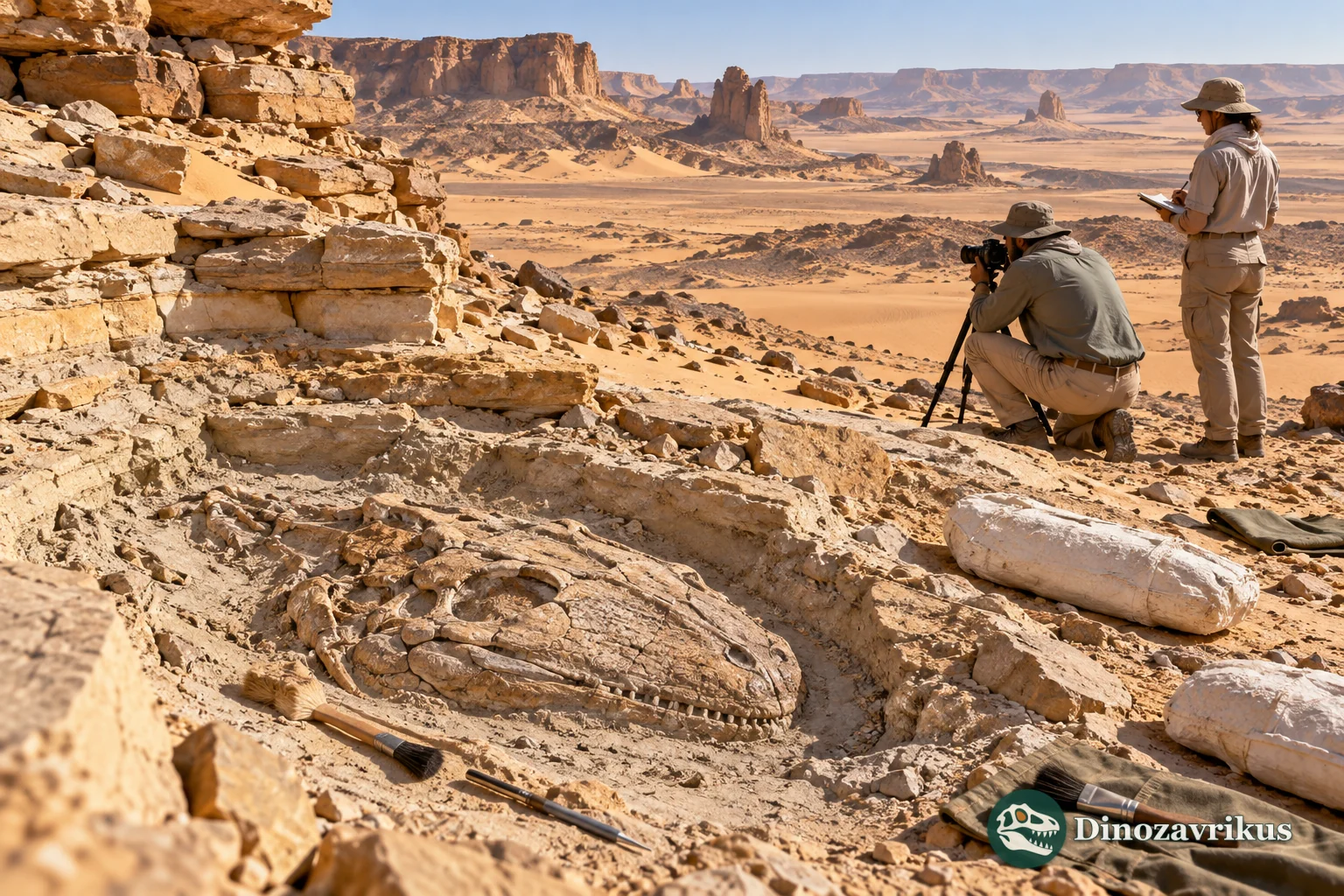
Field research near In Amenas in the Illizi Basin revealed a Triassic fossil site with unusually well-preserved temnospondyl remains. The species Stanocephalosaurus amenasensis was described in 2016 from two skulls in the lower part of the Zarzaïtine Series. The holotype is ZAR03; a second specimen is catalogued as ZAR04.
A later micro-CT study focused on specimen ZAR05, an assigned skull with internal spaces preserved well enough for three-dimensional analysis. The distinction between the original type material and the skull used for detailed internal study matters: not every anatomical observation comes from the holotype.
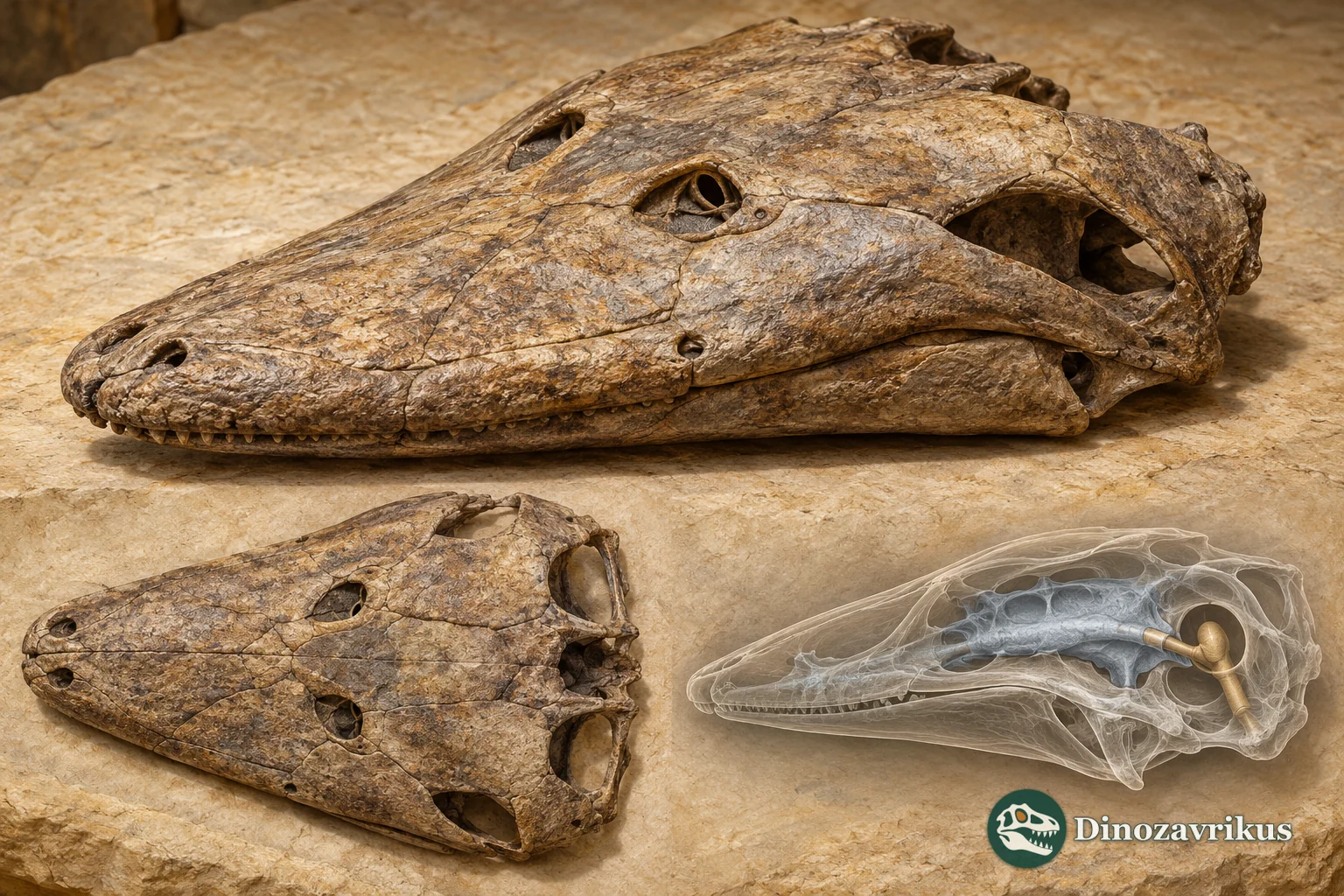
A broad, flattened capitosaurs skull
The skull is wide and low, with an elongated flattened snout and relatively small orbits placed high on the head. Such proportions occur in several capitosauroid temnospondyls and are consistent with life in water, but the overall outline alone is not enough to identify a species.
The diagnosis depends on combinations of cranial-roof and palatal features, including the shape of the nostrils, the proportions of bones behind the orbits and the arrangement of openings in the palate. Comparisons with other capitosaurs such as Mastodonsaurus test these details; resemblance does not mean the two genera are interchangeable.
Micro-CT and the inside of the skull
In 2017, researchers used X-ray micro-computed tomography to reconstruct the endocranial region and study the middle ear in three dimensions. Unlike a conventional surface description, CT sections can reveal internal cavities and the position of small bones without cutting through the specimen.
The work described the stapes and related structures and proposed a possible mechanism for transmitting sound under water. The scan directly documents bony shapes and spaces. How those structures functioned is inferred by comparing them with living animals and by considering the physical properties of sound; it cannot be tested directly in a fossil.
Age and setting of the Zarzaïtine beds
The fossils come from the Reculée section of the Zarzaïtine Series in southeastern Algeria. Stratigraphic position and associated evidence place the assemblage in the Lower to Middle Triassic, though the exact correlation has been refined as the section is studied. No skull has been directly radiometrically dated.
A 2026 paper describing the capitosauroid Stenotosaurus aitoualii discusses its stratigraphic succession relative to Stanocephalosaurus in the same section. This adds a useful comparison for the local faunal sequence, not an exact age for each individual.
What the skulls cannot yet establish
The available material supports detailed claims about skull shape and some internal cranial anatomy. It does not supply a complete articulated skeleton or a measured total body length. A broad-headed aquatic animal is a plausible reconstruction, while exact body proportions, skin colour, diet and behaviour remain uncertain.
Conference abstracts have mentioned additional postcranial material and traces within a skull, but preliminary reports are not a substitute for a full description of the specimens. Until those materials are formally documented, they should not be treated as established anatomy for this species.
Frequently asked questions
When did Stanocephalosaurus amenasensis live?
It is known from the Triassic Zarzaïtine Series of Algeria, commonly placed in the Lower to Middle Triassic while section correlations are refined.
Which fossils were used to describe it?
The 2016 description was based on holotype skull ZAR03 and referred skull ZAR04 from the Reculée locality.
What did the micro-CT scan show?
It revealed internal cranial spaces and middle-ear bones in three dimensions. The proposed underwater hearing mechanism is an interpretation of those structures.
How long was the whole animal?
A dependable total body length has not been established from the skull material.