

Stegomastodon was a North American gomphothere whose fossils span the Pliocene and early Pleistocene. A high-domed skull, one pair of upper tusks and a short lower jaw without lower tusks distinguish it from earlier long-jawed proboscideans. The soft tissue and skin in the cover are interpretive.
Old South American records bearing this name have been reassessed. Morphological and phylogenetic studies support a distinct Notiomastodon there. Similar teeth do not automatically make the animals members of one genus.
Quick facts
| Group | Proboscidea, Gomphotheriidae |
|---|---|
| Type species | Stegomastodon mirificus |
| Age | About 4–1.2 million years ago in North American records |
| Range | United States and Mexico |
| Jalisco specimen | Near-complete S. primitivus skeleton, roughly 3–4 million years old |
| Diagnostic bones | High-domed skull, upper tusks and short lower jaw |
| Species debate | One, two or three species have been recognized |
What can the fossils tell us?
The near-complete S. primitivus specimen from the Lake Chapala region preserves much more than an isolated molar. Its 3–4 million year age refers to geological context, not a direct assay of each bone.
Early S. primitivus third molars have about five or six transverse ridges; more derived forms may have more. Overlap means one tooth cannot always settle the species.
Reviews separate North American Stegomastodon from South American Notiomastodon. Older labels alone cannot demonstrate a range across both continents.
The skeleton from Jalisco
Spencer Lucas, Ricardo Aguilar and Justin Spielmann described a nearly complete S. primitivus skeleton from Jalisco, Mexico, near Lake Chapala. Earlier work on the genus often depended on scattered teeth or skull parts. This specimen associates ribs and limb bones with a proboscidean head, offering a firmer basis for reconstructing body proportions. The locality is assigned an early Blancan age of roughly 3–4 million years.
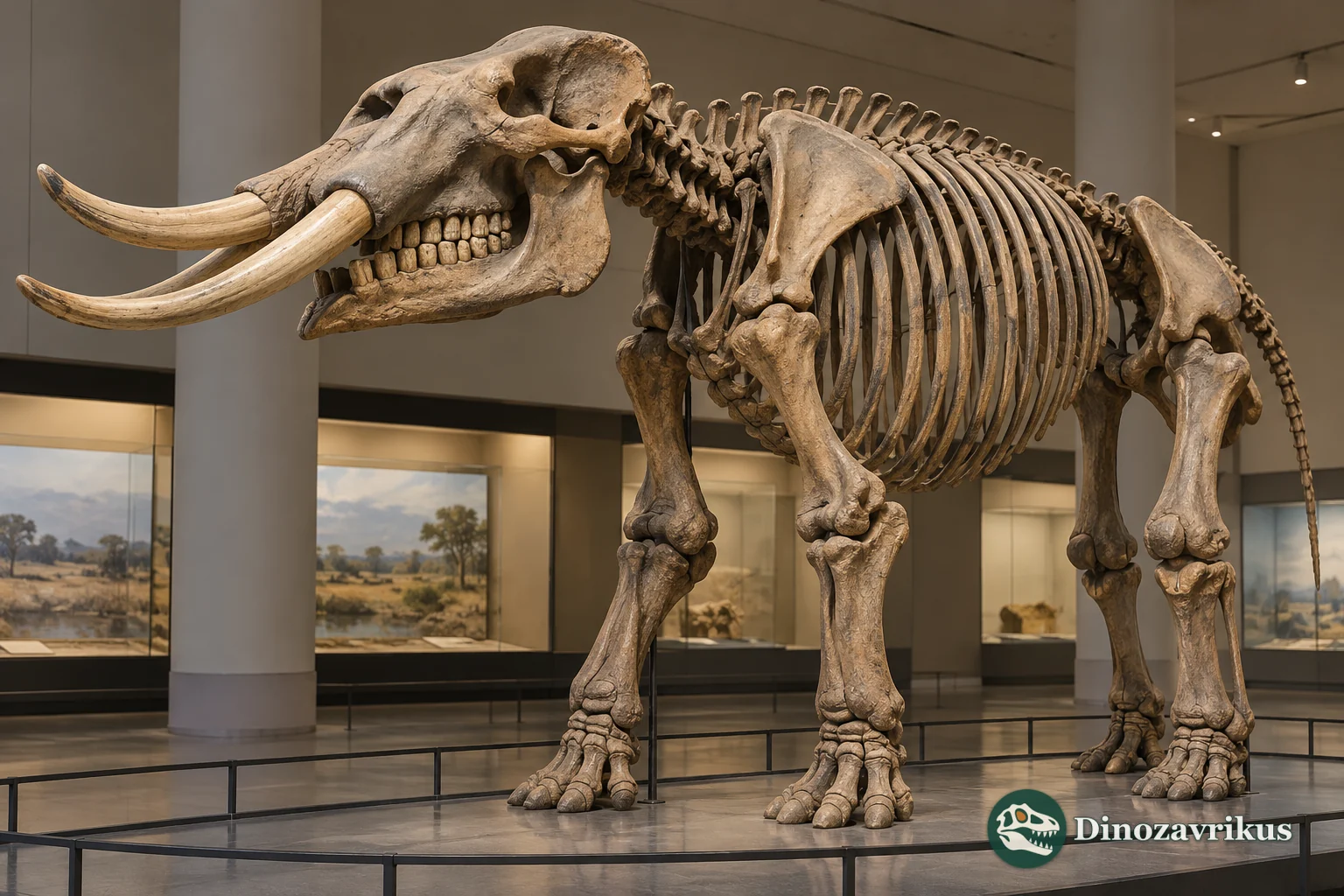
Some bones were damaged or reconstructed, and the skeleton does not reproduce the living animal's posture without interpretation. Other finds from Nebraska, Kansas, New Mexico and Arizona provide comparisons. The illustrative museum mount below is not a photograph or exact replica of the Jalisco specimen.
Tusks, molars and a difficult species count
The upper tusks are gently curved and lack enamel bands. The short lower jaw has no lower tusks, and the third molars carry at least five transverse ridges. In one proposed sequence, S. primitivus has simpler grinding surfaces, S. mirificus more complex ones and S. aftoniae the most elaborate. Yet traits overlap, and researchers have recognized differing numbers of species. A neat ladder of direct ancestors is not established.
The broad cheek teeth fit processing coarse plants. Lucas and colleagues inferred a strong grazing component, but tooth shape cannot measure each individual's exact diet. Trunk length, hide color and social behavior are absent from the hard parts.
Time range and changing classifications
Reviewed North American records extend from about 4 to 1.2 million years ago, across the beginning of the Quaternary. Each deposit requires its own dating evidence. Other proboscidean lineages, including Mammut, must be identified by their own anatomy.
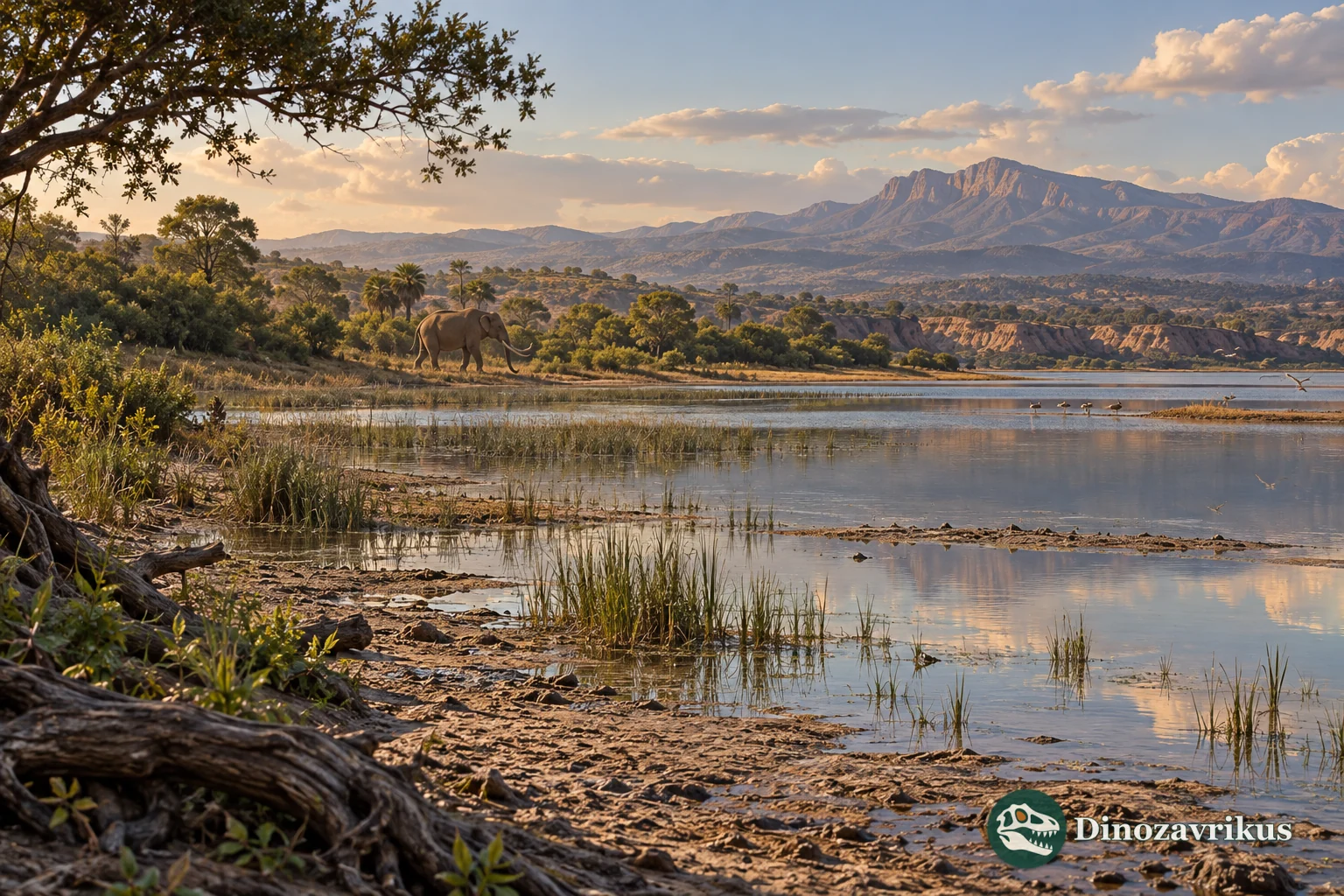
South American gomphotheres were once assigned to Stegomastodon. Comparative skull and tooth work, supplemented by a broader phylogeny including ancient Notiomastodon DNA, supports separating them. The lake-margin image is a possible setting for preservation, not a documentary image of Jalisco.
Limits of the reconstruction
The Jalisco skeleton shows robust weight-bearing limbs, but a small sample cannot determine population size or herd structure. The cover presents a plausible gomphothere rather than a measured portrait of S. primitivus.
Frequently asked questions
Was Stegomastodon an American mastodon?
It was a gomphothere, a different proboscidean lineage from the American mastodon Mammut, despite historical use of the word mastodon.
Did it have lower tusks?
The described genus has a short lower jaw without lower tusks and one pair of upper tusks.
Why do studies disagree over its species?
Molar traits grade and overlap among fossils. Authors have drawn different boundaries among early, intermediate and derived forms.
Did it live in South America?
Older fossils there carried that name, but recent revisions place the South American gomphothere in Notiomastodon.