

Stegotherium was an extinct armadillo from Miocene Patagonia. Its elongated snout and unusually reduced teeth distinguish it from many other armadillos. Those features suggest a specialised feeding niche, but they do not by themselves reveal an exact diet or behaviour.
The genus belongs in the ancient mammal catalogue. It was one member of a diverse South American xenarthran fauna. Its record is also a reminder that a fossil name can outlast the clarity of the museum paperwork attached to its earliest specimens.
Quick facts
| Scientific name | Stegotherium Ameghino, 1887 |
|---|---|
| Type species | Stegotherium tessellatum Ameghino, 1887 |
| Group | Armadillos; Cingulata, Xenarthra |
| Age | Miocene; type species from the Santa Cruz Formation |
| Region | Patagonia, Argentina |
| Key feature | Elongated rostrum and strongly reduced dentition |
| Mass estimate | About 11.5 kg in a comparative model, not a measured individual |
What can the fossils tell us?
Ameghino described Stegotherium tessellatum from armour plates without collection numbers. Later authors designated MACN A 781 as lectotype and MACN A 782–785 as paralectotypes, while another historic La Plata lot complicates the story.
Studied skulls and jaws show an elongated rostrum and a much-reduced tooth row. These features are observed anatomy; a specialist diet is inferred by comparing jaw mechanics and teeth.
Stegotherium tauberi includes parts of the carapace, skull, vertebrae and foot. That material broadens knowledge of the genus but cannot simply be assigned to the type species.
Jaw mechanics, the long rostrum and reduced teeth support feeding on ants or termites. No stomach contents or prey remains have been reported for Stegotherium.
Name and research history
Florentino Ameghino established Stegotherium and its type species, S. tessellatum, in 1887. The first account relied mainly on pieces of armour collected around the Santa Cruz River. Ameghino illustrated additional plates in 1889 but did not provide museum numbers. Carlos Ameghino collected the early material, although the precise findspot of every plate is not documented.
Juan Carlos Fernicola and Sergio Vizcaíno reviewed the genus in 2008. They designated osteoderm MACN A 781 as lectotype of S. tessellatum and MACN A 782–785 as paralectotypes. A historic lot at the La Plata museum, MLP 68-VI-25-438, had also been treated as possible type material. Incomplete collection records make it difficult to reconcile every plate with the original series.
Material and changing species lists
Armour plates remain central to the type species record. Their shape, surface and foramina help palaeontologists compare plates and identify regions of the carapace, but an isolated osteoderm does not reveal the outline of a whole shell or its position on an individual.
Other species provide additional anatomy. S. tauberi is represented by a more extensive set that includes the front of the carapace, a skull, vertebrae and foot bones. S. notohippidensis was described from material near Lago Argentino. These specimens improve the genus-level picture, not the completeness of S. tessellatum. Revisions have changed which named forms are accepted, so species lists should be tied to a particular systematic study.
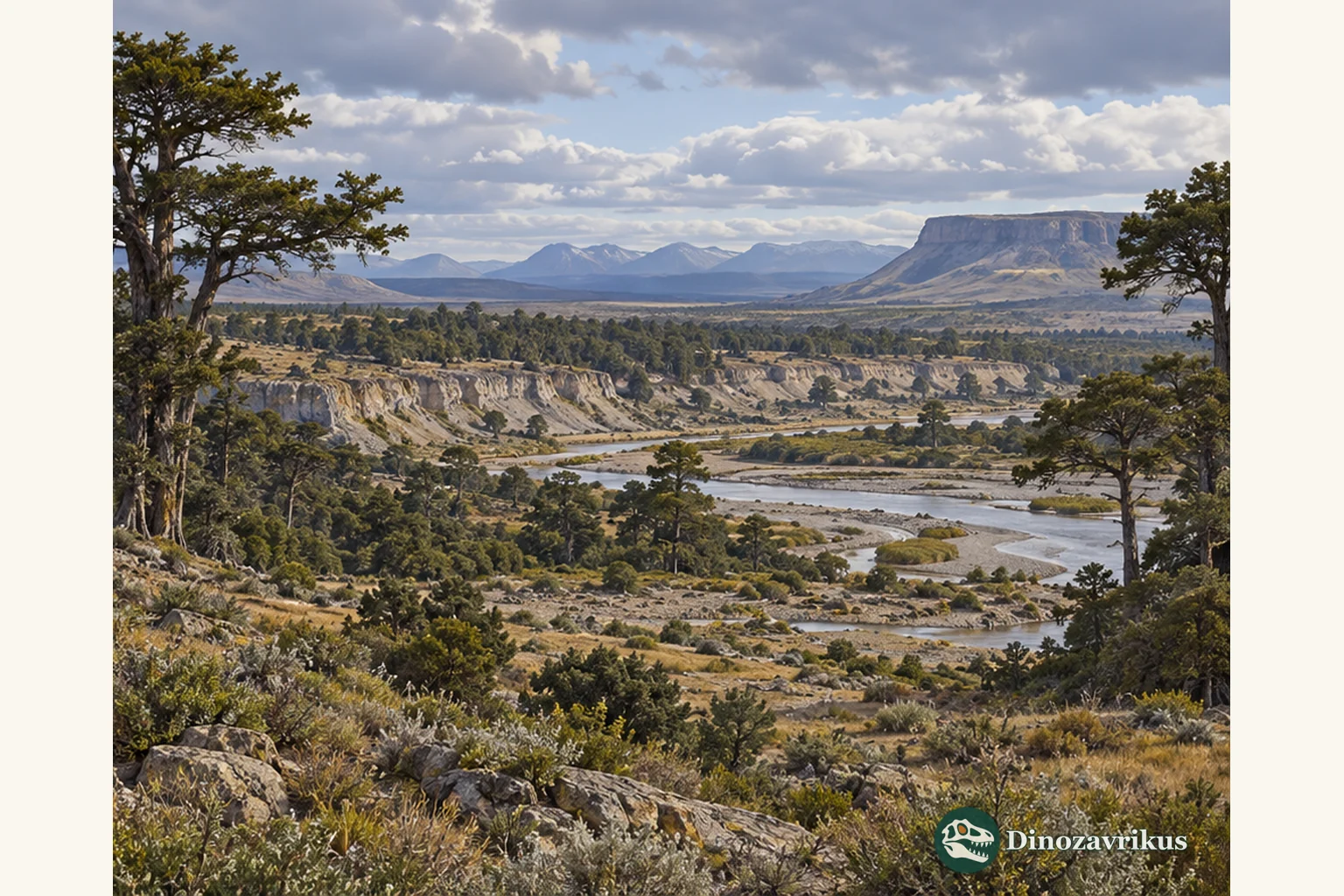
Age and localities
The type locality of S. tessellatum is recorded as the banks of the Santa Cruz River in Santa Cruz Province, Argentina, within the Santa Cruz Formation. The formation spans Early to Middle Miocene deposits; individual levels and faunal associations do not all have the same age. A formation-wide interval is not an exact date for a particular armour plate.
Material assigned to other species comes from additional parts of Santa Cruz Province. The early Miocene age proposed for localities near Lago Argentino was inferred from associated mammals and stratigraphic comparisons. The authors treated the historic “Notohippidian” correlation as tentative rather than a direct radiometric date.
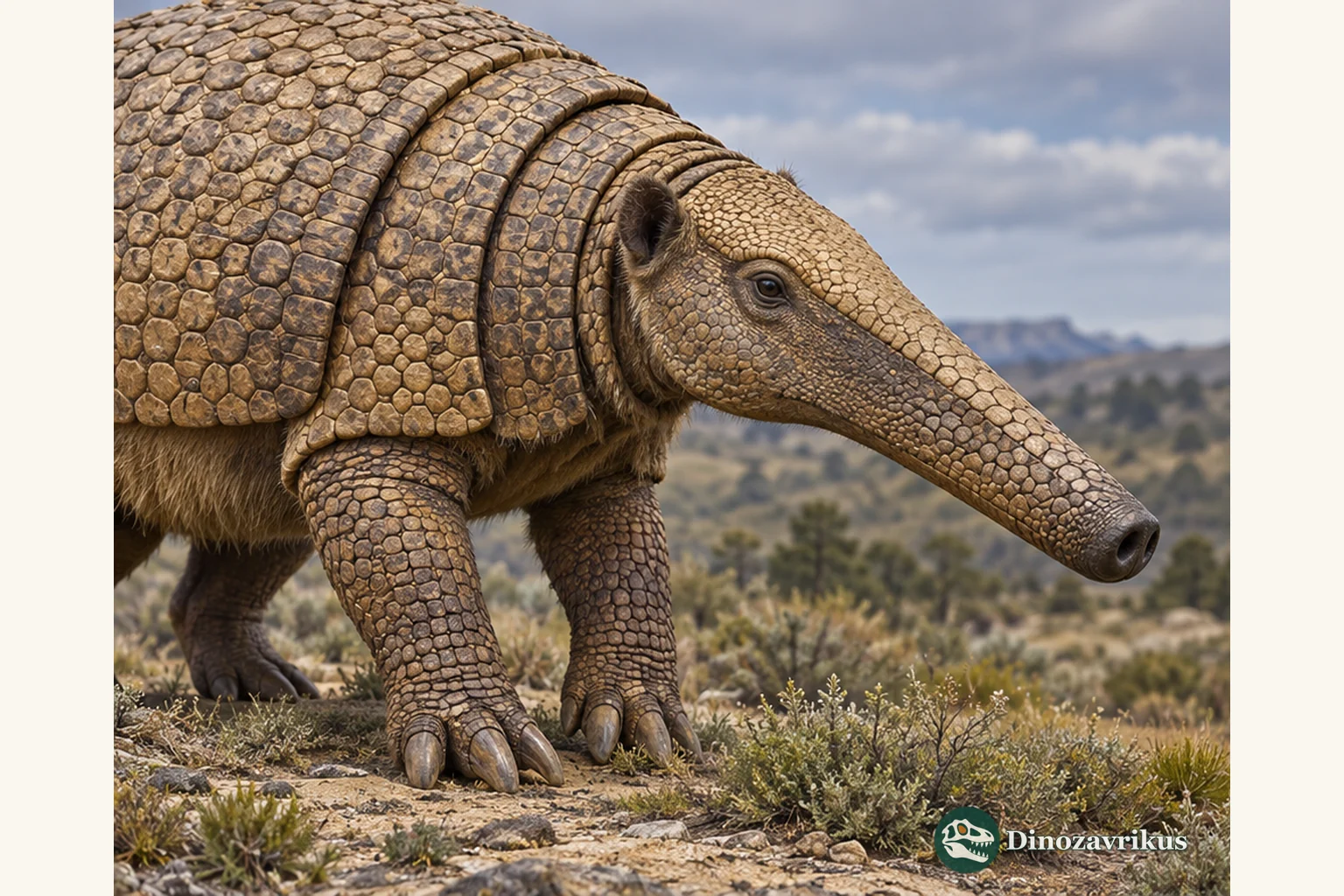
Skull, teeth and feeding
Skulls referred to Stegotherium have an elongated rostral region. The tooth row is strongly reduced compared with that of many armadillos, leaving an extensive toothless part of the jaws. The exact complement varies among specimens and species, so a single count should not be applied to every fossil.
A study of S. tessellatum compared jaw joints and muscle attachments with living xenarthrans. It inferred predominantly fore-and-aft jaw motion. Together, the long snout and reduced teeth support myrmecophagy – feeding on ants or termites. This is a functional interpretation of anatomy, not direct stomach evidence. Fossils have not preserved a tongue, prey item or feeding behaviour.
Size, movement and uncertainty
A comparative study of Santa Cruz armadillos reported an average body-mass estimate of about 11.5 kg for Stegotherium. The estimate was derived from dimensions of limb-bone shafts and allometric equations calibrated on living armadillos. It is a modelled average, not the measured mass of a known individual or a value that applies equally to every species.
The limb record is uneven. Comparative work suggests that several Santa Cruz armadillos were capable diggers, but it cannot establish the speed or digging frequency of a particular Stegotherium. Reproduction, social behaviour and pathologies are not established by the known material.
Systematics and reconstruction limits
Stegotherium is a cingulate armadillo within Xenarthra and is associated with the specialised tribe Stegotheriini. Several revisions have reconsidered the genus because early names rest on small sets of armour plates or incomplete jaws. The placement of a species depends on the characters and type material compared in each study.
Fossils directly document osteoderms, teeth, parts of skulls and jaws, and more extensive skeleton portions in some species. The long snout and armour are anatomical evidence. Myrmecophagy is a well-supported inference from teeth and jaw mechanics. Hair, colour, tongue length, precise prey and behaviour remain unknown or belong to artistic reconstruction.
Frequently asked questions
When did Stegotherium live?
The type species, S. tessellatum, is known from the Santa Cruz Formation of Patagonia, assigned broadly to the Early–Middle Miocene. Ages of individual species and beds are refined using stratigraphy and associated fauna.
What is the type specimen of Stegotherium tessellatum?
Fernicola and Vizcaíno designated osteoderm MACN A 781 as lectotype, with MACN A 782–785 as paralectotypes. The history of older collections leaves some uncertainty about how all early plates relate to the original series.
How did Stegotherium differ from other armadillos?
It had an elongated snout and a strongly reduced tooth row, a distinctive combination among the armadillos known from the Santa Cruz Formation.
Is ant-eating proven?
Myrmecophagy is the best-supported functional interpretation of the skull and jaw anatomy, but direct prey or stomach evidence has not been reported.