

Stenorhynchosaurus munozi was a pliosaurid plesiosaur from Barremian rocks of Colombia’s Paja Formation. Its material includes an articulated juvenile skeleton with missing regions, an adult skull with ten neck vertebrae, and a separate anterior snout with an articulated lower jaw. Together these fossils document a long, narrow rostrum and changes associated with growth, while leaving total body length, soft tissues and species-specific prey uncertain.
Quick facts
| Type species | Stenorhynchosaurus munozi |
|---|---|
| Group | Plesiosaur; pliosaurid |
| Age | Late Barremian, Early Cretaceous |
| Formation | Paja Formation, Arcillolitas Abigarradas Member |
| Locality | Villa de Leyva region, Boyacá, Colombia |
| Holotype | VL17052004-1, nearly complete articulated skeleton with missing regions |
| Other material | Adult skull with ten cervical vertebrae; juvenile snout and jaw fragment |
| Total length | No reliable complete-body estimate established |
Evidence guide
VL17052004-1 preserves an articulated juvenile pliosaurid skeleton. The anterior snout, tail and parts of the paddles are missing. The 2016 description interprets it as juvenile; the fossil does not directly measure the animal’s full living length.
MP050310-1 consists of a skull and the first ten cervical vertebrae of an adult from near Sáchica. It improves anatomical and growth comparisons, but it is not a second complete skeleton.
MPVL-667 includes the anterior snout and articulated mandible. Five premaxillary tooth positions, including a procumbent first position, clarify the snout tip. The fragment does not preserve the rest of the body.
Discovery and the name
Fragments from the front of a marine-reptile snout were found in 2000 during excavation of a small dam on Jorge Muñoz’s property near Villa de Leyva. Muñoz reported the find, and staff from the Colombian Geological Survey investigated it. The main excavation took place in 2004–2005 with the Colombian Foundation of Geobiology. The skeleton was registered as VL17052004-1 and transferred to the paleontological collections of the Museo Geológico José Royo y Gómez in Bogotá.
The species name honours Jorge Muñoz, who discovered and reported the fossil on his land and handed the specimen to the museum collection. The genus name combines Greek roots for narrow, snout and lizard, referring to the elongated rostrum.
Three specimens, three kinds of evidence
The holotype VL17052004-1 is a substantially complete, articulated skeleton, but it lacks the anterior snout, the tail and parts of two paddles. The 2016 authors interpreted the individual as juvenile from skeletal maturity indicators. ‘Nearly complete’ describes how much of the skeleton is represented; it does not make the preserved outline a direct measurement of a living animal.
In 2019, MP050310-1 added a complete skull and the first ten cervical vertebrae of an adult from near Sáchica. A third specimen, MPVL-667, is an anterior snout with an articulated lower jaw collected by museum staff in the 1990s near Sutamarchán. Its exact position within the Barremian sequence could not be narrowed more precisely. These fossils complement one another, but none alone supplies a continuous head-to-tail measurement.
A narrow snout and its teeth
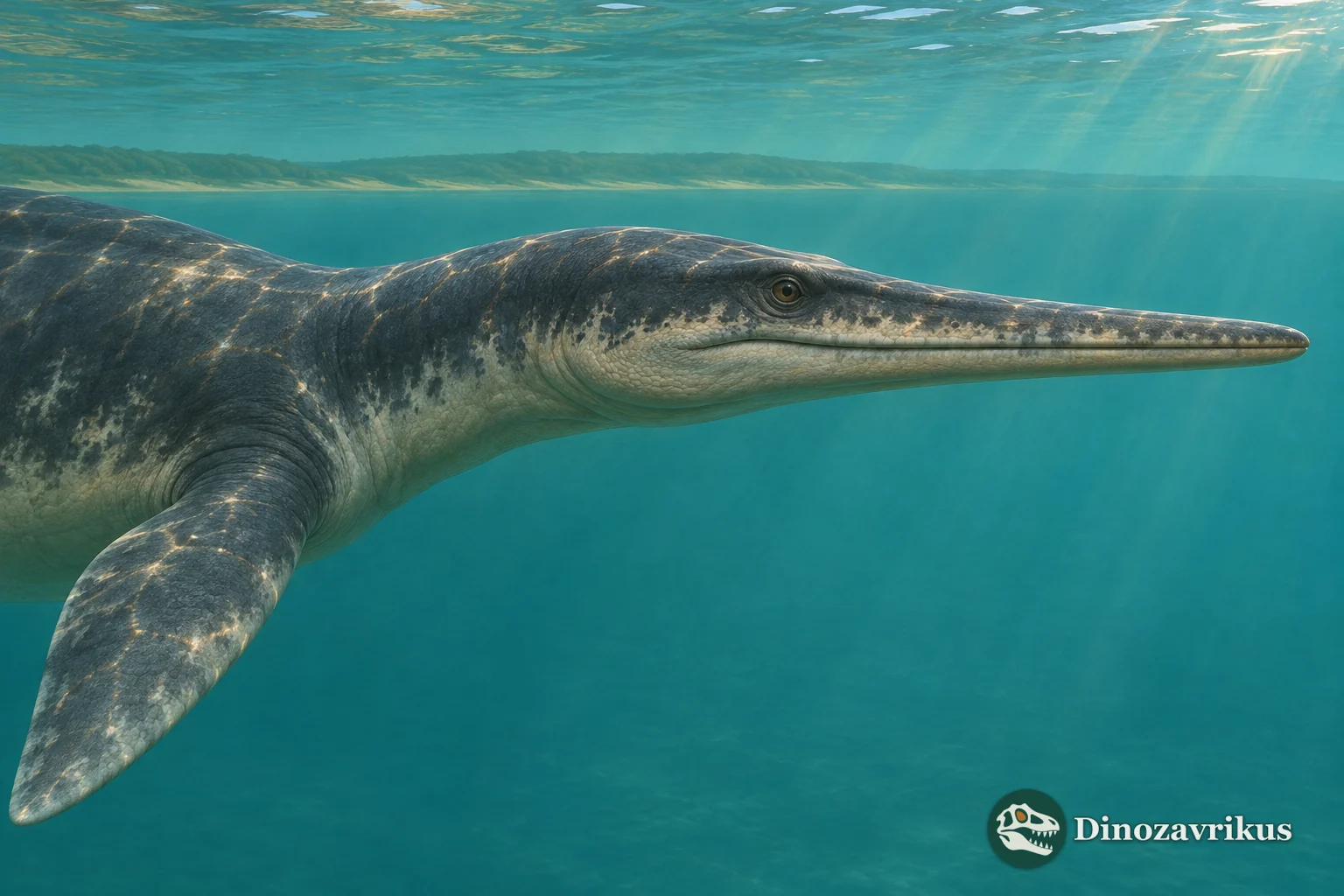
The 2016 description characterizes the rostrum as narrow and elongated, with nearly straight sides in dorsal view. The adult skull added details of the parietal crest and other cranial structures. MPVL-667 helps document five premaxillary tooth positions, with the first directed forward. This new information concerns the front of the jaws; it does not establish a particular prey item or a complete feeding sequence.
Short epipodial bones and other skeletal characters contributed to comparisons with other pliosaurids. Classification rests on combinations of anatomical traits, not on the snout alone. Compare the Colombian record with Kronosaurus, another well-known pliosaurid from the region; similarity does not demonstrate direct ancestry between the named genera.
Age and classification
The holotype came from the Arcillolitas Abigarradas Member of the Paja Formation near Loma La Cabrera in the Villa de Leyva region. The authors assigned it to the upper part of the Upper Barremian. Ammonites from nearby beds support the age interpretation. The adult skull was found near Sáchica, while MPVL-667 came from near Sutamarchán; the regional association does not mean that all three fossils came from one exact bed.
The original description placed Stenorhynchosaurus among Pliosauridae. Later work has refined comparisons using the adult skull and additional jaw material. A phylogenetic placement is an inference from anatomical character data and may change with new evidence; it is not proof that one named species was the direct ancestor of another.
What remains unknown
The available fossils do not establish a reliable total length or body mass. The adult specimen preserves the skull and a short neck series, while the nearly complete holotype lacks the tail and several limb elements. Teeth and skull anatomy are compatible with predation, but no reported stomach contents identify a species-specific menu. Skin colour, soft-tissue outline, swimming speed and hunting behaviour are not preserved.
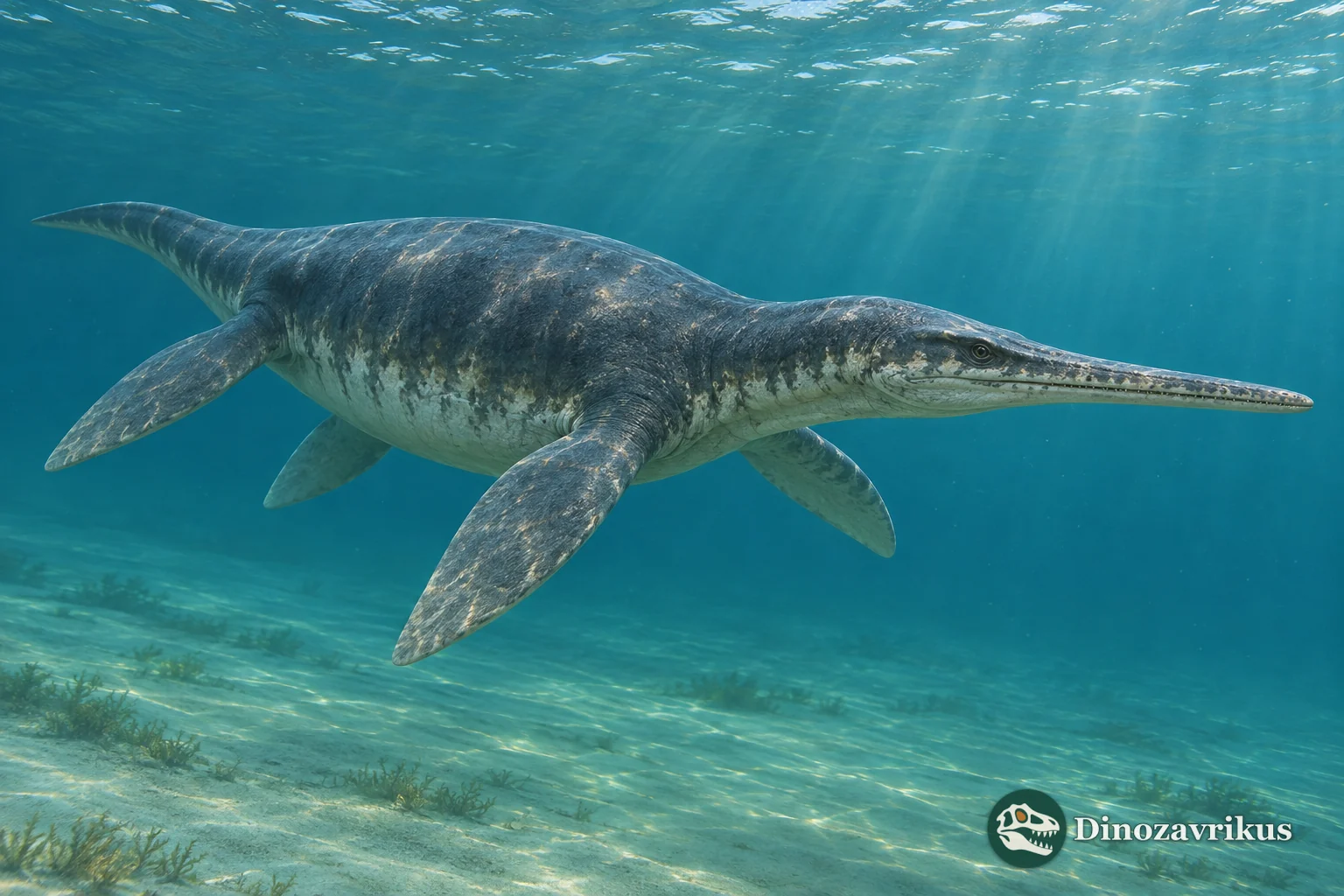
The illustrations are palaeoart based on the known skeletal plan, not photographs of a specimen or a measured life reconstruction. The narrow rostrum is supported by fossils; colour, skin texture and exact posture are not.
Frequently asked questions
Where was Stenorhynchosaurus found?
The holotype came from near Loma La Cabrera in the Villa de Leyva region of Boyacá, Colombia. Other material was reported from near Sáchica and Sutamarchán.
How many important specimens are known?
Three described specimens provide key evidence: a nearly complete juvenile skeleton, an adult skull with ten cervical vertebrae, and a snout fragment with an articulated lower jaw.
How long was Stenorhynchosaurus?
A reliable total body length has not been established from the described material. No specimen preserves an uninterrupted skeleton from snout to tail tip.
What does the name mean?
The genus name refers to a narrow snout, while the species name honours Jorge Muñoz, who reported the original find and transferred it to a museum collection.