

Sthenarosaurus dawkinsi is a plesiosaur named from a partial postcranial skeleton collected at Saltwick, Yorkshire. The type material includes vertebrae, limb bones and both girdles, but no skull has been referred to the genus. Those limits leave the animal’s exact head shape, total length, diet and phylogenetic position uncertain.
Quick facts
| Type species | Sthenarosaurus dawkinsi |
|---|---|
| Group | Plesiosaur; exact placement has been debated |
| Age | Toarcian, Early Jurassic |
| Horizon | Upper Lias, Dactylioceras commune Zone |
| Locality | Saltwick, Yorkshire, England |
| Holotype | MM L8023, partial postcranial skeleton |
| Skull | Unknown; no cranial material has been referred |
| Total length | No reliable estimate established |
Evidence guide
MM L8023 includes vertebrae, both girdles and limb bones. It is a partial postcranial skeleton rather than a complete articulated outline. No cranial material has been referred to Sthenarosaurus, so the head and full-body length cannot be reconstructed directly.
Watson’s 1909 preliminary account highlighted these features in the Manchester Museum skeleton. They are observations of preserved bones; they do not by themselves establish a swimming style or a precise evolutionary position.
Later accounts place MM L8023 in the D. commune Zone at Saltwick. Historical comparisons shifted among plesiosaur groups, and a 2012 analysis excluded the taxon from its phylogeny because the material was insufficiently informative.
Discovery and museum record
William Henry Sutcliffe found the partial skeleton at Saltwick on the Yorkshire coast and donated MM L8023 to Manchester Museum in 1908. In 1909, D. M. S. Watson described it as the type of a new genus and species.
A later review of the Yorkshire coast material linked the specimen to the Dactylioceras commune Zone of the Upper Lias. In modern terms this is the Toarcian Stage of the Early Jurassic. The age comes from geological position and associated fossils, not a direct radiometric date of the bones.
What the type preserves
MM L8023 is a partial postcranial skeleton. Published inventories list vertebrae, both girdles and propodials, the long bones of the paddles. No skull has been referred to Sthenarosaurus. The available bones therefore do not show its jaws, teeth or the shape of its head.
Watson’s preliminary note called attention to small coracoids and a strong clavicular arch. These are features of the preserved shoulder region. They cannot by themselves tell us how fast the animal swam or how it moved its paddles.
A changing taxonomic interpretation
Watson compared Sthenarosaurus with the plesiosaur later called Rhomaleosaurus longirostris. Subsequent authors placed it differently, and some historical discussion considered whether it might belong with another named form. A 2012 study did not include it in the phylogenetic analysis, although it counted the taxon in a broader diversity estimate.
The changing discussion records competing interpretations of a limited skeleton, not several successive animals or a complete evolutionary sequence. The genus remains based on MM L8023, and its exact relationships are less secure than those of better-preserved plesiosaurs such as Microcleidus and Hauffiosaurus.
Size, diet and the missing head
No reliable total body length is established for Sthenarosaurus. Measurements of separate vertebrae, girdle elements or paddle bones are not the same as a continuous head-to-tail measurement, especially when the skull is absent and the postcranial skeleton is incomplete.
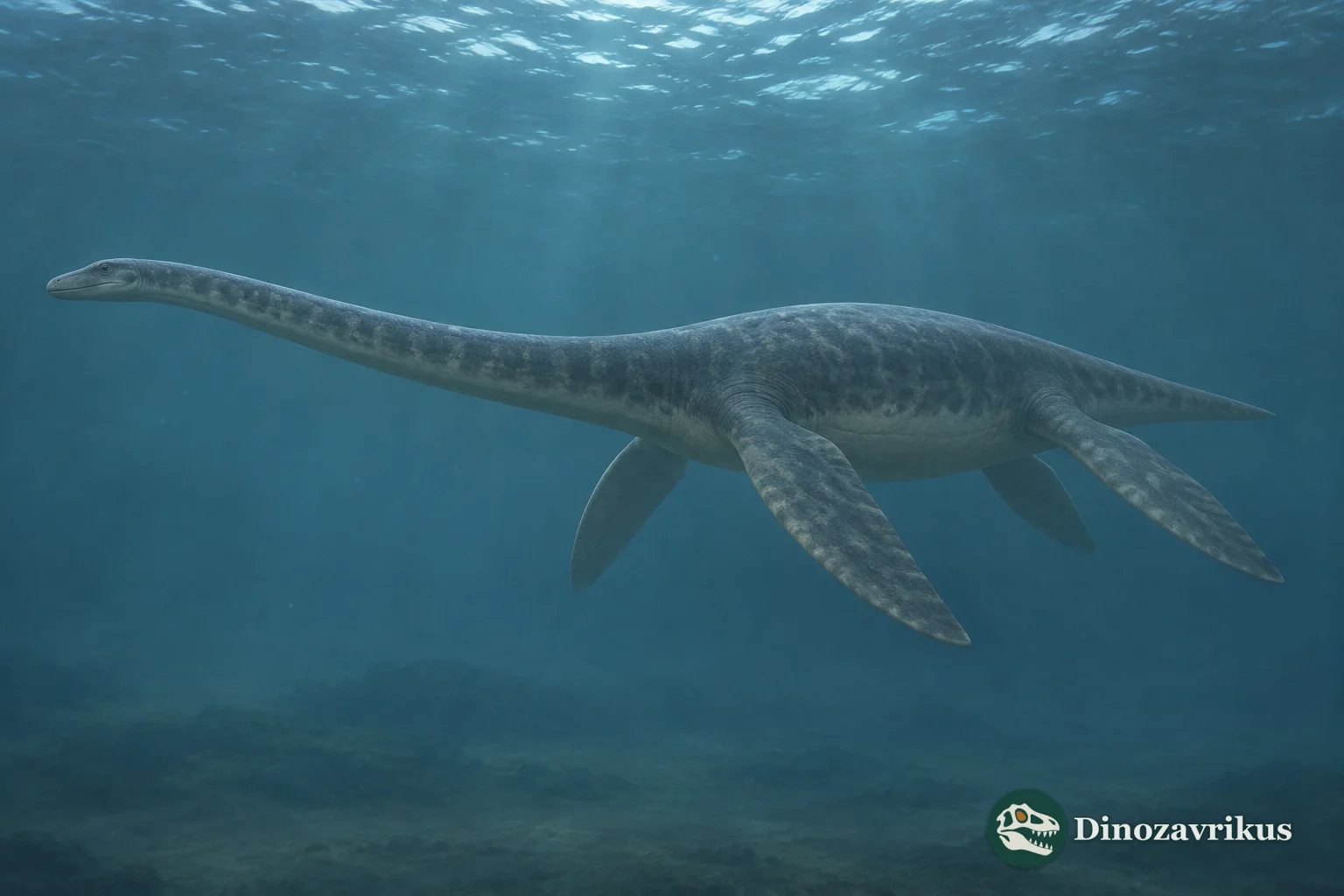
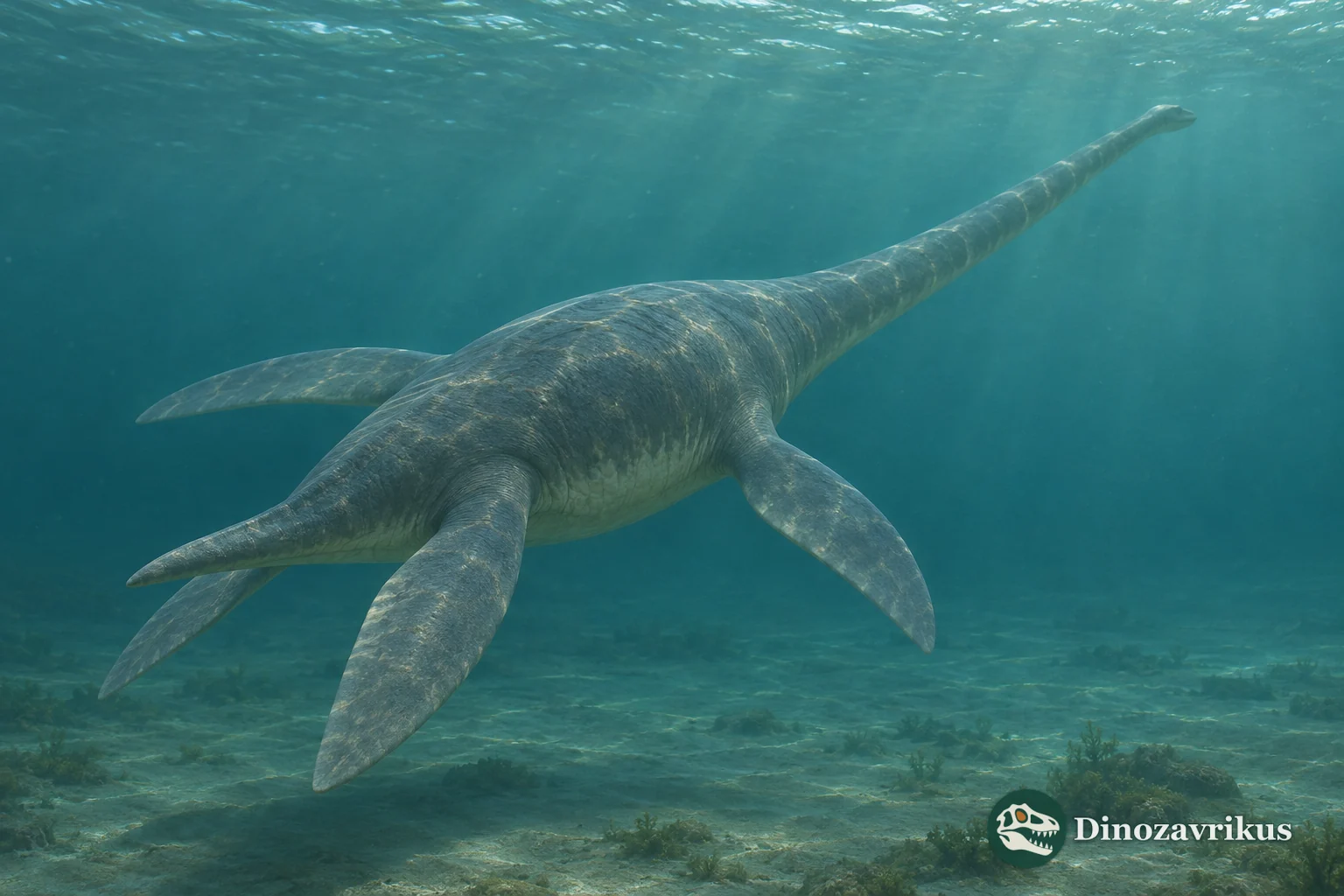
The postcranial fossils do not identify a specific diet. Without referred teeth, jaws or stomach contents, a species-level prey claim would go beyond the evidence. The illustrations are intentionally tentative: a general long-necked plesiosaur body plan is shown, while the exact skull shape, skin, colour and soft tissues remain unknown.
Frequently asked questions
Where was Sthenarosaurus found?
Its type specimen, MM L8023, was found at Saltwick on the Yorkshire coast of England.
Is the skull of Sthenarosaurus known?
No. No cranial material has been referred to the genus, so its exact head shape and teeth are unknown.
How large was Sthenarosaurus?
A reliable total length has not been established. The type is a partial postcranial skeleton without a skull.
Why has its classification changed?
Different authors interpreted the limited girdle, limb and vertebral characters in different ways. The missing skull and incomplete description restrict phylogenetic testing.