

Stockoceros was a Pleistocene member of the pronghorn family in southwestern North America. It is often called four-horned, but each side of its skull carried one bony horn core that split into forward and rear branches near the base. Two forked cores made four prominent tips, not four separate horn bases.
Skulls and limb bones from cave deposits reveal anatomy, while the colour of the coat and the complete keratin sheaths remain unknown. The cover is an artistic life reconstruction. The smaller Capromeryx shows how much headgear and body form varied within extinct pronghorn relatives.
Quick facts
| Family | Antilocapridae, pronghorn relatives |
|---|---|
| Age | Pleistocene, especially late Pleistocene records |
| Range | Southwestern United States and Mexico |
| Headgear | One low-forked bony horn core above each orbit |
| Material | Skulls, horn cores, teeth and limb bones |
| Species names | S. conklingi and S. onusrosagris; boundaries debated |
What can the fossils tell us?
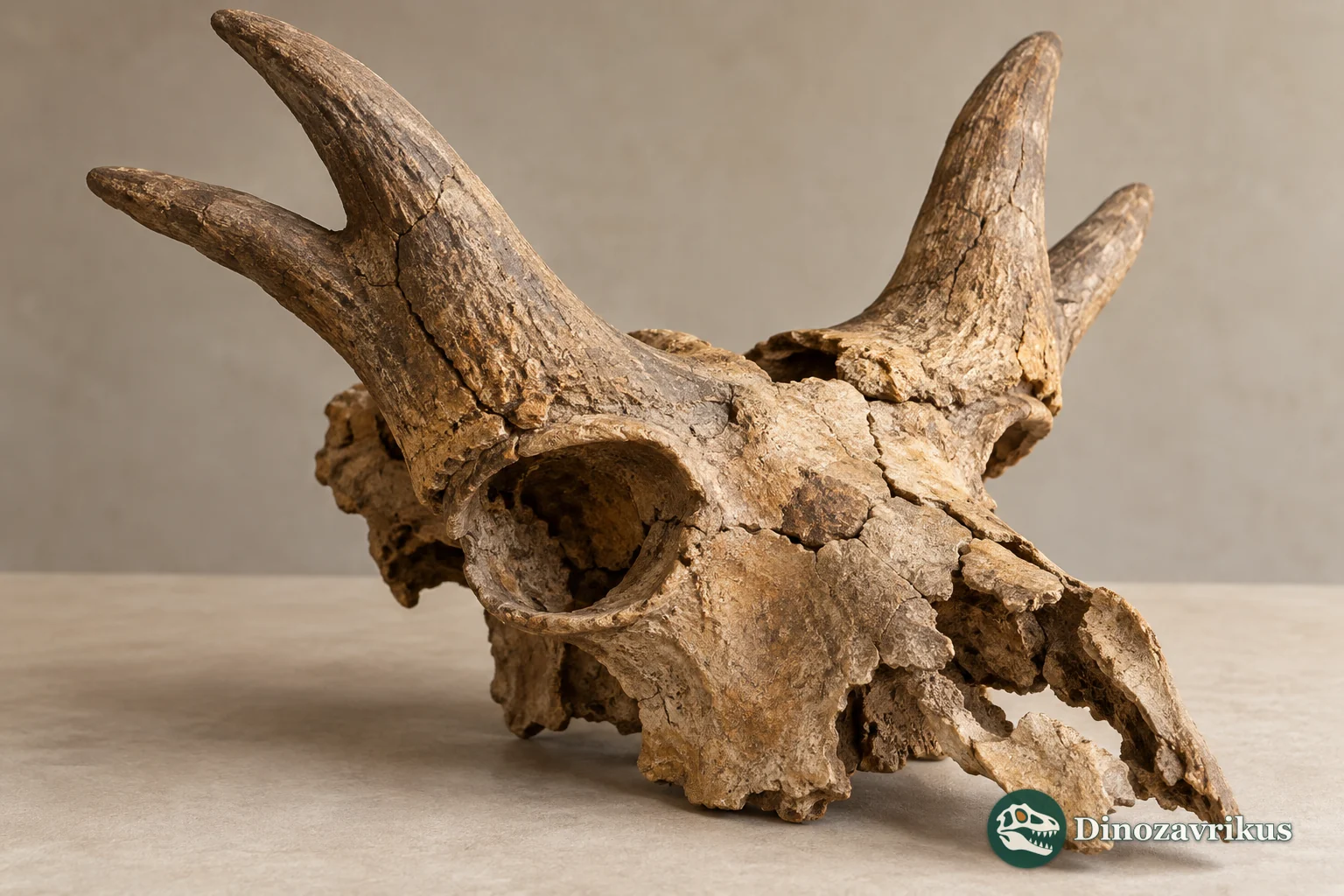
Skulls preserve one horn core above each orbit, forked close to its base. Bone reveals the branching pattern but not the exact outer shape of the shed keratin sheath.
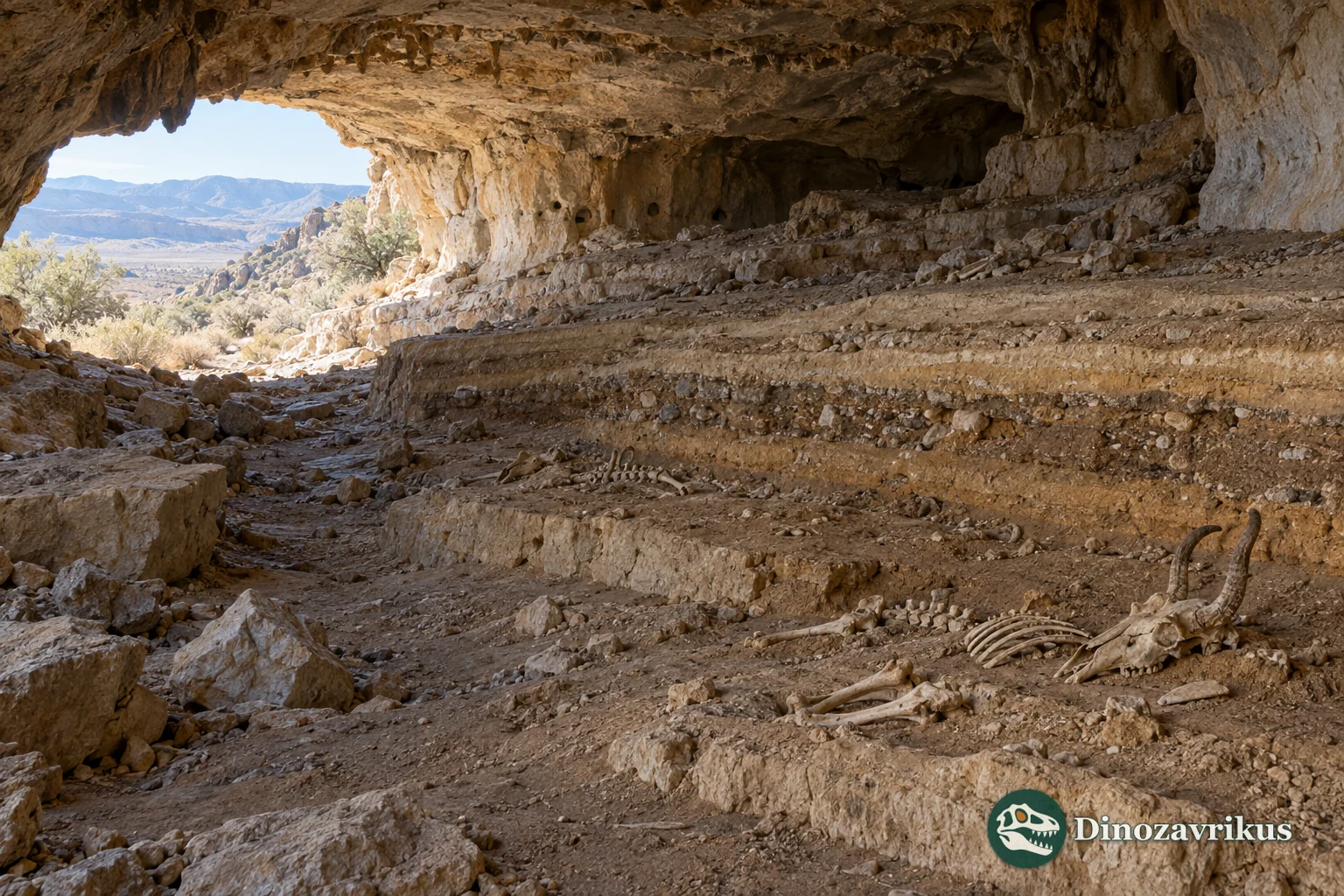
Papago Springs Cave yielded remains attributed to many individuals, including articulated skeletons. Lack of obvious tooth marks weakens a simple predator-cache explanation but identifies no single cause of accumulation.
Mesowear and microwear of S. onusrosagris molars were compared with living pronghorn. The pattern supports mixed plant feeding, without identifying the last meal of an individual.
Two names and a distinctive fork
Chester Stock described the Shelter Cave, New Mexico material as Tetrameryx conklingi in 1930. The name Stockoceros was later applied to low-forked pronghorn forms. Unlike the living pronghorn, whose forward tine is small and arises higher, its anterior and posterior bony branches diverge close to the skull and are more nearly alike in length. A fossil horn core is not a preserved cast of its entire keratin covering.
A partial skull from Oswaldo Mooser's Aguascalientes collection, IGM 5268, preserves much of both anterior and posterior horn cores. Their tips are missing, so the precise outline of that specimen cannot be drawn from the fossil alone. A 2026 reassessment refers it to S. conklingi. Papago Springs Cave material is commonly called S. onusrosagris. Some classifications distinguish these names; others treat them as synonyms. The figure below illustrates the branching principle without pretending to show IGM 5268.
Why were so many bones in Papago Springs Cave?
The American Museum of Natural History reports remains of about 125 individuals assigned to the Papago Springs form. Some skeletons were articulated and obvious predator tooth marks were not recorded. Those observations make wholesale transport by carnivores an inadequate simple explanation. Water, mineral salts or shelter have been suggested as possible attractions, but the cave record does not choose one. A count of individuals also does not demonstrate a single death event or a herd entering together.
Another cave assemblage illustrates a different limit. A recent Shelter Cave reassessment distinguishes identified specimens from the minimum number of animals. Dung formerly assigned to the extinct pronghorn was more plausibly left by a later living pronghorn. The bones remain significant, but nearby organic traces should not be turned into certain behaviour without their own identification.
Plant food inferred from molars
A comparison of S. onusrosagris molar mesowear and microwear with the living pronghorn places the extinct form among mixed plant feeders. The more macroscopic wear and finer scratches capture different effects of chewing and abrasive material. This is a sample-based dietary inference, not preserved stomach contents or a list of plant species eaten by every Stockoceros.
Cave sites also contained other herbivores, while Palaeolama occupied some North American landscapes. Co-occurrence over a region does not establish direct interaction. Horn cores alone cannot establish running speed, seasonal movements or whether the animals gathered in a fixed social group. The cover's coat pattern and landscape details remain illustrative choices.
Frequently asked questions
Did Stockoceros have four separate horns?
No. It had one bony horn core on each side, and each core forked near its base into two prominent branches.
Why did so many animals end up in Papago Springs Cave?
The cause is unresolved. Articulated skeletons and little evidence of predator tooth marks do not identify one explanation.
What did Stockoceros eat?
Tooth-wear comparisons in S. onusrosagris support mixed plant feeding, but not an exact list of plants.
How many Stockoceros species were there?
S. conklingi and S. onusrosagris are often named, but their separation is disputed across classifications.