

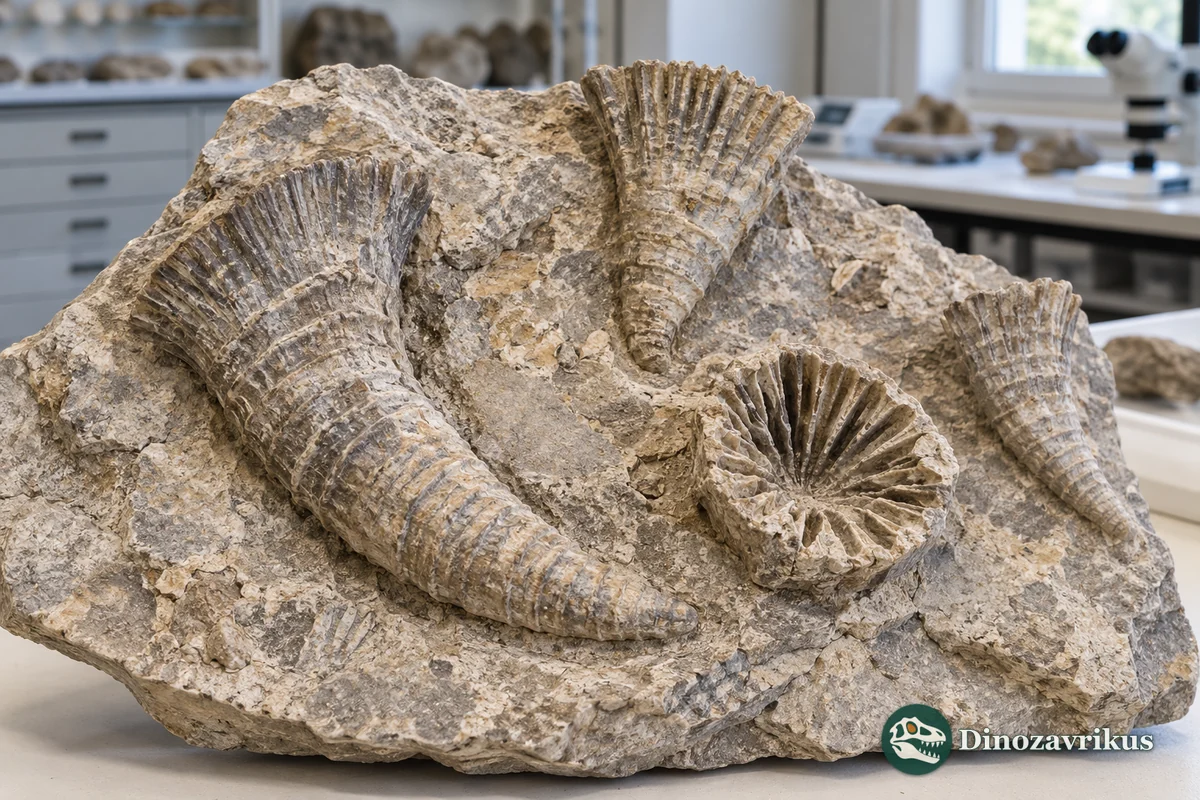
Streptelasma is a genus of solitary rugose corals, recognised by an individual conical or curved corallite. James Hall introduced the name in 1847. Later researchers revised both its species and the application of the generic name. The clearest reference is the type species S. corniculum and its lectotype from the Middle Ordovician of New York.
Rugose corals built a mineralised skeleton. In Streptelasma, the fossil preserves the outer curve and internal partitions, but not the polyp, tentacles or colour. Attachment and suspension feeding are inferred from coral form and biology, rather than demonstrated by a preserved gut.
The early animal catalogue gathers this and other fossil marine taxa; its broad catalogue placement does not change the Ordovician age of the specimen.
Quick facts
| Scientific name | Streptelasma Hall, 1847 |
|---|---|
| Type species | Streptelasma corniculum Hall, 1847 |
| Group | Solitary rugose coral, Anthozoa |
| Type specimen | Lectotype AMNH 64511(a), American Museum of Natural History |
| Type locality | Middleville, New York; lower Trenton Limestone |
| Type age | Middle Ordovician |
| Lectotype size | 39.5 mm high; calice 18.5 mm across |
| Ecology | Attached benthic suspension-feeder inferred from coral biology |
| Limit | Soft polyp, colour and exact ecology are unknown |
What can the fossils tell us?
Björn Neuman designated lectotype AMNH 64511(a) for Streptelasma corniculum. Its label records the lower Trenton Limestone near Middleville, New York. It anchors the name, but does not represent variation across every species.
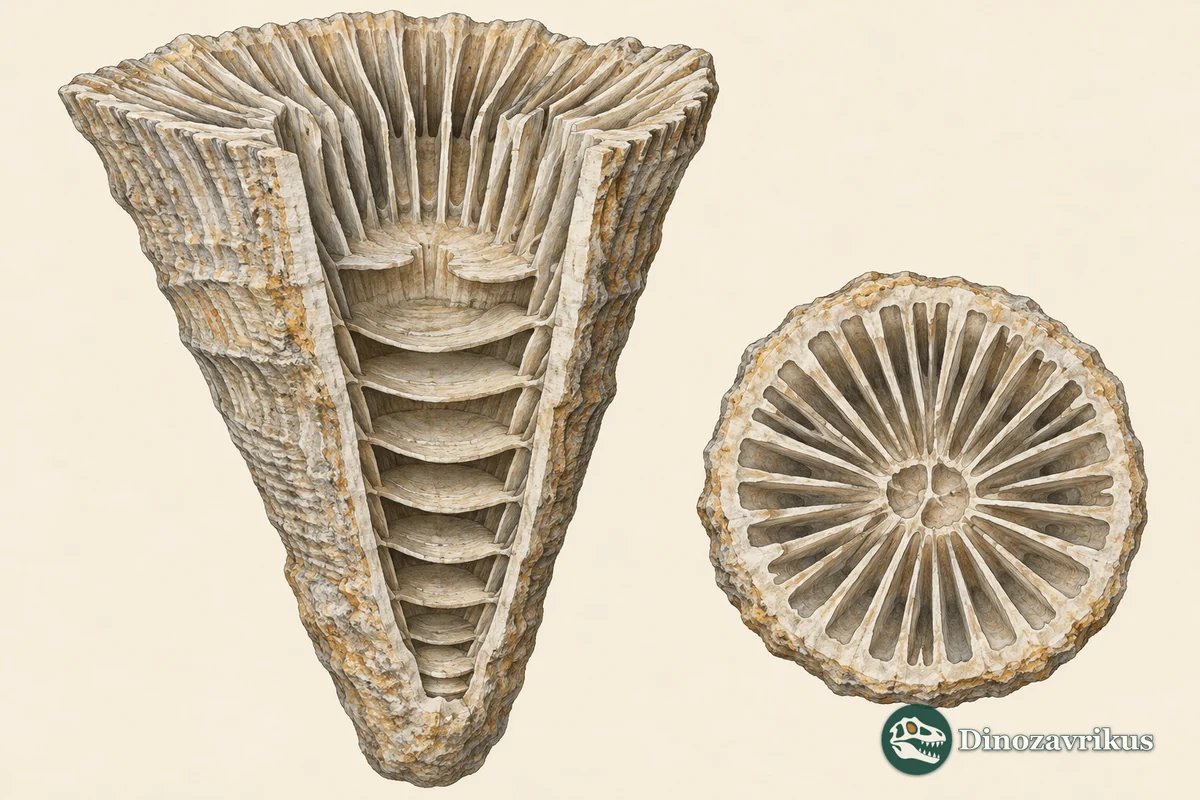
Serial transverse and longitudinal sections expose septa, stereozone and tabulae, and show how these structures change during growth. External resemblance alone cannot resolve every solitary rugose coral.
The type is Middle Ordovician. Species assigned to the genus have also been reported from the Upper Ordovician and Lower Silurian, but Neuman cautioned that some old identifications may belong to related genera.
Names, type and taxonomic revision
James Hall established Streptelasma in the first volume of Palaeontology of New York in 1847. Ferdinand Roemer selected S. corniculum as the type species in 1861. Hall illustrated several corallites, but their internal anatomy was not examined in serial sections until Björn Neuman's revision. Neuman showed that Hall's original series could include more than one morphological form and formally selected a lectotype.
In 1969, Neuman reassessed the relationship between Streptelasma and Brachyelasma and proposed moving some forms into the new genus Helicelasma. The history illustrates how genus names can shift when type material and growth stages are studied. Modern lists may use a broader or narrower concept, so old species combinations should be checked against later revisions rather than copied uncritically.
Corallite anatomy and growth
The type species has a curved, horn-shaped corallite with a deep cup, or calice. Inside are numerous radial septa. During early growth, major septa are longer and may meet weakly near the axis; later they become shorter and need not form a central structure. Tabulae divide the inside into successive chambers. Identification depends on this combination and on how it changes through ontogeny.
Neuman used serial transverse peels and thin sections, comparing septal length and number, stereozone width and the axial region. He stressed that morphological variation within a species can be considerable. Researchers therefore need to separate growth stages and damage from differences that justify naming another species.
Age, localities and preservation
The S. corniculum lectotype came from the lower Trenton Limestone, Upper Middle Ordovician, near Middleville, New York. Neuman also studied Upper Ordovician corals from central Sweden and southern Norway, including material from the Boda Limestone and beds known as the Dalmanitina Beds. These regional collections contain different species and should not be treated as one time-equivalent population.
Complete corallites can be difficult to extract from hard carbonate rock. Recrystallisation and broken walls obscure septa, while serial sections recover part of the internal sequence without restoring soft anatomy. Records assigned to Streptelasma extend into the Lower Silurian in the literature, but Neuman warned that many later assignments were insufficiently studied and could belong to related genera. The Ordovician and Silurian provide the geological context for those records, not a guarantee that every historical identification is sound.
Measurements and palaeobiology
Neuman measured the type lectotype at 39.5 mm high with a calice 18.5 mm across. These values describe one specimen, not the average or maximum size of the genus. Other forms in the literature have different proportions; compaction and chipped margins can also change measured width.
The skeleton supports a solitary, benthic coral. Suspension feeding is a reasonable inference from coral biology, but no fossilised gut contents of Streptelasma establish a particular diet. Soft polyp tissues, reproduction, colour and water-flow regime remain unknown. For the type specimen, Neuman noted no attachment structures, so an attached base should not be assumed for that individual.
Evidence and reconstruction
Fossils directly show the corallite outline, calice, growth lines, septa and tabulae. A benthic solitary life is strongly supported; suspension feeding follows comparison with other corals. The exact polyp, colour and local currents are artistic choices. A genus-level reconstruction should not present every old assignment as taxonomically secure.
Frequently asked questions
When did Streptelasma live?
The genus is best documented in the Ordovician. Lower Silurian records exist, but some historical assignments may belong to related genera.
Where is the type specimen held?
The lectotype of Streptelasma corniculum is AMNH 64511(a) at the American Museum of Natural History. It came from the lower Trenton Limestone near Middleville, New York.
How large was the coral?
The S. corniculum lectotype is 39.5 mm high with an 18.5 mm calice. Those are measurements of one specimen, not a genus-wide size range.
What do internal sections reveal?
They show radial septa, tabulae and how these structures changed as the corallite grew. They do not preserve the soft polyp, its colour or its food.