

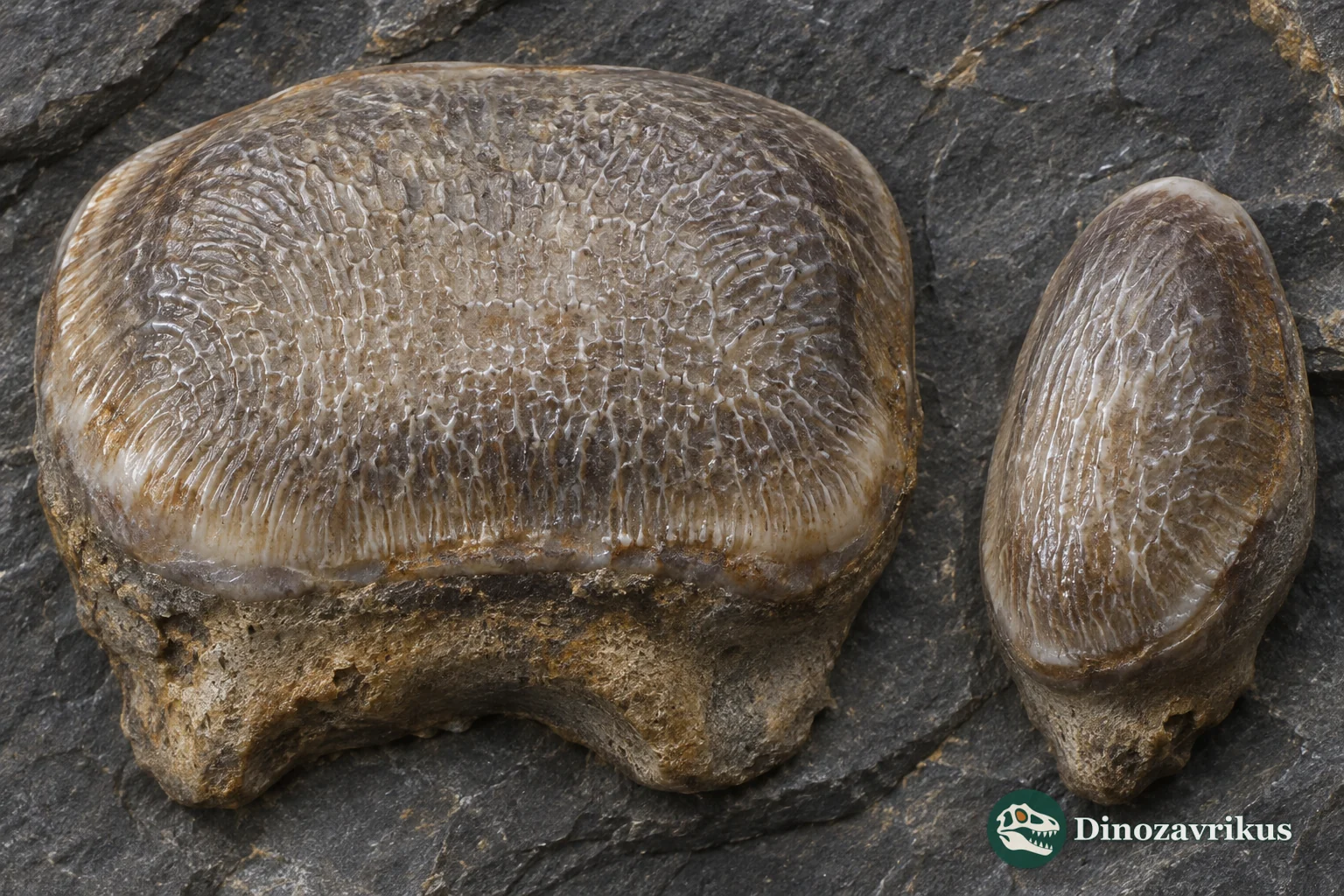
Strophodus was a hybodontiform cartilaginous fish. Its broad teeth carried sculptured crowns capable of crushing hard food. Some English fossils preserve these teeth in association with dorsal fin spines. That combination helped put two genera under the same name until a German skeleton revealed a different kind of jaw.
Quick facts
| Group | Hybodontiformes |
|---|---|
| Genus named by | Louis Agassiz, 1838 |
| Age of examples | Middle and Late Jurassic |
| Material | Teeth and associated fin spines |
| Likely feeding mode | Crushing hard prey |
| Body length | Uncertain from the material discussed |
What can the fossils tell us?
The shape of lateral teeth supports hard-prey crushing. The teeth alone do not identify the animals eaten.
Two museum lots preserve Strophodus teeth alongside tuberculate spines.
Asteracanthus had similar-looking spines and a grasping dentition with several cusps. The crushing dentition belonged to Strophodus.
Why the two names were merged
Louis Agassiz introduced Strophodus in 1838 for hybodonts with broad crushing teeth. He used Asteracanthus for fin spines covered in rounded tubercles. While the two kinds of fossil were known separately, their relationship remained open.
Arthur Smith Woodward combined the genera in 1889 after crushing teeth turned up with tuberculate fin spines in Callovian deposits at Fletton, England. The association was genuine. The mistake was treating resemblance between the spines as evidence that all of them came from the same genus.
What the teeth show
In the English species Strophodus reticulatus, folds branch over the upper surface of the crown and form a network along its sides. Two Natural History Museum lots, NHMUK PV P 6869 and NHMUK PV P 6870, preserve teeth with spines. Comparing the proportions and outlines of the latter helped distinguish them from spines belonging to Asteracanthus.
Position in the jaw matters when identifying an isolated tooth. Anterior crowns were comparatively short, while the lateral crowns were more elongated. A tooth can therefore look unlike another from the same mouth. Where position can be inferred, researchers can compare equivalent teeth before using crown outline and ornament to diagnose a species.
Strophodus also occurs in a historical collection from Upper Jurassic deposits in Poland. That collection includes hybodont teeth with several different crown shapes, recording animals with different dentitions in the same region. Scattered teeth do not directly reveal how many individuals were present because each fish shed and replaced teeth during its lifetime.
The skeleton that changed the interpretation
A Late Jurassic skeleton of Asteracanthus from Germany preserves tuberculate dorsal fin spines beside teeth with pointed central cusps and lower side cusps. This jaw was suited to gripping in a way that the low crushing crowns were not. Sebastian Stumpf and colleagues compared the German specimen with the English material and recognised Strophodus as a separate genus.
Older publications may still list crushing teeth under Asteracanthus. When comparing localities or compiling a species list, a figured crown and its specimen details reveal more than a historical name alone. The older label records the classification used at the time.
How much can a crushing tooth tell us?
Low, broad crowns offer surfaces that can bear pressure. A row of such crowns in opposing jaws could have fractured shells or other hard coverings. The examples discussed here do not preserve a meal, so they cannot establish which molluscs, crustaceans or other animals were actually taken.
Wear can also alter crown relief. Food contact can smooth a surface during life, while movement or abrasion after burial can change it further. Comparing repeated marks across equivalent teeth and checking other surfaces helps distinguish the possibilities.
Frequently asked questions
Was Strophodus a modern shark?
It was a hybodontiform, a member of an extinct branch of cartilaginous fishes.
What were the broad teeth for?
They could deliver pressure across hard food. The teeth do not establish the identity of the prey.
Where were teeth and spines found together?
Two examples come from Callovian deposits at Fletton in England.
How long was Strophodus?
The teeth and spines discussed here do not yield a reliable total body length.