

Suuwassea emilieae was a Late Jurassic sauropod from the northern exposures of the Morrison Formation. A small opening behind the parietals survives at the back of its skull. The feature resembles one in some other diplodocoids. Its shin bone also shows how a relatively small individual could already have reached an advanced stage of growth.
Quick facts
| Group | Sauropods (Diplodocoidea) |
|---|---|
| Age | Late Jurassic |
| Region | North America (southern Montana, United States) |
| Diet | Herbivore |
| Type species | Suuwassea emilieae |
| Holotype | ANS 21122 |
| Formation | Morrison Formation |
| Measured humerus length | 752 mm in the holotype |
What can the fossils tell us?
ANS 21122 preserves a nearly complete braincase. The opening behind the parietals resembles one in some dicraeosaurids. Its function is uncertain.
The cross-section of the tibia shows that growth slowed. The authors inferred that the individual was probably sexually mature and could still grow larger.
The rear tail vertebrae have much longer bodies in proportion to their width. The available series helps identify the group and leaves total tail length uncertain.
The skeleton from southern Montana
The bones were collected in Carbon County during the 1999 and 2000 field seasons. Jerald Harris and Peter Dodson named the species in 2004. The Crow word behind Suuwassea refers to the first thunder heard in spring. The species name honours Emilie deHellebranth, who supported the expeditions.
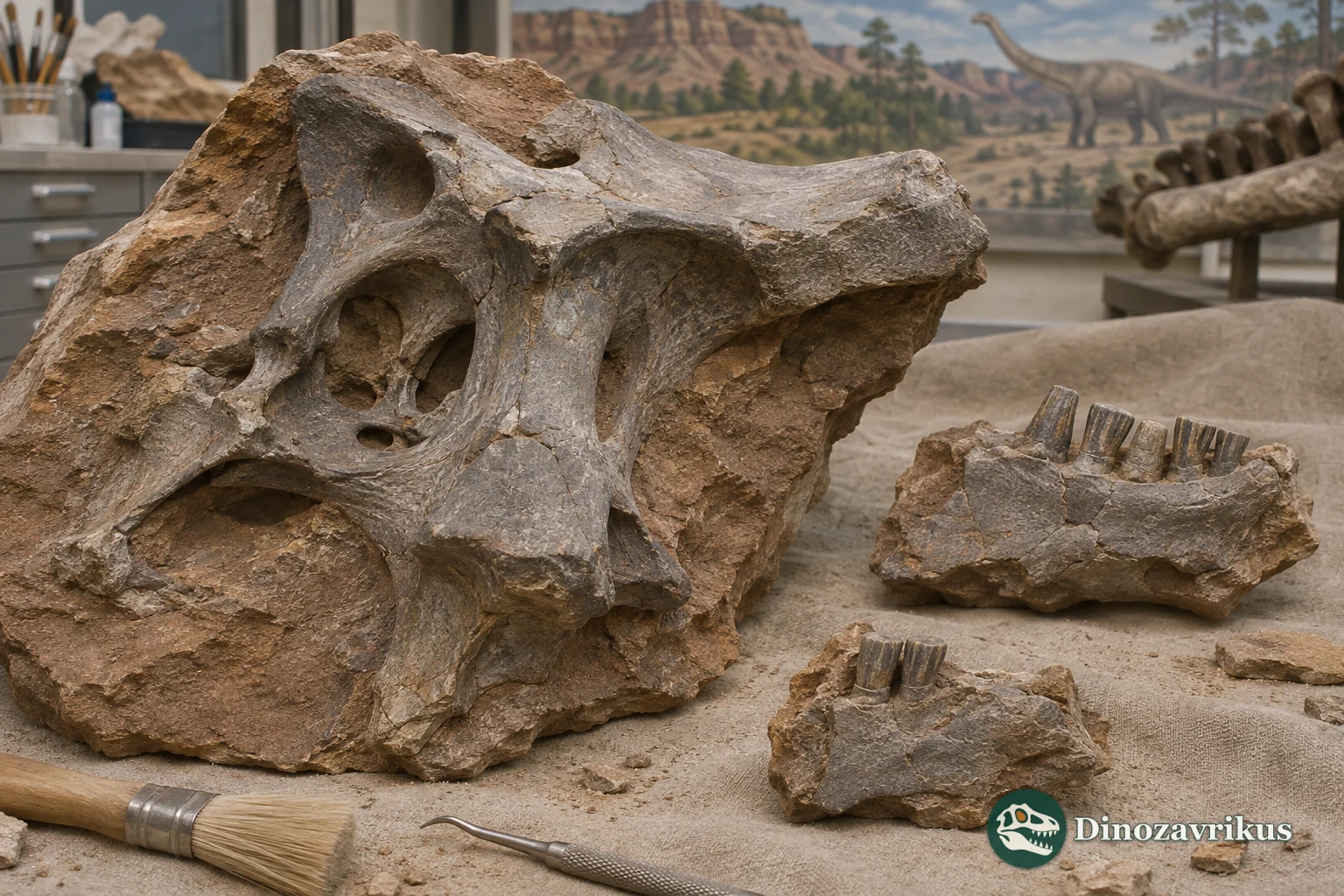
The Academy of Natural Sciences in Philadelphia holds the type specimen as ANS 21122. Jaw fragments with teeth, the braincase, neck, back and tail bones, the shoulder girdle and limb elements were found associated and mostly disarticulated. The original description regarded a Tithonian assignment as uncertain. The Late Jurassic placement is better established.
An opening in the skull and a whip-like tail
The opening at the rear of the skull lies behind the parietals. A similar feature occurs in Dicraeosaurus, although the rest of the skull shows differences. Alveoli in the maxilla contain several replacement tooth crowns. This demonstrates that teeth developed inside the bone before they erupted.
The bodies of the distal tail vertebrae are considerably more elongate than those near the base. The original study placed Suuwassea in Flagellicaudata, the diplodocoid group that includes dicraeosaurids and diplodocids. Many later analyses place it close to or within Dicraeosauridae. Its precise position depends on which anatomical characters are compared.
Interpreting the size of the type individual
The complete humerus measures 752 mm. To investigate the growth stage, researchers took a thin section through the tibia. They interpreted a change in the bone microstructure as a sign of probable sexual maturity and estimated that the individual had attained roughly 75–80 per cent of its maximum adult size.
The estimate describes one animal at the time it died. A growth curve and a complete adult body length cannot be established from that specimen alone. Its teeth and diplodocoid affinities point to a herbivorous diet, without evidence of the particular plants it ate.
Frequently asked questions
What does the name Suuwassea mean?
It draws on a Crow word for the first thunder heard in spring.
Where is the type skeleton kept?
At the Academy of Natural Sciences in Philadelphia, under catalogue number ANS 21122.
Was the type specimen a juvenile?
The tibia suggests the individual was probably sexually mature. There was still scope for further growth.
What places it among the diplodocoids?
Its skull, teeth and vertebrae show characteristic similarities. Strongly elongate vertebrae are preserved from the rear of the tail.