

Tagarosuchus kulemzini is an early crocodyliform known from a small skull discovered in western Siberia. A second skull from the same locality belongs to Kyasuchus. The two specimens help document the variety of small crocodyliforms in the region during the Early Cretaceous.
Quick facts
| Species | Tagarosuchus kulemzini |
|---|---|
| Age | Early Cretaceous, probably Aptian |
| Locality | Shestakovo 3, Kemerovo Oblast, Russia |
| Formation | Ilek Formation |
| Material | Incomplete skull |
| Skull length | About 6 cm |
What can the fossils tell us?
The regional museum gives dimensions of about 6 by 4.5 cm. The skull measures one part of the animal and provides no direct total length.
The Tagarosuchus skull was found in 1997. A skull with a lower jaw recovered the previous year became the type of Kyasuchus.
Early Cretaceous palynomorphs support an Aptian age for the formation. The estimate comes from the geological succession rather than the skull itself.
Two small skulls from a Siberian fossil site
The Tagarosuchus skull was found in 1997 at Shestakovo 3, in the valley of the Kiya River. Vladimir Alifanov, Mikhail Efimov, Igor Novikov and Michael Morales named the species in 1999. The genus name refers to the Tagar archaeological culture, and the species honours Anatoly Kulemzin.
Another small skull with a lower jaw was discovered at Shestakovo 3 in 1996. It was named Kyasuchus saevi and preserves features of the palate that belong to that animal. Other local crocodyliform fossils include isolated teeth, jaw fragments and bones from behind the skull.
What the skull records
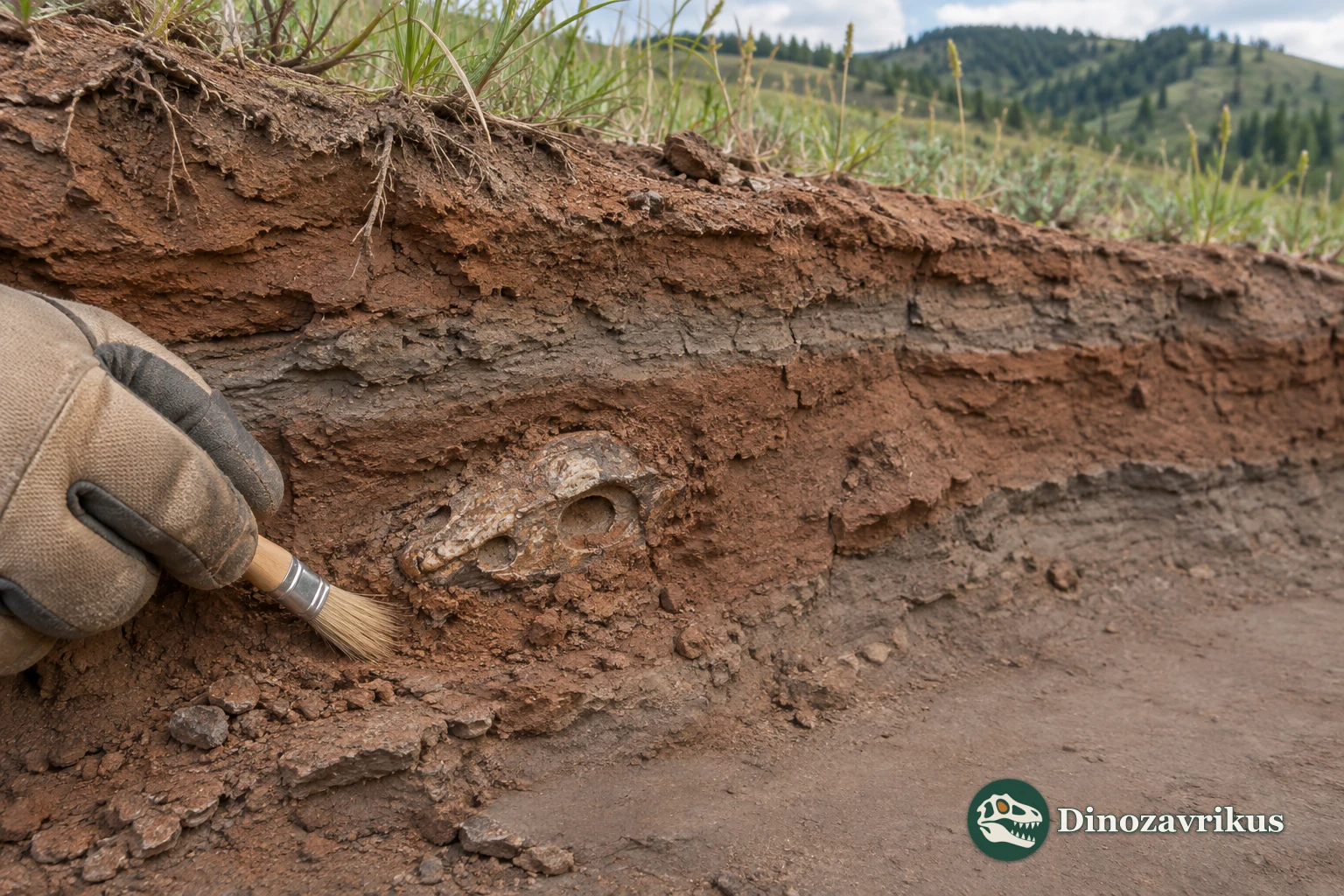
The Kuzbass regional museum gives the dimensions of the compact, broad skull as about 6 cm long by 4.5 cm wide. Its small pointed teeth are consistent with taking animal prey. They give little basis for deciding which prey it caught or whether it did most of its hunting on shore.
Tagarosuchus was assigned to Protosuchia, a traditional grouping of early crocodyliforms based on skull anatomy. Estimates of leg length and detailed reconstructions of its gait would require securely identified bones from the rest of the skeleton.
The Early Cretaceous deposits at Shestakovo
The Ilek Formation records continental sedimentation, including river and lake settings. Pollen and spores support an Aptian age, while older comparisons of vertebrate faunas allowed an interval extending into the Albian.
Turtles, lizards, mammals and dinosaurs also occur at the Shestakovo sites. The local fossils of Psittacosaurus show that small crocodyliforms were only one part of this diverse vertebrate assemblage.
Frequently asked questions
Where was Tagarosuchus found?
The known skull comes from Shestakovo 3 in the Kiya River valley of western Siberia.
How does the find differ from Kyasuchus?
Kyasuchus was named from a different skull and jaw discovered at the same locality a year earlier.
How big was Tagarosuchus?
The skull was about 6 cm long. Its overall length cannot be measured directly from the known material.
Who is commemorated in the species name?
The name kulemzini honours Anatoly Kulemzin.