

Tastavinsaurus sanzi was a long-necked dinosaur from what is now eastern Spain. The type specimen preserves much of the rear half of the skeleton, including the hips, hindlimbs and a sequence of tail vertebrae. A second fossil from Teruel shares a distinctive forked ridge at the top of the shin bone.
Quick facts
| Group | Sauropods (Sauropoda) |
|---|---|
| Age | Early Cretaceous, around the Barremian–Aptian boundary |
| Region | Europe (Aragon, Spain) |
| Diet | Herbivore |
| Type species | Tastavinsaurus sanzi |
| Holotype | MPZ 99/9 |
| Formations | Xert and Forcall |
| Hindlimb proportion | Tibia about 56% of femoral length in the holotype |
What can the fossils tell us?
The holotype preserves caudal vertebrae and chevrons, the bones that lay underneath them. The series allows comparisons along the tail.
A wide, shallow groove splits the lateral edge of the cnemial crest. The feature can be compared in the two described skeletons.
The type fossil comes from the lower Xert Formation. The second skeleton comes from the Forcall Formation. Ammonites help correlate the strata across the basin.
Two skeletons from Teruel
The type specimen, MPZ 99/9, was recovered in 1996–1997 at Arsis-1, near Peñarroya de Tastavins. The partly articulated skeleton includes dorsal vertebrae, ribs, a sacrum, 25 tail vertebrae, the pelvis and hindlimb bones. José Ignacio Canudo, Rafael Royo-Torres and Gloria Cuenca-Bescós described the species in 2008. The genus name draws on the locality and the species name honours palaeontologist José Luis Sanz.
A team from the Dinópolis foundation excavated a second partial skeleton in 2004 at La Canaleta, close to El Castellar. Shared details of the pelvis and lower leg supported its referral to Tastavinsaurus. The original description dated the type site to the early Aptian. Subsequent ammonite work supports a latest Barremian age for the lower Xert Formation, and the Forcall Formation is dated to the early Aptian.
A short tibia with a forked ridge
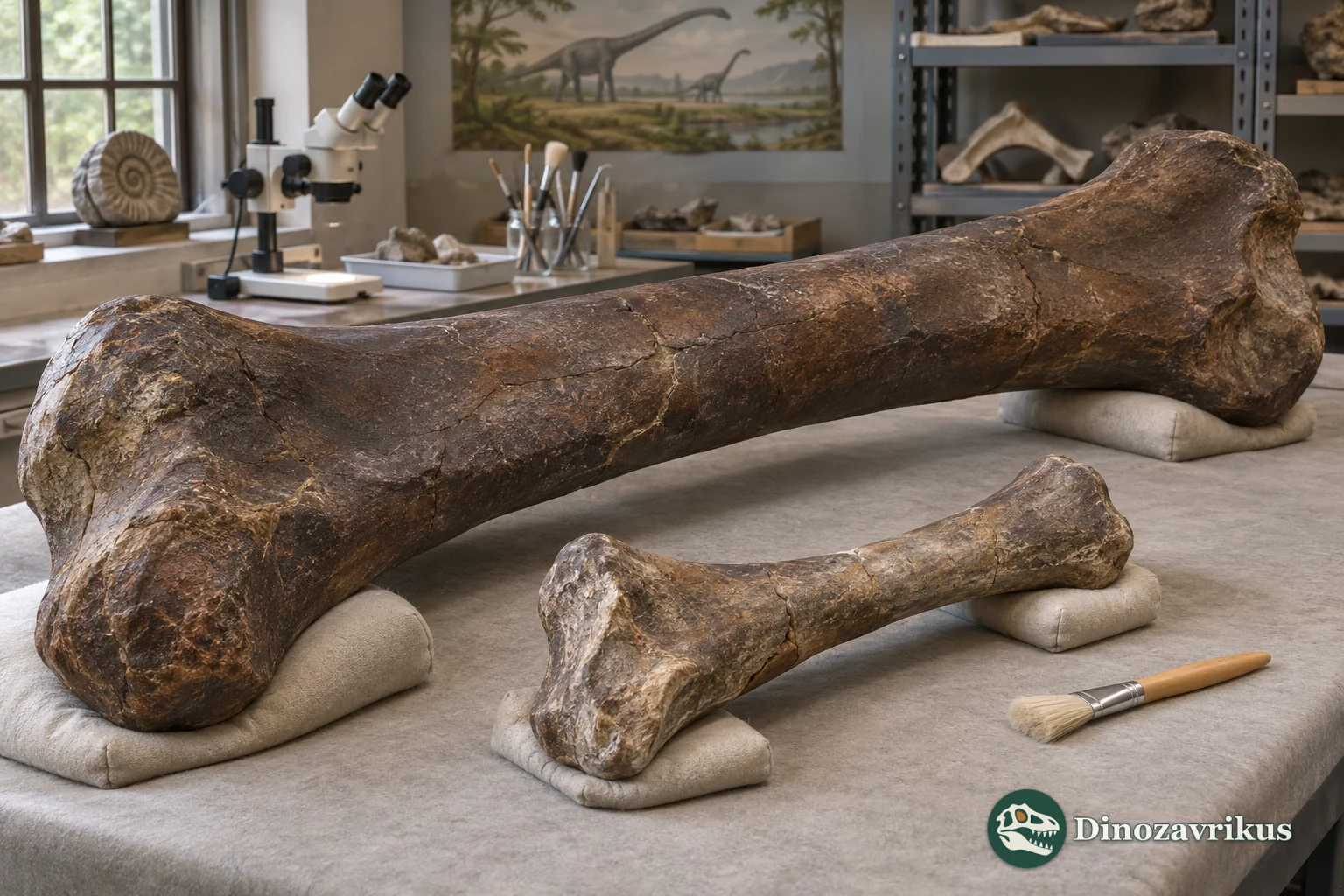
In the holotype, the tibia measures about 56 per cent of the length of the femur. The cnemial crest at its upper end forms part of the knee extensor apparatus. Along its lateral edge, the crest divides into two thin ridges. The shape of the pelvis and fibula provides further clues to identifying the species.
Several analyses place Tastavinsaurus close to the early branches of Titanosauriformes. The study of the second skeleton placed it in Laurasiformes, a group whose membership and position vary across later studies. Another Early Cretaceous sauropod, Aragosaurus, comes from the same Spanish province.
Burial near the sea
Marine invertebrates were found with the Arsis-1 skeleton. Their presence indicates marine influence at the site of burial. It leaves open how much of the surrounding landscape the animal used. The bones support a reconstruction of the hindquarters, while the head is inferred from relatives because the skull is unknown. Sauropod affinities support a plant diet, with no specific food identified.

Frequently asked questions
Where was Tastavinsaurus found?
The two described skeletons come from Teruel in eastern Spain, near Peñarroya de Tastavins and El Castellar.
Why is the shin bone distinctive?
It is about 56 per cent as long as the femur in the type specimen. The lateral edge of its crest splits into two narrow ridges.
Has a skull been found?
No skull has been described. The head in a life reconstruction is based on related sauropods.
Who was the species named for?
The name sanzi honours Spanish palaeontologist José Luis Sanz.