

Tatenectes laramiensis was a small plesiosaur from the Late Jurassic Sundance Sea of what is now Wyoming. Its skeleton is notable for flattened, nearly horizontal ribs and thickened gastralia along the belly. The original material described in 1900 was later lost or unregistered, so a neotype and additional specimens now anchor the species account.
Quick facts
| Type species | Tatenectes laramiensis |
|---|---|
| Age | Late Jurassic, Oxfordian |
| Locality | Near Shell, Wyoming, United States |
| Formation | Sundance Formation, upper Redwater interval |
| Key specimen | USNM 536976, with articulated vertebrae, pelvis, ribs and gastralia |
| Estimated length | Under 3 m in a 2011 reconstruction; neck proportions are uncertain |
Evidence guide
Knight's original material was later lost or remained unregistered in a way that prevents re-examination. A neotype and additional material were used to clarify the application of the name.
USNM 536976 preserves 22 articulated vertebrae, pelvis, ribs and gastralia. The ribs are flattened and nearly horizontal, while the midline gastralia are thickened; the soft-tissue profile remains unknown.
Histology found local pachyostotic thickening and osteoporotic bands in gastralia. This does not show that every bone in the skeleton was uniformly dense or heavy.
The broad, low body and rib arrangement led authors to discuss possible stability in shallow water. Fossils do not directly record swimming depth, speed or habitat use.
A lost type and a replacement reference specimen
William Knight named the species in 1900 from incomplete, disarticulated material collected in Wyoming. The original specimen included axial bones and part of a forelimb, but it was later lost or could not be located as a registered museum specimen. That history made it difficult for later researchers to check the anatomical basis of the name against the original bones.
A later redescription designated a neotype and examined additional fossils, including USNM 536976. The latter was excavated in 2006 near Shell, Wyoming, in the upper part of the Sundance Formation, within the informal Redwater Shale interval. The Oxfordian age comes from stratigraphic context. A neotype gives researchers a reference for the name; it does not recreate the missing original specimen.
Ribs and gastralia broaden the trunk
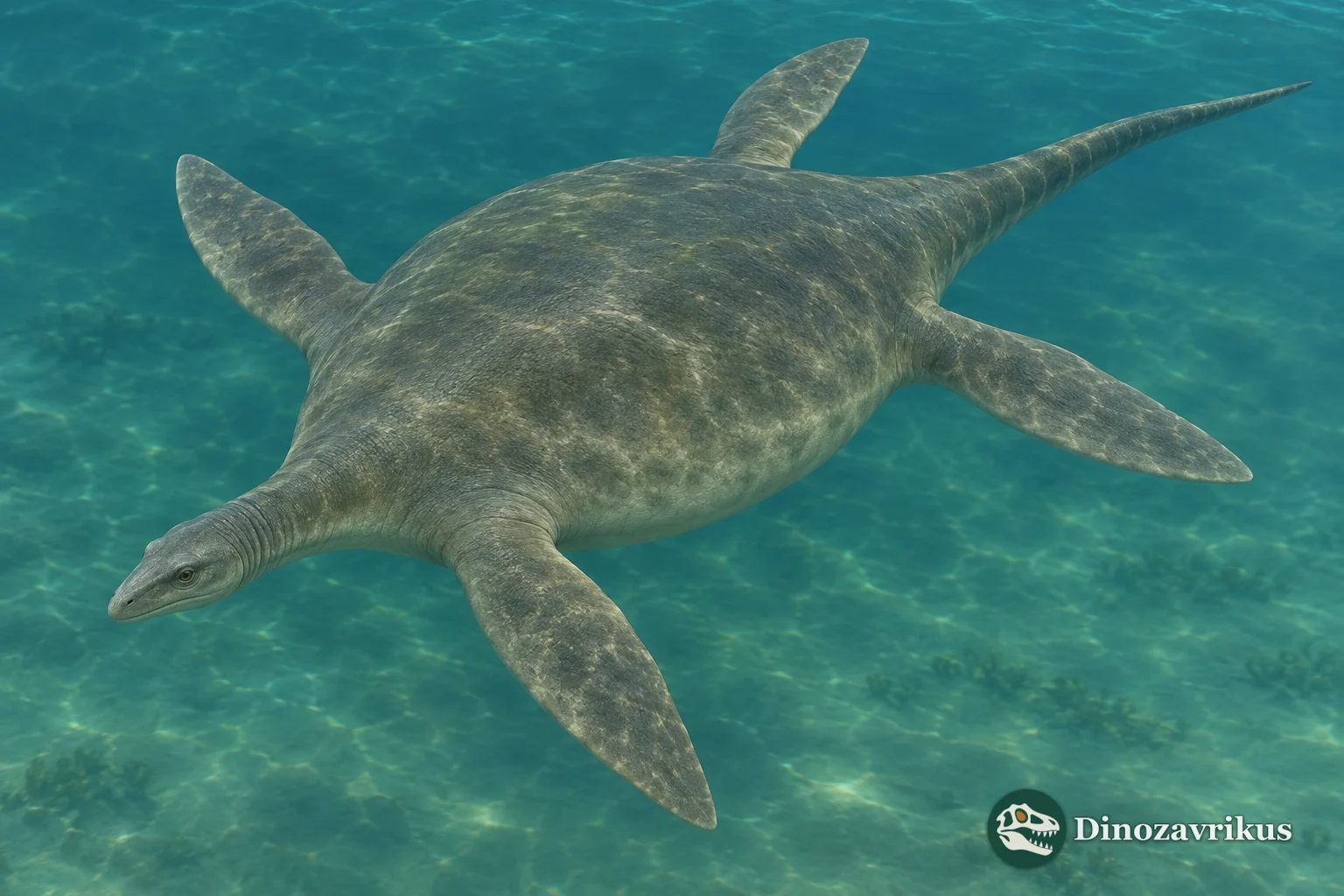
USNM 536976 preserves 22 articulated vertebrae: 16 dorsal, four sacral and two caudal. The specimen also includes the pelvis, ribs and gastralia, the rod-like bones that formed part of the ventral body wall. The ribs are strongly flattened and extend nearly horizontally from the vertebral column, giving the torso a wider skeletal outline than in many other plesiosaurs.
The midline gastralia are thickened. A histological study later found pachyostosis in these elements, alongside porous or osteoporotic bands in the internal tissue. Pachyostosis means local thickening of bone; it is not synonymous with osteosclerosis, and neither observation shows that the entire skeleton was uniformly dense.
A reconstruction under three metres
The 2011 revision described Tatenectes as small and reconstructed a total body length under three metres. That number is approximate, not a measurement of a complete articulated skeleton. The number of cervical vertebrae and the full length of the neck are uncertain, so the estimated body proportions depend on reconstruction choices.
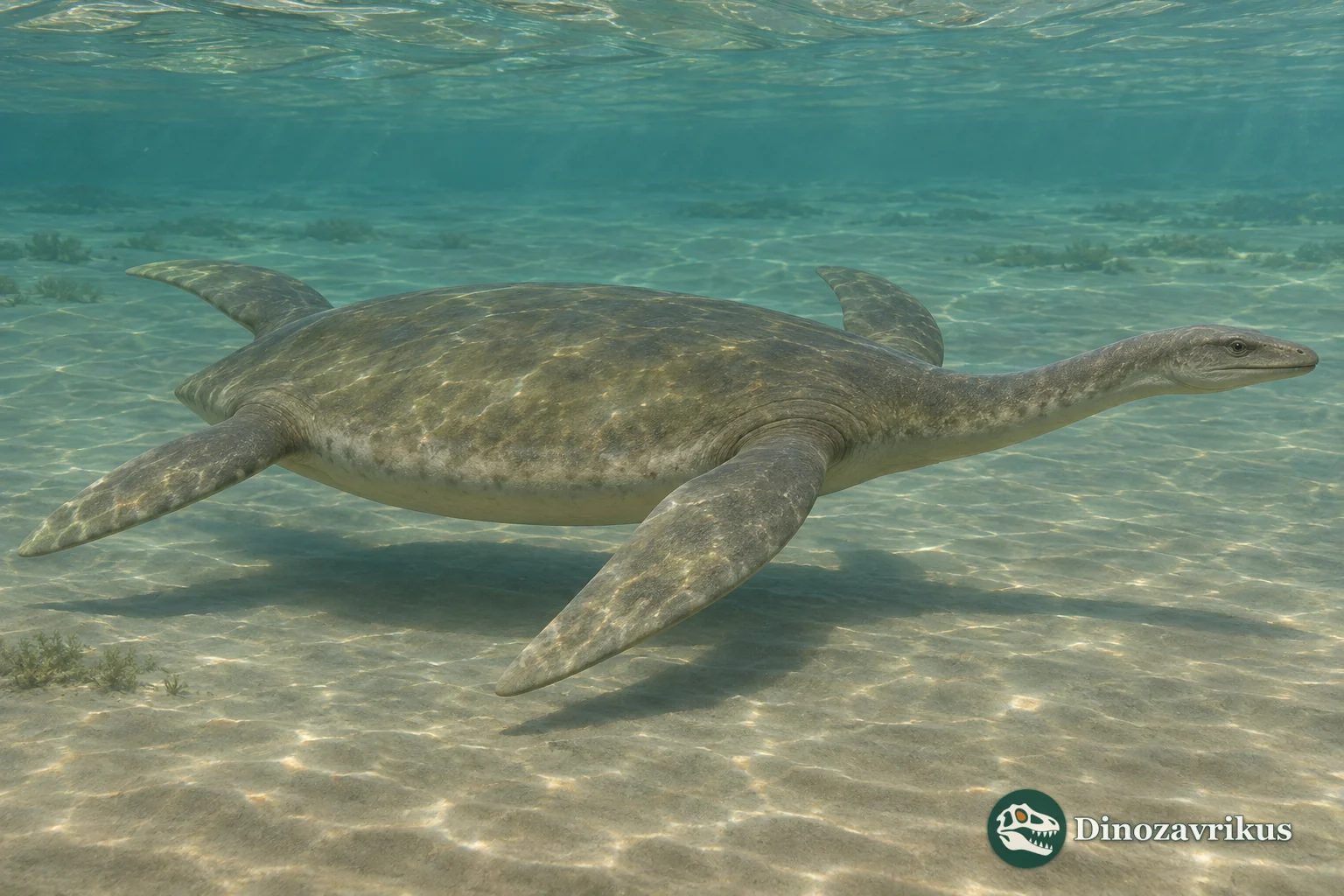
A broad torso could have influenced buoyancy or stability in water. The authors discussed whether its form might be useful in shallow coastal settings, but that is a functional hypothesis. The skeleton records bone geometry; it does not preserve a water-depth preference or a particular swimming technique.
Bone histology and the limits of functional claims
Histological sections show that different regions of the gastralia did not have identical internal structure. Thickened outer regions and porous bands caution against turning a single anatomical label into a simple claim that Tatenectes carried unusually heavy bones throughout its body. Bone density, bone thickness and body shape are related research questions, but they are not interchangeable measurements.
The skeleton supports a broad, low trunk with four plesiosaurian paddles. It cannot supply skin, colour or the exact contour of muscle and other soft tissue. The illustration here is an informed reconstruction of the body plan, not a photograph and not a scaled diagram.
The Sundance Sea and plesiosaur relationships
The Sundance Formation records a marine setting during the Jurassic. The fossils place Tatenectes within that marine sequence, while the suggestion of a nearshore or shallow-water niche depends on anatomical interpretation and the local geology together. It should not be stated as a directly observed habitat.
Researchers have discussed Tatenectes among cryptocleidoid plesiosaurs, but exact family-level and closest-relative assignments vary with the taxonomic sample and character analysis. Recognising the genus is a separate question from resolving every branch of its phylogeny. Compared with other plesiosaurs and pliosaurs, Tatenectes stands out for its axial skeleton rather than a completely preserved skull or a known full body outline.
Frequently asked questions
Why does Tatenectes have a neotype?
The material on which Knight based the 1900 name was later lost or could not be located for study. A neotype was designated to anchor the name to accessible, described fossils.
What is unusual about its skeleton?
Its described material includes flattened, nearly horizontal ribs and thickened gastralia, producing a broad skeletal outline.
Were its bones uniformly dense?
No such conclusion follows from the evidence. Histology found thickening in some gastralia as well as porous bands, and those observations should not be generalized to every bone.
How long was Tatenectes?
The 2011 paper reconstructed it at under 3 m, but that is an estimate because the full neck proportions and a complete skeleton are not known.