

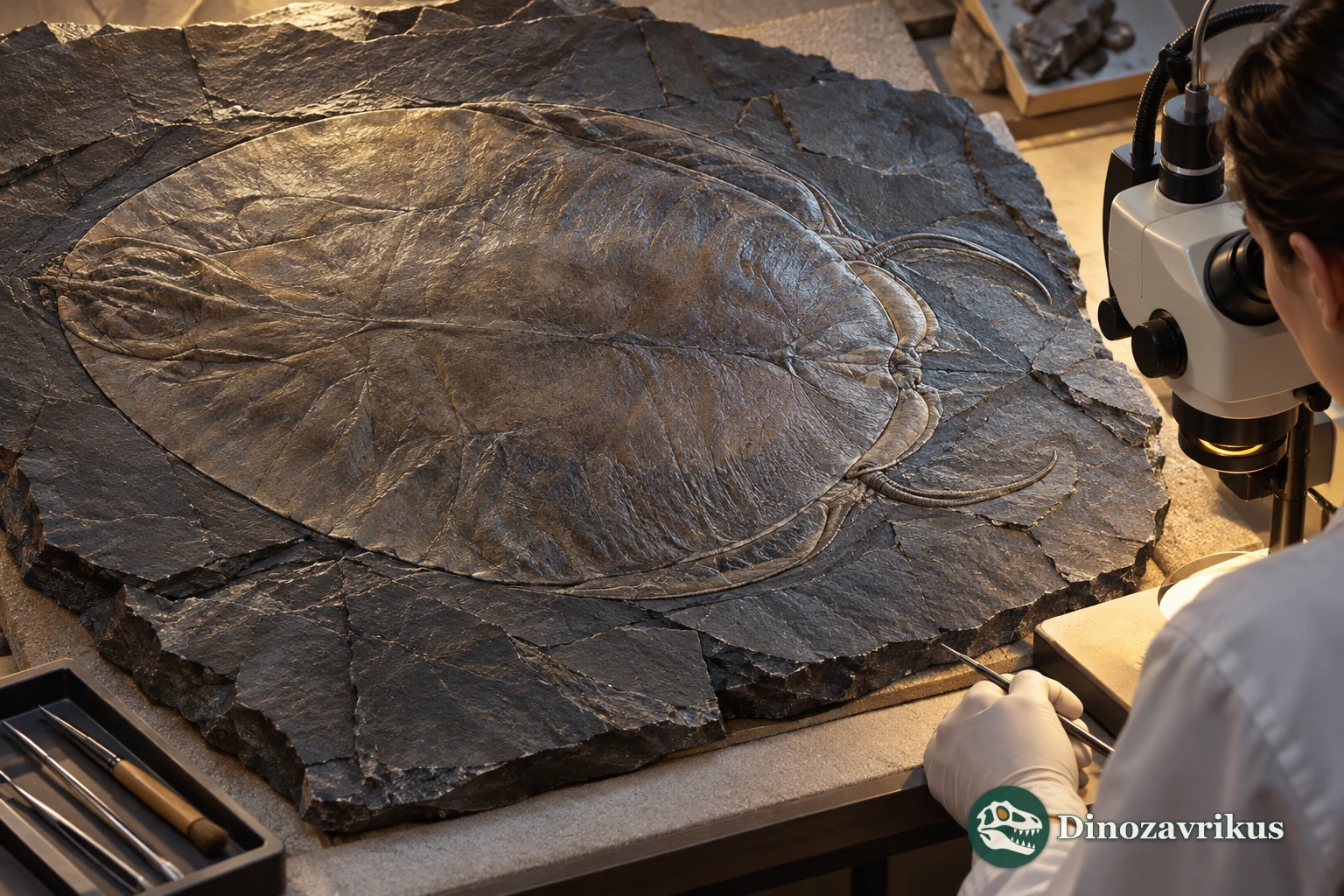
Tegopelte gigas was a large but exceptionally rare arthropod in the Middle Cambrian Burgess Shale of British Columbia. Its two described specimens measure 25.7 and 27.0 centimetres. A broad, smooth dorsal shield covered much of the body, with numerous limbs preserved beneath it.
The fossil record is also a lesson in reading flattened fossils. Early descriptions treated transverse marks as divisions between body segments. Later work interpreted some marks as folds made when the shield was compressed in sediment. The animal belongs in the Cambrian animal catalogue.
Quick facts
| Scientific name | Tegopelte gigas Simonetta & Delle Cave, 1975 |
|---|---|
| Group | Arthropoda; relationships among trilobite-like forms remain debated |
| Age | Middle Cambrian; about 505 million years ago in the Burgess Shale account |
| Locality | Walcott Quarry, Fossil Ridge, British Columbia |
| Known specimens | Two: holotype USNM 189201 and paratype USNM 189200 |
| Length | 25.7 and 27.0 cm in the two described fossils |
| Diet | Unknown |
What can the fossils tell us?
Re-examination argued that folds across the broad dorsal covering formed as the animal was flattened. They should not automatically be read as boundaries between separate tergites.
Descriptions report paired antennae and roughly 33 pairs of appendages with walking and filamentous branches. The exact sequence is reconstructed from both specimens.
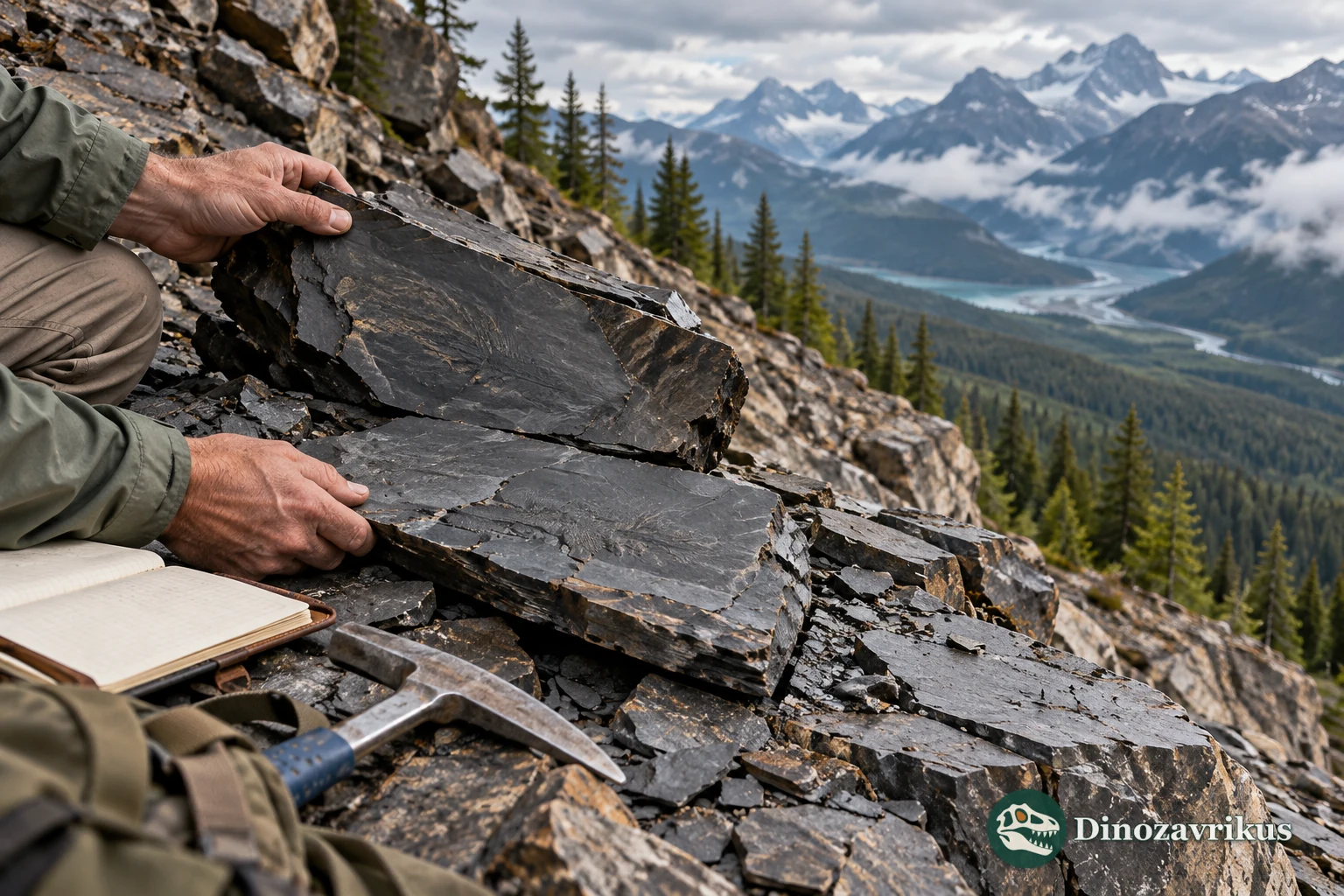
Both known specimens come from Walcott Quarry. They show a large animal, but cannot establish a population-wide size range, diet or behaviour.
Two large fossils from Walcott Quarry
Alberto Mario Simonetta and Laura Delle Cave named Tegopelte in 1975 from two unusually large specimens. The holotype, USNM 189201, is held by the Smithsonian National Museum of Natural History; USNM 189200 is the paratype. Both came from Walcott Quarry on Fossil Ridge. The museum record does not identify a specific collector for the original discovery.
Harry Whittington re-examined the animal in 1985. In 1996, Lars Ramsköld, Jun-yuan Chen, Gregory Edgecombe and Gui-qing Zhou revisited the supposed segment boundaries and showed why compression can create folds that resemble anatomical seams.
A shield that may not be divided into plates
The dorsal surface is an elongated oval covering without secure evidence for a row of separate plates. A pair of jointed antennae projects at the front. Beneath the shield are numerous biramous appendages: inner branches form segmented walking limbs, while outer branches carry thin blades along a central axis.
The first reconstruction proposed repeated body units with their own limb groups. Later workers argued that several visible lines could be folds in a continuous shield, not tergite boundaries. The folds are real; interpreting them as segment seams is the uncertain step.
Length, movement and unknown diet
The two fossils measure about 25.7 and 27.0 centimetres, making Tegopelte one of the larger Burgess Shale arthropods. Those lengths do not yield a dependable mass: the soft-bodied animal is preserved as a flattened film with no intact volume to weigh or scale from. Two individuals cannot define the full adult size range.
Many jointed limbs support an interpretation of movement along the sea floor. Filamentous outer branches may have assisted gas exchange and might have helped the animal move through water. These are anatomical inferences, not observations of living behaviour. Its diet remains unknown; large size alone does not make it a predator.
The cover is an artistic reconstruction. The shield, antennae, limbs and approximate length follow fossil descriptions; colour and posture are illustrative choices.
Frequently asked questions
When did Tegopelte live?
It lived in the Middle Cambrian. Both known specimens came from the Burgess Shale at Walcott Quarry in British Columbia, dated to about 505 million years ago in the museum account.
How many fossils are known?
Two specimens are described: holotype USNM 189201 and paratype USNM 189200, both held by the Smithsonian National Museum of Natural History.
Was its back divided into segments?
Some transverse marks were once interpreted as boundaries. A later study argued that at least some are folds produced as the broad shield was flattened.
What did Tegopelte eat?
Its diet is unknown. The available fossils do not preserve a specialised feeding structure that identifies a particular food source.