

Teleidosaurus calvadosii lived in Middle Jurassic seas. Nearly a century and a half after the first description, a new fossil from Normandy allowed researchers to revisit its skull anatomy. The specimen includes parts of the cranium, a lower jaw and a neck vertebra. Details of the skull link the genus to the marine metriorhynchoids.
Quick facts
| Species | Teleidosaurus calvadosii |
|---|---|
| Group | Metriorhynchoidea, Thalattosuchia |
| Age | Middle Jurassic, Bathonian for the neotype |
| Neotype locality | Écouché, Normandy, France |
| Neotype | MPV 2010.3.45, partial skull, lower jaw and cervical vertebra |
| Collection | Paléospace, Villers-sur-Mer |
What can the fossils tell us?
The first specimen was destroyed in 1944. MPV 2010.3.45 was designated as the neotype after comparison with descriptions and surviving casts.
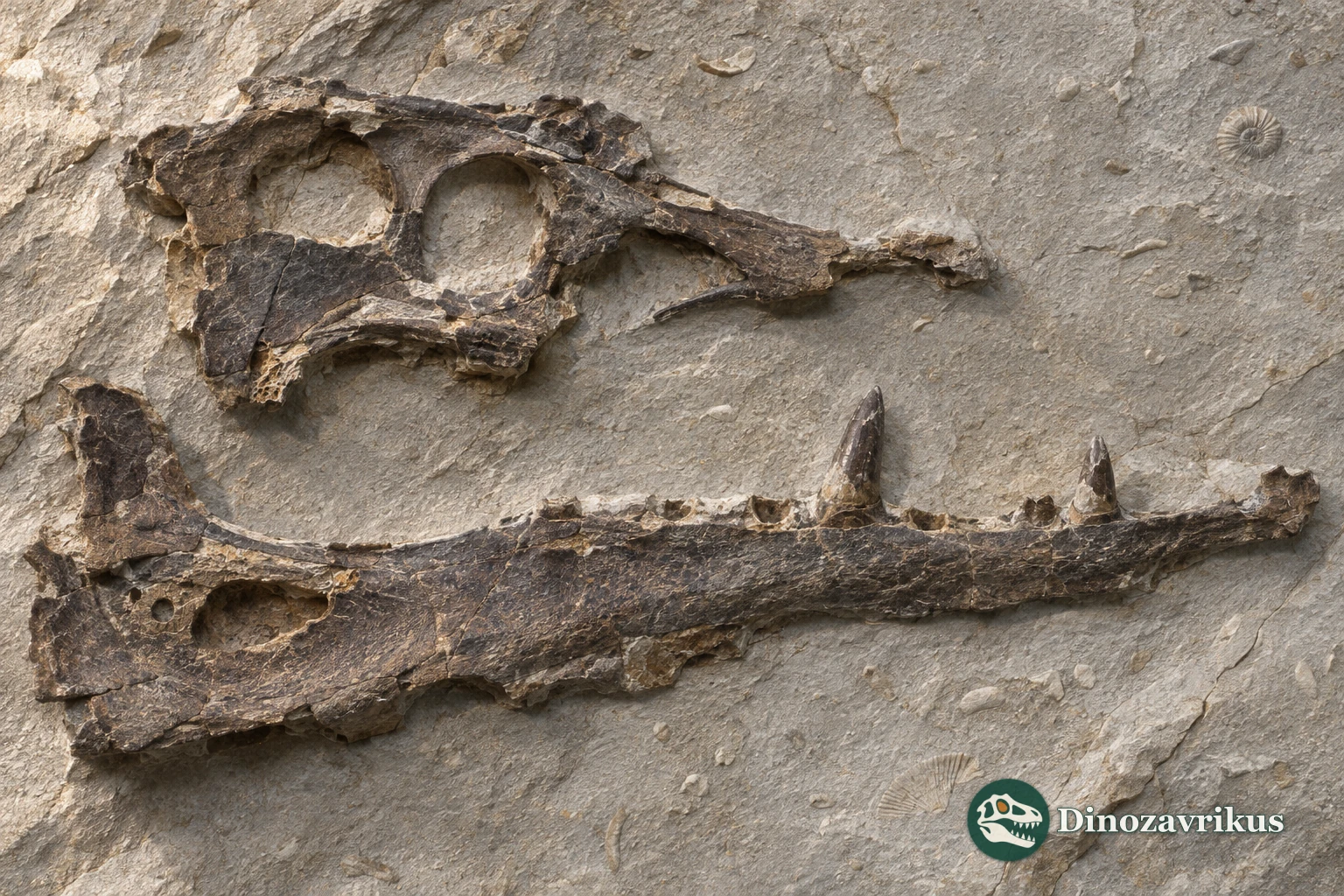
The neotype preserves outlines in the antorbital region that can be compared with those in other metriorhynchoids.
An opening remains in its outer wall. The joint lies near the level of the tooth row. These features help distinguish this early branch from more specialised marine forms.
A lost skull and an Écouché fossil
Jacques Amand Eudes-Deslongchamps described the species in 1866 as Teleosaurus calvadosii. Eugène Eudes-Deslongchamps established the name Teleidosaurus in 1869. The original specimen, from the Caen area, was destroyed in 1944. Nineteenth-century descriptions, illustrations and casts survived.
A separate fossil came from Bathonian rocks at Écouché. The specimen, MPV 2010.3.45, is held by Paléospace in Villers-sur-Mer. Stéphane Hua described it in 2020 and designated it as the neotype, the replacement specimen that anchors the species name.
What the new material preserves
The antorbital opening of MPV 2010.3.45 is associated with a depression extending towards the snout. Its contours were difficult to judge from casts of the lost specimen. The skull also preserves a broad frontal and evidence of sideways-facing orbits.
The lower jaw retains an opening in its outer wall, and its joint lies near the level of the tooth row. In many later metriorhynchids the opening is closed and the joint sits at a different level from the teeth. This combination of skull and jaw characters helps distinguish Teleidosaurus from more specialised forms.
What the fossils tell us about marine life
Teleidosaurus belongs among the early branches of Metriorhynchoidea. Another member of the group, Pelagosaurus, lived earlier and is known from more complete skeletons. Comparing such forms helps trace changes in the skull before later crocodylomorphs became highly specialised for life at sea.
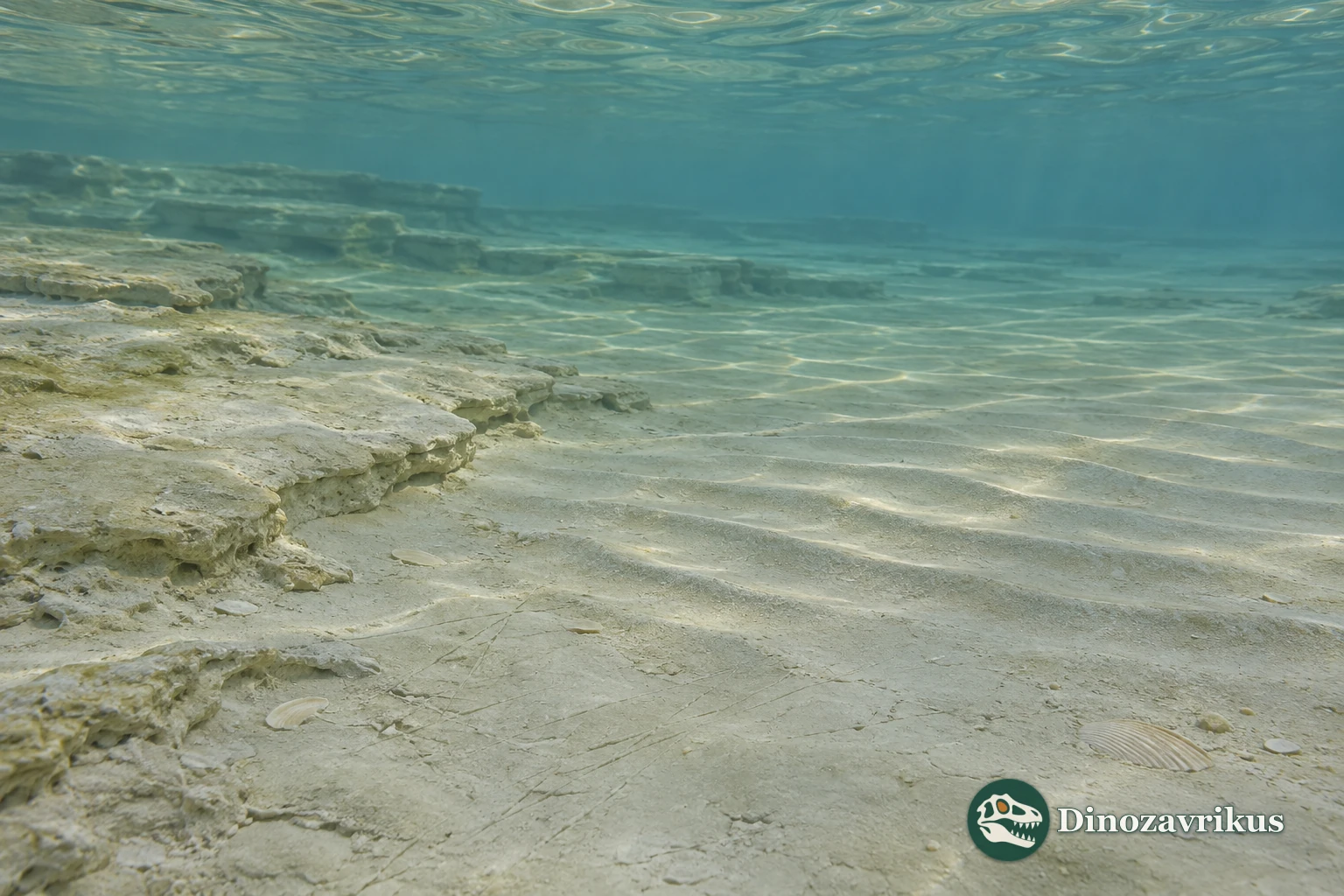
The rocks of Normandy preserve a marine setting. The neck vertebra provides little information on overall body proportions. The shape of the limbs and tail remains uncertain because the corresponding bones are unknown.
Frequently asked questions
Why was a neotype designated?
The original type was lost in 1944. MPV 2010.3.45 provides a replacement specimen against which new finds can be compared.
Where is the Écouché fossil held?
It is held at Paléospace in Villers-sur-Mer, France.
Which feature did the neotype clarify?
It preserves the opening in front of the eye socket and its elongate depression towards the snout.
Can scientists reconstruct the tail?
The neotype includes a neck vertebra, but no tail remains are available to establish its shape.