

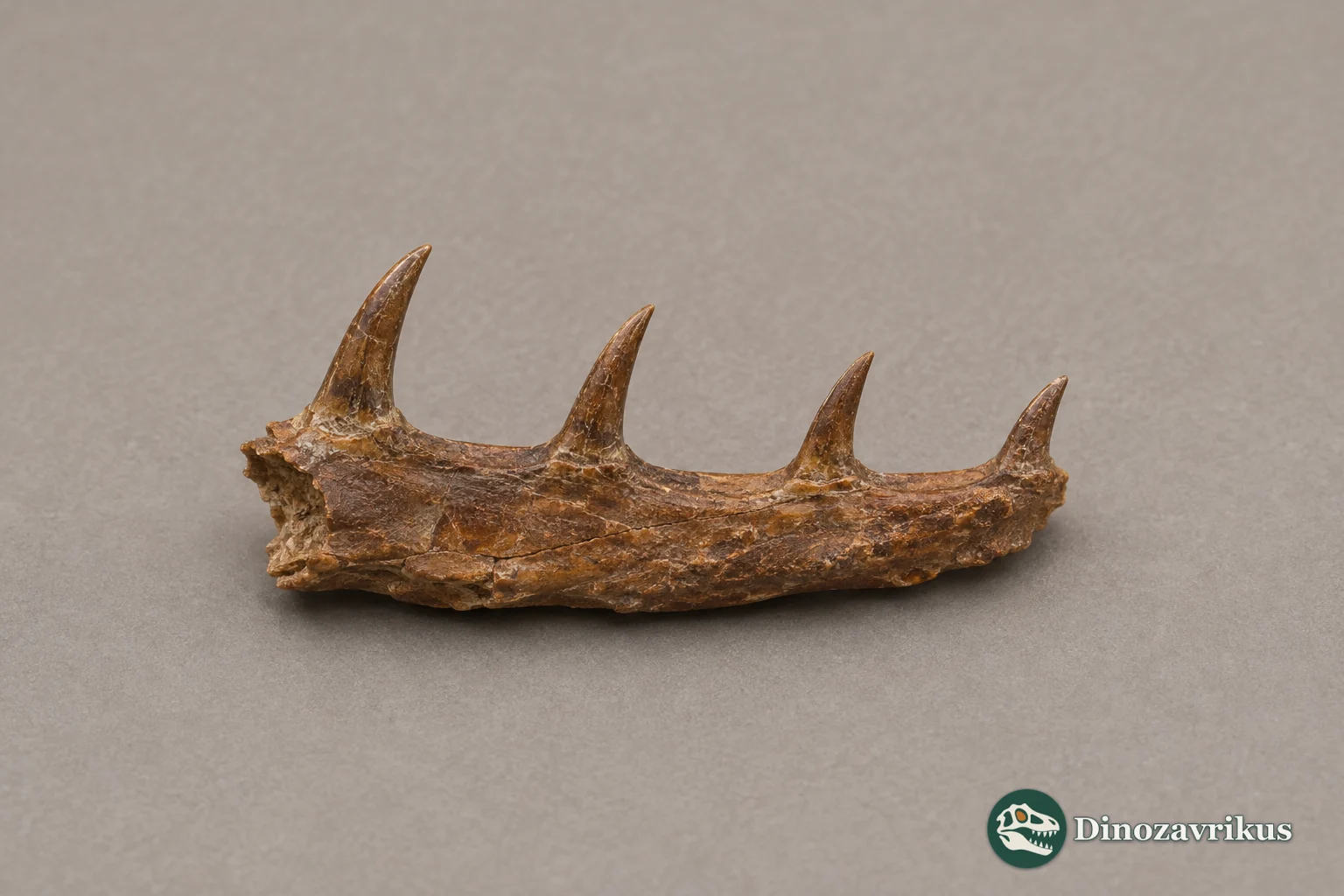
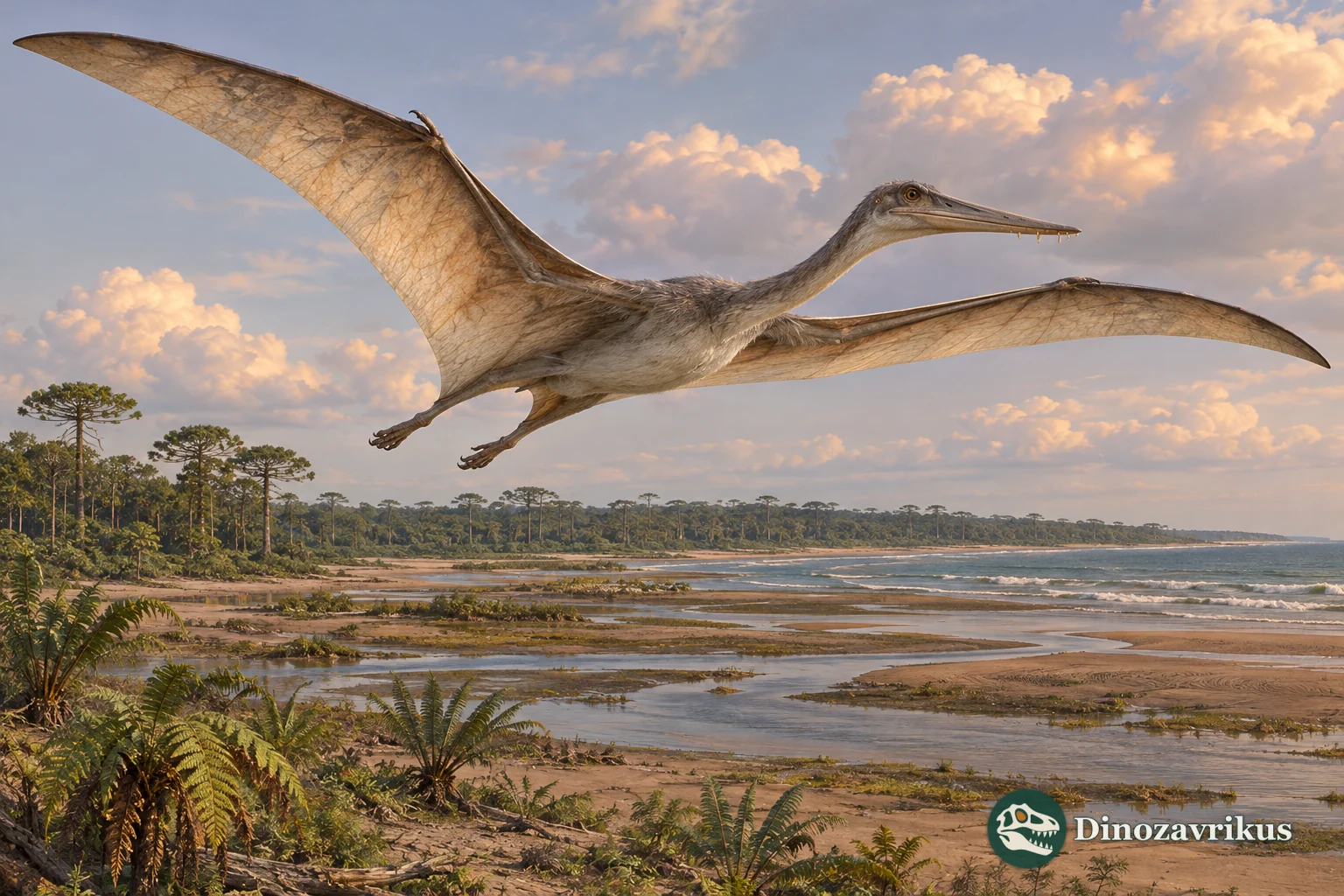
Tendaguripterus recki rests on a 25.9 mm preserved section of lower jaw with teeth from the Late Jurassic Tendaguru Beds of Tanzania. Jaw shape and tooth spacing distinguish the fossil, while the wings, body and most of the skull are unknown. The cover's complete pterosaur is a cautious visual hypothesis, not a portrait recovered from the specimen.
Quick facts
| Named species | Tendaguripterus recki, Unwin and Heinrich, 1999 |
|---|---|
| Holotype | MB.R.1290, incomplete lower-jaw symphysis |
| Repository | Museum für Naturkunde, Berlin |
| Locality | Excavation site Jg (Wj), Tendaguru, Tanzania |
| Rock unit | Middle Saurian Beds; exact stratigraphic position unknown |
| Age | Late Jurassic, Kimmeridgian–Tithonian |
| Preserved measurement | 25.9 mm of the lower jaw |
| Complete wingspan | Not measured; about 1 m was inferred by comparison |
What can the fossils tell us?
MB.R.1290 is 25.9 mm long as preserved and lacks its front tip. The figure measures a fragment, not the whole snout or animal.
The pointed unserrated teeth become larger backwards and are widely spaced. No prey remains or stomach contents establish a particular diet.
The fossil came from site Jg (Wj) in the Middle Saurian Beds, dated broadly to the Kimmeridgian–Tithonian. Its exact level within them was not recorded.
No wing bone belongs to the holotype. The original estimate of about a one-metre span assumes proportions like Germanodactylus and remains conditional.
A prepared jaw from a historic quarry
David Unwin and Wolf-Dieter Heinrich named Tendaguripterus recki in 1999. The genus refers to Tendaguru and the Greek word for wing; the species honours Hans Reck, who had studied pterosaur bones from the area. The holotype MB.R.1290 is in Berlin's Museum für Naturkunde. It came from excavation site Jg (Wj), worked by German expeditions between 1910 and 1912. The paper identifies the Middle Saurian Beds as its source but states that its precise position within them is unknown.
Heinrich recognized the small jaw in a collected block during later microvertebrate preparation. After an initial identification, preparators used acid to release the bone from its matrix and mechanical work to remove remaining sediment. This sequence matters: the museum recognition and preparation are separate events from the original field excavation.
The 25.9 mm that can be measured
The preserved piece is the rear portion of the symphysis where the lower jaws meet. It has been somewhat compressed and lacks its front end. The teeth are pointed, lack serrations and grow larger toward the rear. Their gaps are conspicuous, and the back of the lower jaw has a deeply concave underside. The original authors used this combination to distinguish the taxon and placed it among pterodactyloids.
Their narrower dsungaripteroid assignment relied on comparative jaw features. It does not establish the missing skull or wings. The authors compared the jaw with Germanodactylus and, assuming broadly similar proportions, suggested a skull shorter than 200 mm and wingspan approaching 1,000 mm. Both are estimates by analogy. The directly measured fossil is the 25.9 mm jaw section, and even the full length of its own symphysis is unknown.
What Tendaguru tells us
The paper places the jaw in a broad Kimmeridgian–Tithonian interval. Sedimentological work on the Tendaguru Beds describes alternating lagoons, tidal flats and low coastal plains in a marginal-marine landscape. This makes a coastal illustration plausible but does not show that this individual fished or crossed a particular channel.
Unwin and Heinrich also reviewed older pterosaur names from Tendaguru and regarded several based on isolated limb bones as doubtful. One had been called a local Rhamphorhynchus. Those fossils are different finds, not alternative names for the diagnostic jaw of Tendaguripterus. Proximity in the same formation cannot join isolated bones into a single individual.
Why a whole-animal scene is uncertain
The jaw illustration is an interpretive model, not a photograph or exact copy of MB.R.1290. The flight scene borrows general pterodactyloid anatomy. Nothing in the named fragment directly fixes wing shape, head crest, body mass, colour or prey. Its visible teeth support a toothed jaw, but not a precise feeding strategy.
Frequently asked questions
What fossil names Tendaguripterus?
The holotype MB.R.1290 is a preserved 25.9 mm section of lower-jaw symphysis bearing teeth.
Where was it found?
It came from site Jg (Wj) in the Middle Saurian Beds of Tendaguru, Tanzania; its precise bed is unknown.
Do we know its wingspan?
No wing bone was found with the jaw. The original estimate of around one metre depends on comparison with Germanodactylus.
What distinguishes its teeth?
The unserrated pointed teeth become larger toward the back of the preserved jaw and stand relatively far apart.