

A computer model can estimate how loads are distributed across a skull or bone, which poses a limb might support, or how a result changes when a muscle reconstruction is altered. But a vivid stress map is not a direct observation of an extinct animal’s behaviour. To judge a model, follow its route from fossil to conclusion.
Start with the question the model can answer
“Biomechanical model” covers several methods. Finite element analysis calculates deformation and stress in a structure under specified loads and constraints. Musculoskeletal models estimate the forces muscles and joints can produce in a chosen pose. Hydrodynamic models estimate how a body interacts with water or air. A result from one method cannot automatically be transferred to another.
A useful study asks a focused question, such as whether two jaw shapes differ in their relative resistance under the same specified loading scenario. If the target, measured output and conditions are unclear, a polished visualisation tells the reader little. Fossil geometry and muscle reconstruction also involve assumptions; the guide to reconstructing dinosaurs from evidence explains how observations and restorations are distinguished.
Check how the digital anatomy was built
Input geometry may come from computed tomography of a bone or skeleton, a surface scan, or a reconstruction based on several fragments. Look for which parts are preserved, which were mirrored or restored from relatives, and how bone was separated from surrounding rock. Mineral-filled cavities, damage and fossil deformation can all change the digital shape.
The digital structure is then divided into many elements – a finite mesh. A paper should describe its resolution and whether the result remains stable when the mesh is refined. If a key output changes substantially as the mesh gets finer, numerical convergence has not been established. A denser mesh alone cannot make an uncertain reconstruction more accurate.
Researchers assign material properties, apply loads and constrain motion. For fossils, some values are unknown: soft tissues are gone, and burial may have altered bone. Look for why parameters were chosen and how forces were applied. When several skulls are compared, check whether scale, supports and loading conditions are comparable.
Separate numerical verification from empirical validation
Numerical verification asks whether software solves the stated equations correctly and whether the result is stable for the chosen mesh. Validation asks a different question: does the model correspond to measurements or observations of a real system?
An extinct animal cannot be tested under a living load. Researchers can, however, apply the same modelling procedure to an extant animal for which strain sensors, bite forces or limb experiments provide measurements. They compare calculated and observed outputs. This does not prove that reconstructed muscles in a fossil are exact; it shows how the method performs for a measurable system.
Validation is specific to an output. A model may reproduce where strain is relatively high or the direction of deformation better than it predicts an exact value in megapascals. Reviews of palaeontological finite element models emphasize that, when inputs are incomplete, relative comparisons may be better supported than precise absolute estimates.
Test how much the result depends on assumptions
Sensitivity analysis changes parameters that lack a single secure value: muscle direction, force magnitude, material stiffness, restored shape or pose. Researchers then ask whether the broad conclusion survives. If it remains stable across a reasonable range, confidence in the qualitative result increases. If a small parameter change reverses the result, the study should make that dependence clear.
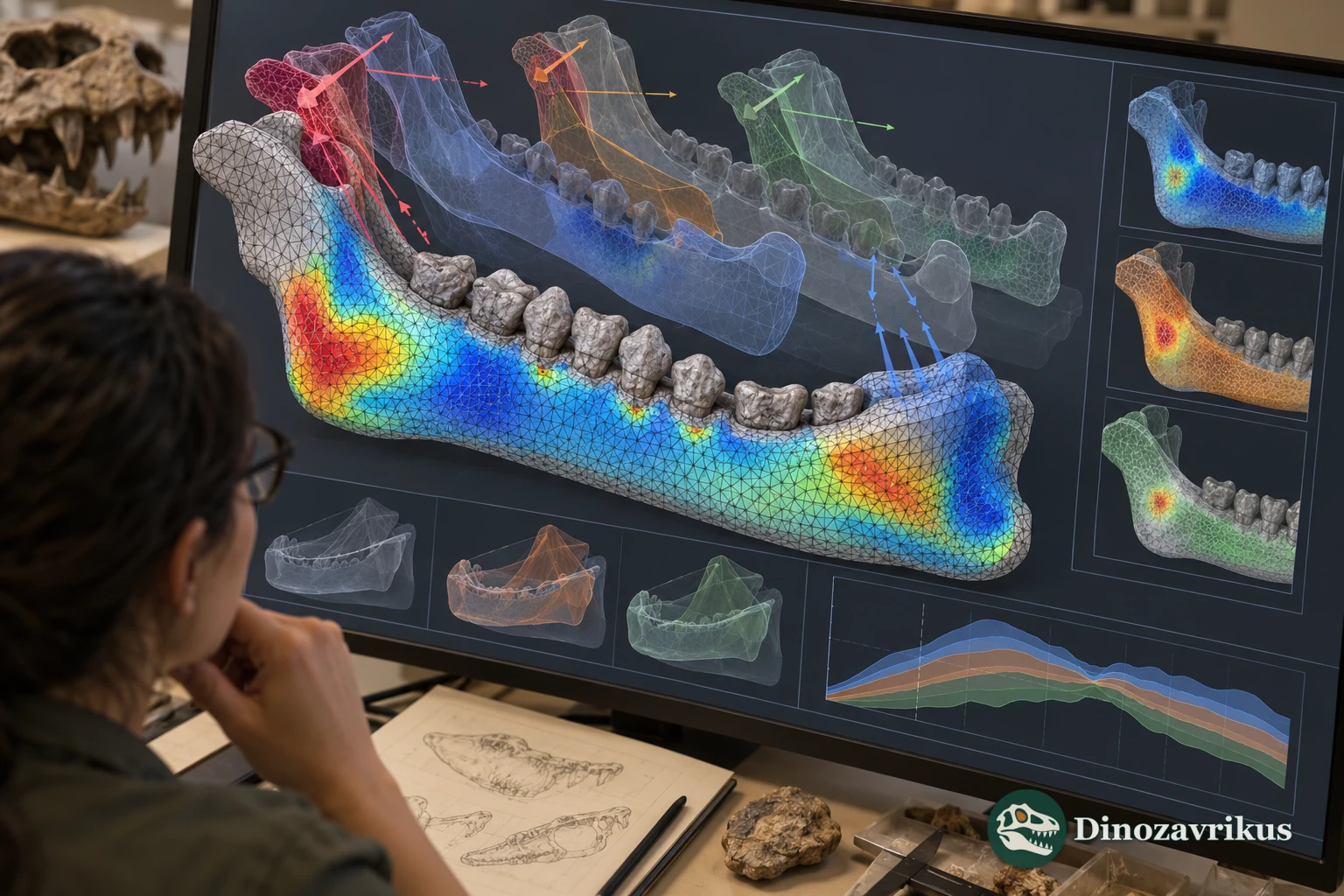
Be especially cautious with exact bite force, speed or “power” figures. They may depend on muscle mass, physiological cross-section, attachment angles and selected pose. A robust answer to “which shape better resists this specified load?” does not automatically establish that an animal always bit with a particular force. The guide to comparing dinosaur strength estimates separates different measurable traits from modelled values.
What makes a model persuasive?
A transparent paper reports which specimen was digitised, how missing parts were restored, which parameters were measured or assumed, where forces were applied, whether numerical stability was checked, and what the model was compared against. It also states which alternative inputs could change the conclusion.
These checks do not sort models into infallible and useless. They help separate a stable comparative result from an estimate sensitive to unknown muscles, materials or behaviour. A calculation may show that one skull shape better resists a specified load under stated conditions. Turning that into a claim about an animal’s exact diet or behaviour requires independent evidence.
Frequently asked questions
What is finite element analysis?
It divides a digital structure into many elements and calculates how it responds to specified loads and constraints.
Can scientists directly test a model of an extinct animal?
No extinct animal can be tested under a living load. Researchers can test the modelling procedure against measurable living systems, then state the additional assumptions used for fossils.
Why do researchers vary model parameters?
Sensitivity analysis shows whether a conclusion depends on uncertain values such as muscle force, material properties or load placement.
Does a detailed colour map mean the result is exact?
No. Colours display calculated output for selected settings. Reliability depends on geometry, material properties, loads, constraints and validation.