

Tetonius was a genus of small early Eocene primates in the family Omomyidae. Fossils from Wyoming include skull material, jaws and teeth, with different samples representing different species and localities. The genus is useful for understanding how researchers reconstruct early primate relationships from a patchy record: a modest change in which teeth are compared can alter the boundaries of species and even the apparent branching order.
Large eyes and a branch-climbing pose are common in illustrations, but fossils do not establish the animal's exact colour, daily activity or full body outline. Tetonius belongs in the ancient mammal catalogue, where its changing relationship with Pseudotetonius gives the profile a story beyond a familiar small-primate silhouette.
Quick facts
| Scientific name | Tetonius Matthew, 1915 |
|---|---|
| Type species | T. homunculus (Cope, 1882) |
| Group | Primates, Omomyidae; internal relationships have been revised |
| Age | Early Eocene, Wasatchian |
| Range | Western North America, especially Wyoming |
| Material | Skulls, jaws and teeth; postcranial remains vary by sample |
| Diet | Not directly known; dental interpretations remain hypotheses |
| Key caveat | Different species and basins cannot be combined into one population |
What can the fossils tell us?
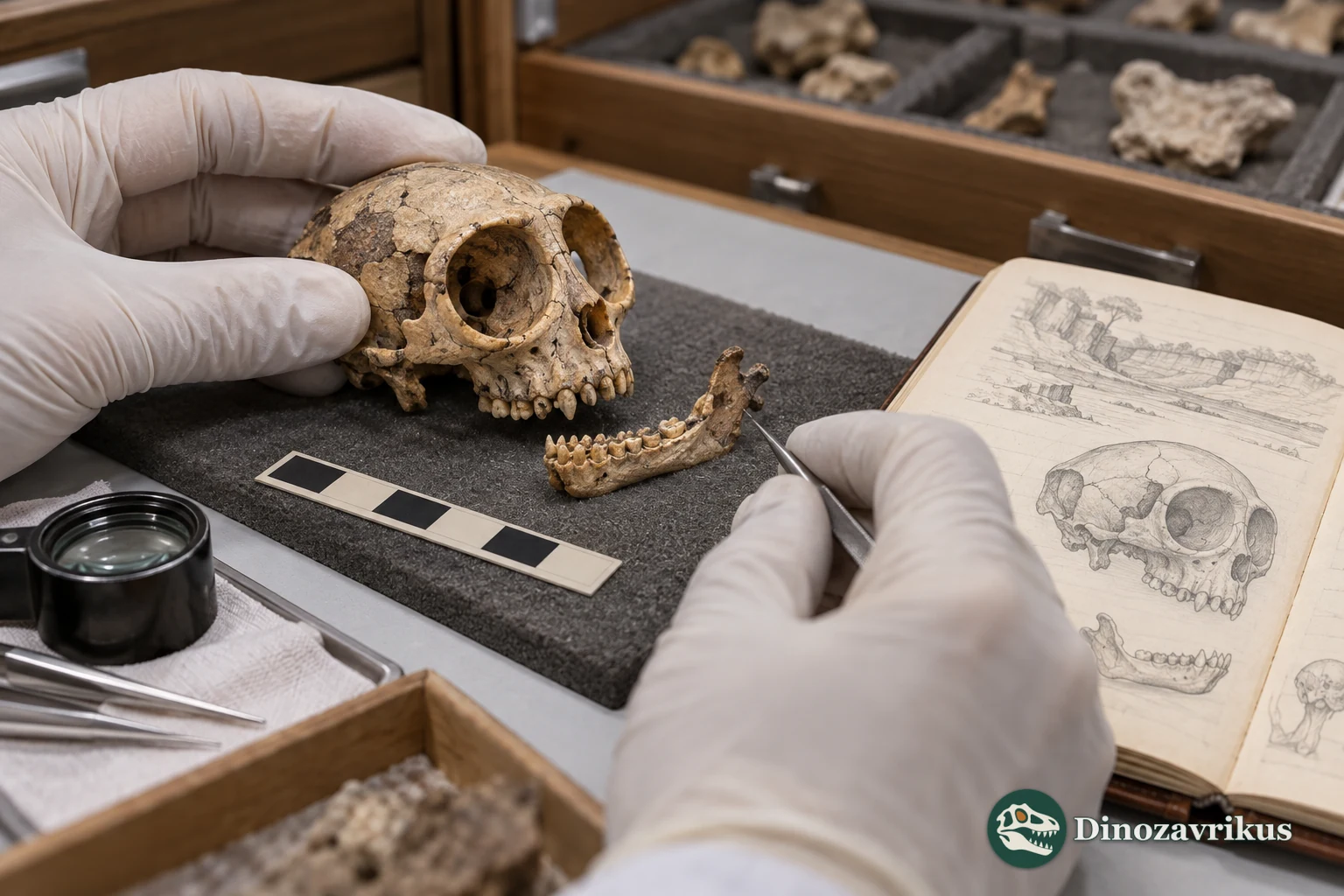
A Smithsonian specimen of Tetonius homunculus from the Willwood Formation includes skull material, mandible and teeth. These remains document cranial anatomy, not the coat, colour or exact outline of the body.
Comparisons of incisors, premolars and molars helped distinguish Tetonius from Pseudotetonius. An isolated tooth can be informative, but its identification depends on preservation, age and comparison with a larger sample.
Classic records come from the Bighorn Basin. A 2026 study of the Great Divide Basin described Tetonius varleyorum and added a broader geographic sample. The discoveries do not mean all named species lived together.
Eye size and comparisons with living primates can motivate functional hypotheses. Tetonius has no fossilised retinal tissue or other direct evidence fixing its activity schedule.
From Anaptomorphus to Tetonius
Edward Drinker Cope named the type species as Anaptomorphus homunculus in 1882. William Diller Matthew later placed it in a separate genus, Tetonius. The change reflects a revision of how fossil teeth and skull features were grouped; it does not refer to a second animal or a newly discovered skeleton.
A Smithsonian record documents a T. homunculus specimen collected in 1931 in Wyoming's Willwood Formation, Gray Bull Member. It includes skull material, a mandible and teeth. The entry is a useful collection record, but it is not a complete skeleton and should not be used to fill in soft tissue or the entire body.
Teeth as evidence and as a taxonomic challenge
Early Eocene omomyids are often represented by isolated teeth and jaws. Researchers compare tooth size, cusp arrangement, enamel and the proportions of premolars and molars to distinguish species. The 1987 revision by Thomas Bown and Kenneth Rose described several species and assembled a substantial record from the Bighorn Basin. Later work tested how dental proportions changed through related forms.
These comparisons carry uncertainty. Tooth wear can remove diagnostic detail, and a single tooth may not represent the variation of a population. Similar features can also evolve in closely related lineages. A proposed synonym or new species is therefore a hypothesis tied to a specific sample and character set, not a simple label change.
A more complex Wyoming history
A 2026 study described Tetonius varleyorum from the Great Divide Basin in southern Wyoming and analysed it alongside other omomyids. In the authors' phylogenetic analysis, the new species was more closely related to Pseudotetonius ambiguus than to the Bighorn Basin species traditionally assigned to Tetonius. The result reinforces earlier concerns that the conventional genus may not form a single natural group.
That is a testable phylogenetic result, not a final consensus that closes the question. The branching pattern depends on which fossils and characters are included. What is clear is that a second Wyoming basin supplied evidence for geographic complexity that the classic Bighorn record alone could not show.
Size, diet and movement: where the evidence ends
The fossil record supports a small-bodied primate, but a single body-mass figure would overstate what the fragmentary samples can tell us. A skull or tooth cannot by itself specify body mass across the genus, especially when the named species come from different time intervals.
Tooth form can be used to discuss food-processing adaptations, but the precise diet of Tetonius is not directly preserved. Likewise, comparisons with living tarsiers or other small primates can suggest how eyes or limbs functioned, but they do not prove identical behaviour. Large orbits alone do not establish night vision or nocturnal activity.
What the illustrations can and cannot show
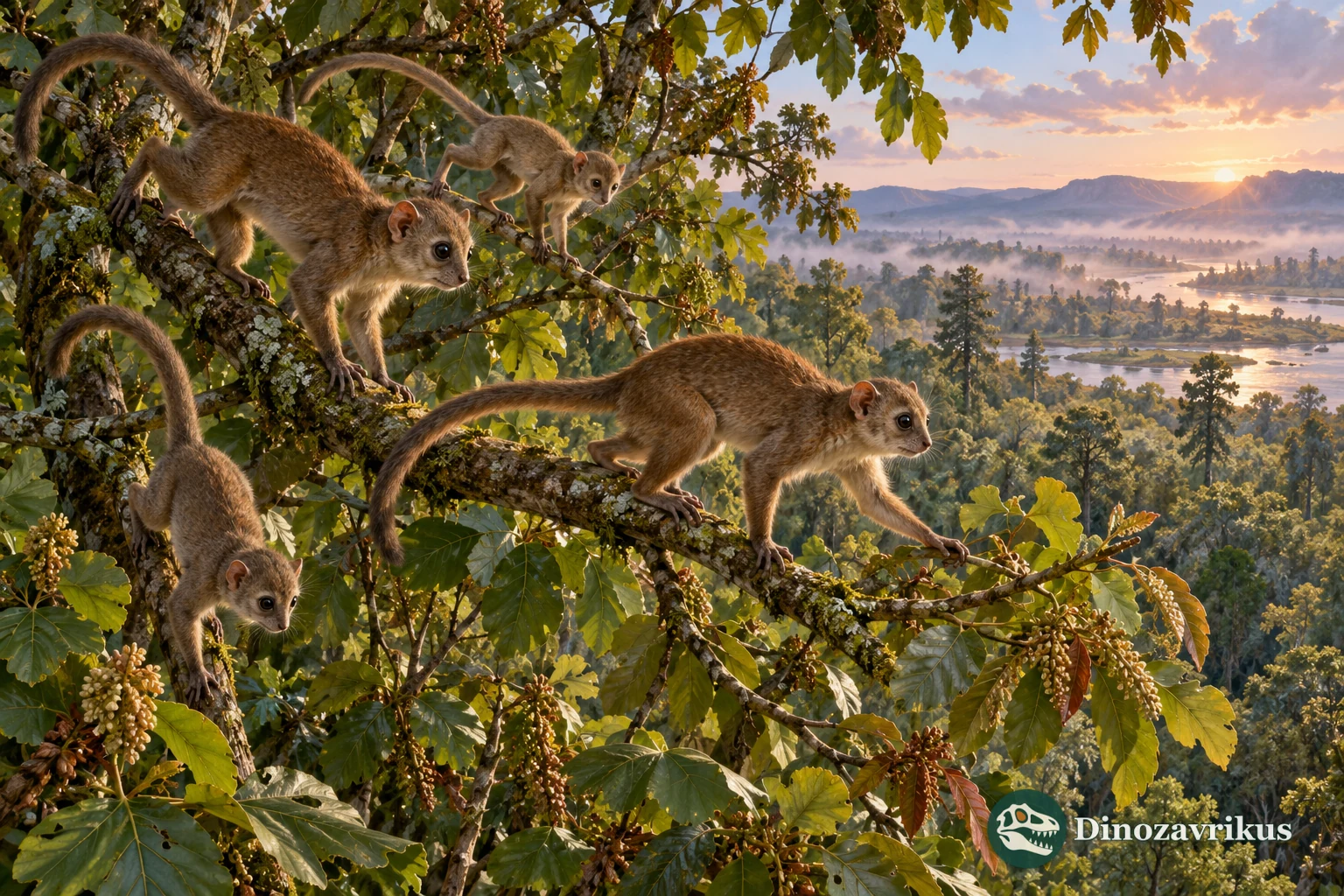
The cover uses a small, long-tailed primate in a forest as a visual guide to the kind of animal represented by the fossils. Neither fur colour nor the precise pose is known. The more reliable evidence lies in the named teeth, jaws and skull elements and in the stratigraphic positions of the collections.
The story of Tetonius is therefore not a straight line from a tiny ancestor to a modern primate. It is a record of closely related fossil species distributed across basins and time, whose relationships become clearer when new specimens expand the comparison.
Frequently asked questions
When did Tetonius live?
Tetonius is known from the early Eocene, especially Wasatchian deposits in Wyoming.
Was Tetonius an ancestor of humans?
No direct ancestry has been established. It was an extinct omomyid primate, and its exact position among early primates has been revised repeatedly.
What did Tetonius eat?
Its exact diet is unknown. Teeth support functional comparisons, but no direct stomach contents identify a menu.
Do its large eyes prove it was nocturnal?
No. Eye size can prompt hypotheses, but the fossils do not establish a daily activity schedule.