

Tetragraptus is a genus of colonial marine graptolites. Typical members had four stipes, but the number of branches is only a starting point for identification. Palaeontologists also compare the proximal end of the colony and the shape and spacing of its tiny thecae.
The genus is known from Ordovician rocks around the world. Treatise Online gives a range from the Floian of the Lower Ordovician to the Darriwilian of the Middle Ordovician. This combines occurrences of several species; it is not the lifespan of one population. The wider setting is described in the guide to the Ordovician Period.
Quick facts
| Scientific name | Tetragraptus Salter, 1863 |
|---|---|
| Group | Graptolithina, family Phyllograptidae |
| Range | Lower Ordovician Floian to Middle Ordovician Darriwilian |
| Typical colony | Four stipes with repeated thecae |
| Type material | Lectotypes of T. serra and T. bryonoides |
| Preservation | Flattened impressions and carbon films in sedimentary rock |
| Ecology | Suspension feeding and a planktonic habit are inferred for graptoloids |
| Limit | A four-branched outline alone does not confirm the genus |
What can the fossils tell us?
Typical specimens have four stipes emerging from a compact proximal region. Their position may be horizontal, reclined, pendent or partly upright. The slab records a flattened colony, not how it moved through the water.
Treatise Online lists a lectotype of Tetragraptus serra at the Natural History Museum, London, and a lectotype of T. bryonoides at the Geological Survey of Canada. These specimens guide comparisons; a similar outline alone is not enough for a new identification.
The Treatise range runs from the Lower Ordovician Floian to the Middle Ordovician Darriwilian and is reported worldwide. The age of an individual slab depends on its bed and associated fossils, not on branch shape alone.
Stipe attitude varies, and phyllograptoid-looking colonies may have evolved in more than one lineage. Identification therefore uses the proximal region and thecae as well as the number and angle of branches.
The name and its type species
James Hall described early graptolite forms in 1858, and John William Salter established Tetragraptus in 1863. Older literature also used the spelling Tetragrapsus; ICZN Opinion 650 conserved the familiar name. Treatise Online cites Graptolithus bryonoides Hall, 1858 as the type species and links it with Tetragraptus serra Brongniart, 1828.
The reference volume lists a lectotype of T. serra, NHMUK PM 26995, from Lévis, Quebec, and a lectotype of T. bryonoides, GSC 978, in the Geological Survey of Canada. These specimens fix how the names are applied; they do not make every four-branched fossil a member of the same species.
Reading the colony
The fossilised rhabdosome is the rigid colony skeleton. In typical Tetragraptus, four stipes arise from a compact proximal region. Each carries repeated thecae, the small tubes that housed individual zooids. The stipes may extend horizontally, slope, hang down or turn upward, depending on species and preservation.
Researchers measure stipe width and length, compare thecal spacing, and inspect the sicula and crossing canals near the colony's origin. Published lectotypes are figured with millimetre scale bars, but there is no single body-size estimate for the genus. Growth stage, species and flattening during burial all affect the dimensions of a specimen.
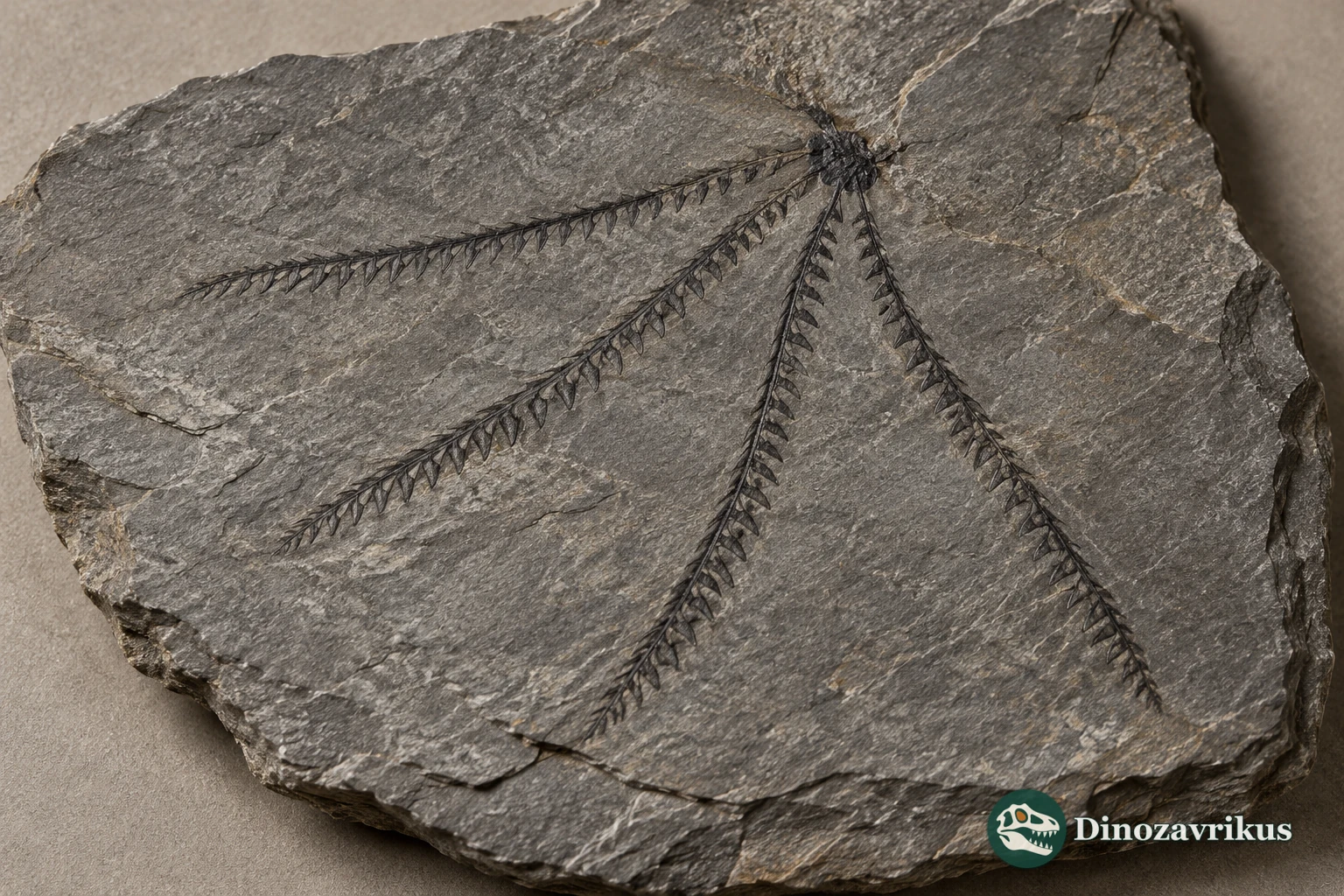
Branch number is not sufficient for a diagnosis. The first thecae, proximal development, branch angles and preservation help distinguish Tetragraptus from other early graptolites. A broken or compressed fragment may not preserve these characters.
Occurrences and preservation
Graptolitic shales and other fine-grained Ordovician deposits yield flattened colonies from many regions. A study of the Bogo Shale in the Trondheim region, Norway, records T. quadribrachiatus, T. bigsbyi and specimens left at genus level. The age assignment comes from the graptolite assemblage rather than one outline in isolation.
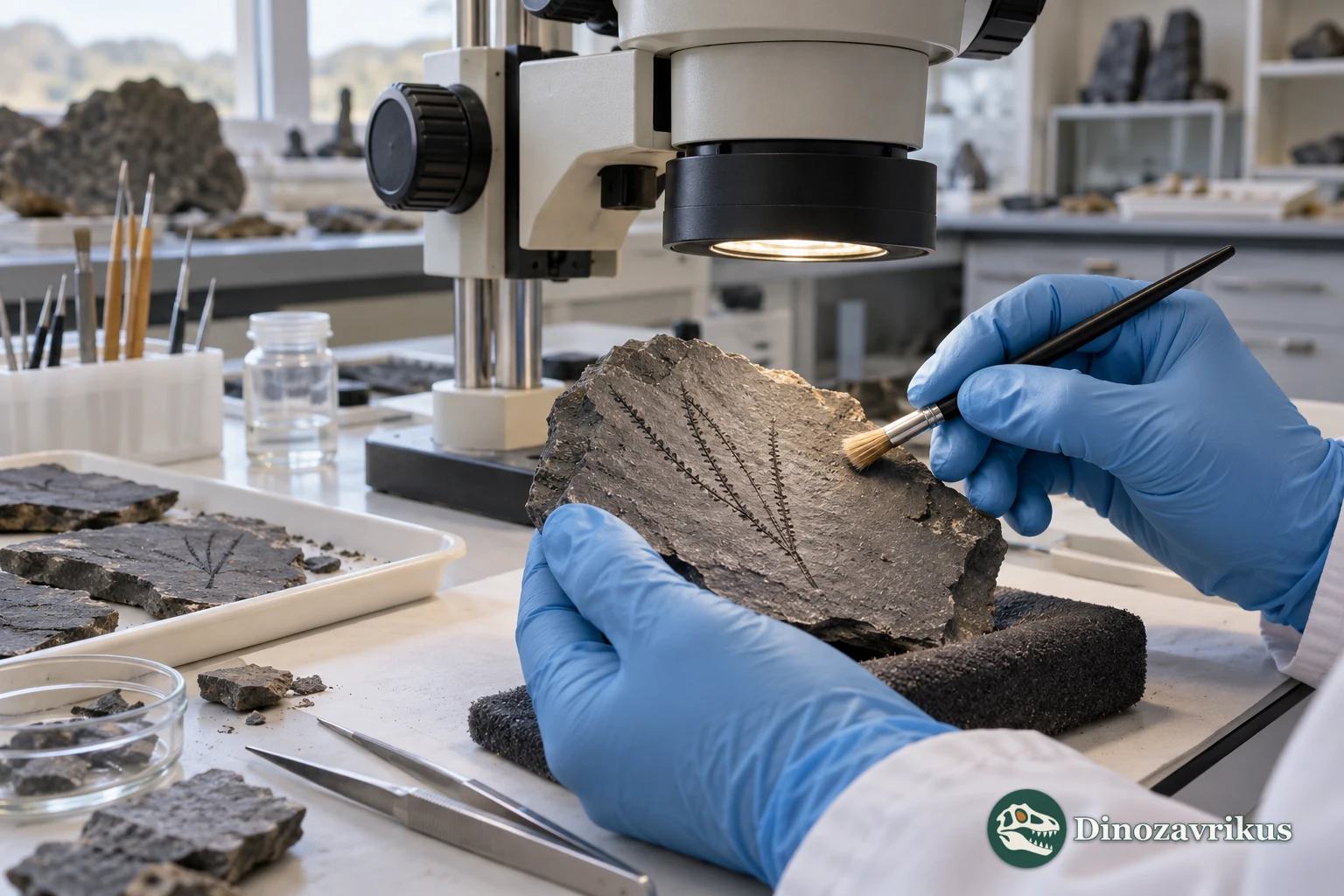
Most material is preserved as a film or impression in sedimentary rock. Colony fragments may be separated before burial; compaction and later deformation can change branch angles. Researchers compare the slab, its counterpart and the proximal details before treating a record as secure.
Ecology and what remains unknown
The colony skeleton is direct evidence. A planktonic life in the water column and suspension feeding are inferred from graptoloid biology and the distribution of fossils in marine sediments. A fossil slab cannot establish the swimming speed, exact depth, seasonal movement or feeding behaviour of one colony.
Several graptolite lineages developed similar phyllograptoid forms. This possible convergence means that a leaf-like outline can conceal different histories. The appearance, colour and soft zooids of Tetragraptus are not preserved in ordinary shale impressions. Cover art and environmental scenes are reconstructions, not observations of a named fossil community.
Frequently asked questions
Was Tetragraptus one animal or a colony?
It was a colonial graptolite. Many zooids occupied thecae along the shared rhabdosome, which is the part most commonly preserved.
Why does the genus have four branches?
Four stipes are typical, but their angle and arrangement vary. Identification also depends on the proximal region and thecae.
When did Tetragraptus live?
The Treatise compilation gives a Floian to Darriwilian range, from the Lower to Middle Ordovician. Individual occurrences need their own stratigraphic context.
Can fossils reveal its colour or behaviour?
No. Ordinary impressions preserve the colony skeleton, not colour or soft zooids. Planktonic life and suspension feeding are inferences from graptoloid biology.