

Thalassomedon haningtoni was a large, long-necked plesiosaur from the middle Cenomanian Western Interior Seaway. Two skulls with associated skeletons make it unusually informative among mid-Cretaceous elasmosaurids. The fossils show a long cervical series and distinctive teeth, while damage to the skull and missing bones still limit some measurements and anatomical interpretations.
Quick facts
| Type species | Thalassomedon haningtoni |
|---|---|
| Group | Plesiosaur; elasmosaurid |
| Age | Middle Cenomanian, Cretaceous |
| Formation | Graneros Shale |
| Region | Colorado and Nebraska, United States |
| Holotype | DMNS 1588, an articulated skull and much of the skeleton |
| Referred specimen | UNSM 50132, a second skull and associated skeleton |
| Length | About 11.6 m in an early estimate; reconstructed, not directly measured |
Evidence guide
The Colorado holotype includes the skull and jaws, a long cervical series, trunk and tail vertebrae, ribs, and parts of the girdles and limbs. Several bones are broken or missing, so the restored mount is not a literal record of every preserved element.
UNSM 50132 preserves a skull and associated vertebrae and limb elements. A 2021 re-examination found shared features with DMNS 1588, including enlarged fang-like teeth at the second maxillary position, and referred both to the same species.
The teeth are anisodont, with especially enlarged crowns near the front of the upper jaw. This documents the feeding apparatus, but teeth alone do not identify the animal’s exact prey or hunting technique.
FMNH 12009 from Montana was previously referred to Thalassomedon. The 2021 study excluded it pending further assessment, so it should not be treated as confirmed evidence for the genus’s range or growth.
Discovery and study
The holotype, DMNS 1588, was found in 1939 by highway workers digging along a creek bank near Pritchett in Baca County, Colorado. They reported it to local science teacher Andrew Weresch. Several months passed before the Denver Museum of Nature and Science could organise an expedition; during that interval, visitors removed some bones as souvenirs. Museum curator Harvey C. Markman and preparators Robert L. Landberg and Philip Reinheimer recovered missing pieces and restored the skeleton. Samuel P. Welles examined it in May 1940 and named the species in 1943.
A second specimen, UNSM 50132, was found in spring 1964 on the Adolph Rezac farm near Valparaiso, Saunders County, Nebraska. Geologists Hal De Graw, Charles Osborn and Phil Emory were involved in the discovery. It is held by the University of Nebraska State Museum. In 2021, Sven Sachs, Johan Lindgren, Daniel Madzia and Benjamin P. Kear re-examined the skulls of both specimens and supported their referral to the same species.
What the skeletons preserve
DMNS 1588 includes the skull and lower jaw, the atlas-axis complex, about 60 post-axial cervical vertebrae, pectoral and dorsal vertebrae, three sacrals, 21 caudals, ribs, and parts of the shoulder and pelvic girdles and limbs. The original vertebral counts differ slightly because Welles grouped the first dorsal vertebra differently. Some portions are incomplete, and restored bones should be distinguished from fossils preserved in the ground.
UNSM 50132 also contains a skull and jaw with an articulated axial series and associated limb bones. Its mounted position at the museum limits access to some parts, but direct comparison of the available skull anatomy helped test whether it belonged to the Colorado species. Together, the two specimens provide complementary evidence rather than two equally complete copies of one skeleton.
Skull and teeth
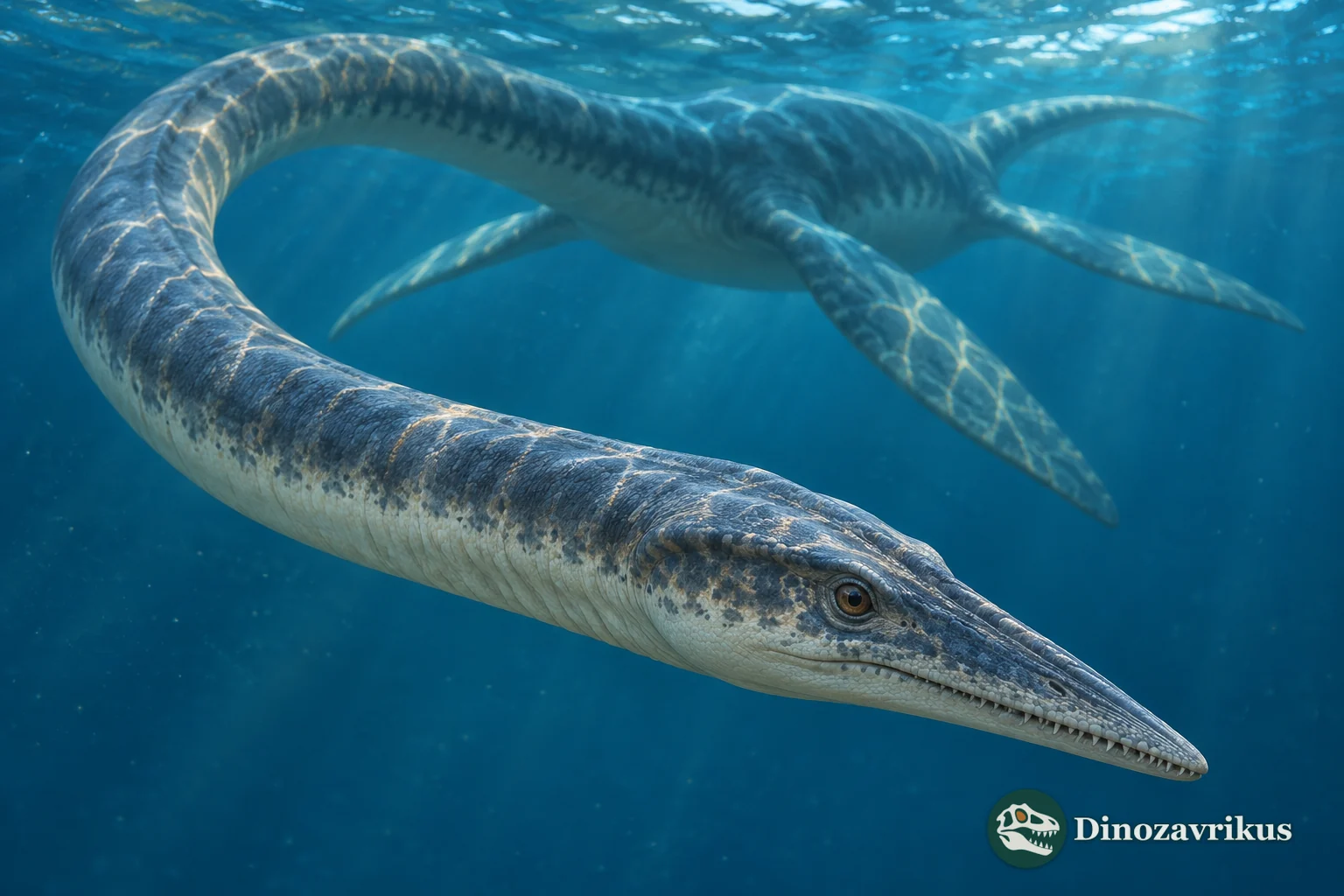
The holotype skull is badly crushed and displaced. The 2021 study nevertheless identified a sharply tapering premaxillary rostrum with a prominent midline ridge and a small, rounded external bony nasal opening. The Nebraska skull is also damaged, but both specimens share enlarged, fang-like teeth in the second maxillary position. This shared feature, alongside several other cranial characters, supports the referral of UNSM 50132 to Thalassomedon haningtoni.
The crowns vary in size along the tooth rows and curve inward. Such anatomy is consistent with a predatory plesiosaur, but no stomach contents have been reported for the securely referred specimens. The fossil evidence therefore does not establish a species-specific menu.
Age and relationships
Both accepted specimens come from the middle Cenomanian Graneros Shale. During the Cretaceous, this region lay beside the Western Interior Seaway, a marine corridor across central North America. The formation records the geological setting; two localities in different states do not mean that the species lived at only one site.
Thalassomedon is an elasmosaurid, a plesiosaur group known for long necks. Its precise branching position has varied among phylogenetic analyses. The 2021 reassessment supported the two-specimen grouping but cautioned that crushing and missing anatomical data make some relationships difficult to resolve. Compare its long-necked anatomy with [Styxosaurus](/styxosaurus/) and [Libonectes](/libonectes/), two other Cretaceous elasmosaurids.
A partial specimen from Montana, FMNH 12009, had been assigned to the genus in earlier work. Sachs and colleagues excluded it in 2021 until it can be assessed separately. That distinction matters: an uncertain referral should not extend the confirmed geographic or age range of the taxon.
Size, swimming and limits of reconstruction
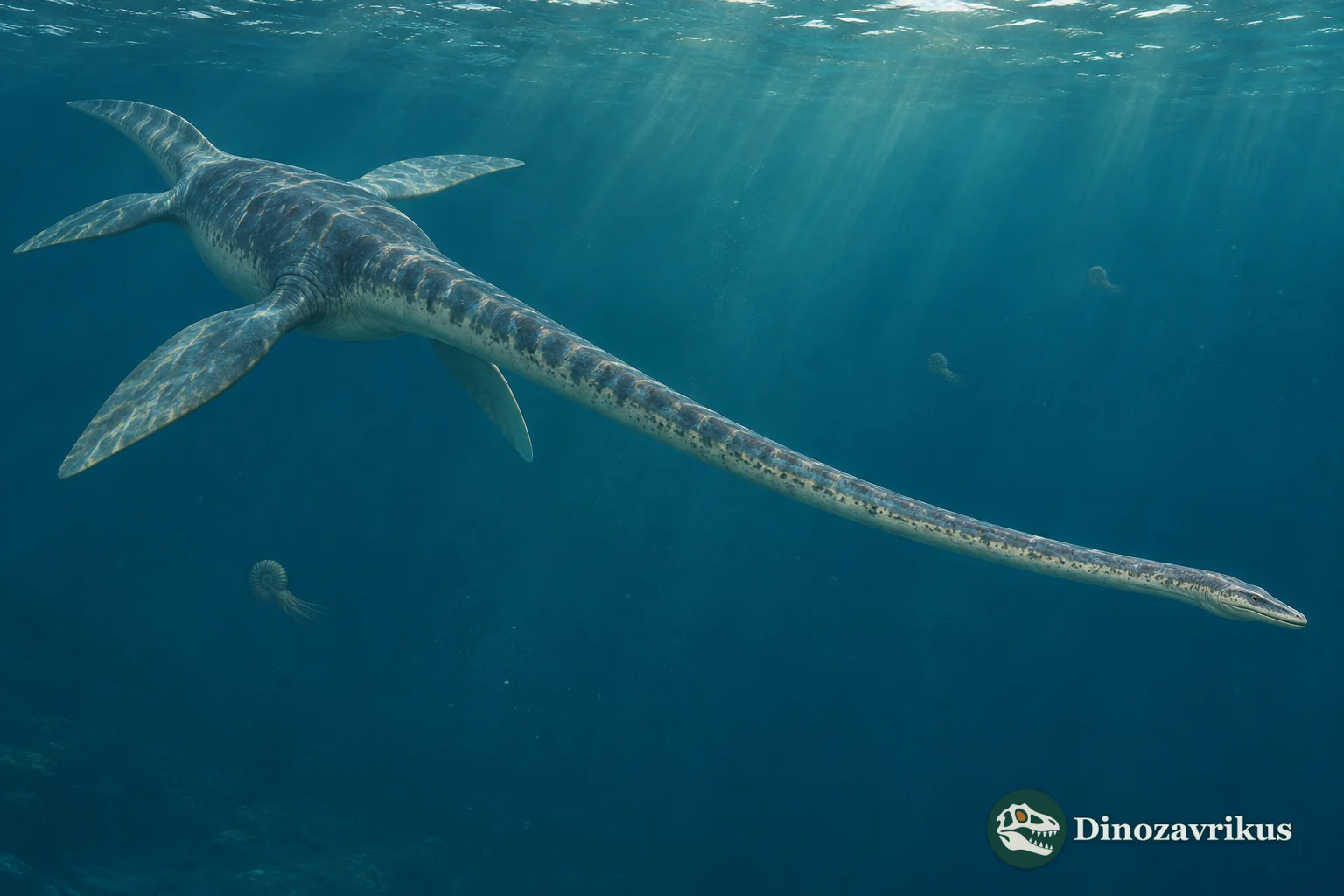
Welles’s early description gave a total length estimate of about 11.6 m. This is a reconstruction based on the mounted skeleton, not a direct measurement of a completely preserved animal. The holotype is unusually informative for an elasmosaurid, but missing and restored elements still affect the estimate. It is safest to describe the animal as large and to retain the caveat whenever the historical figure is quoted.
The long neck, broad body and four paddles show the general plesiosaurian body plan. Bones do not record a precise swimming speed, stroke pattern or hunting manoeuvre. The scene below is palaeoart, not a photograph or a measured reconstruction of a specific moment.
Frequently asked questions
Where was Thalassomedon found?
The holotype was found near Pritchett in Baca County, Colorado. A second accepted specimen came from the Rezac farm near Valparaiso, Nebraska.
How many skeletons are securely referred to it?
The 2021 reassessment compares two specimens: DMNS 1588 from Colorado and UNSM 50132 from Nebraska. A fragmentary Montana specimen was excluded pending further study.
How long was Thalassomedon?
An early description estimated about 11.6 m. This is a reconstructed length, not a direct measurement of a fully preserved skeleton.
What do its teeth tell us?
The teeth vary in size, and enlarged fang-like crowns occur at the second maxillary position. This supports a predatory interpretation but does not reveal a precise diet.