

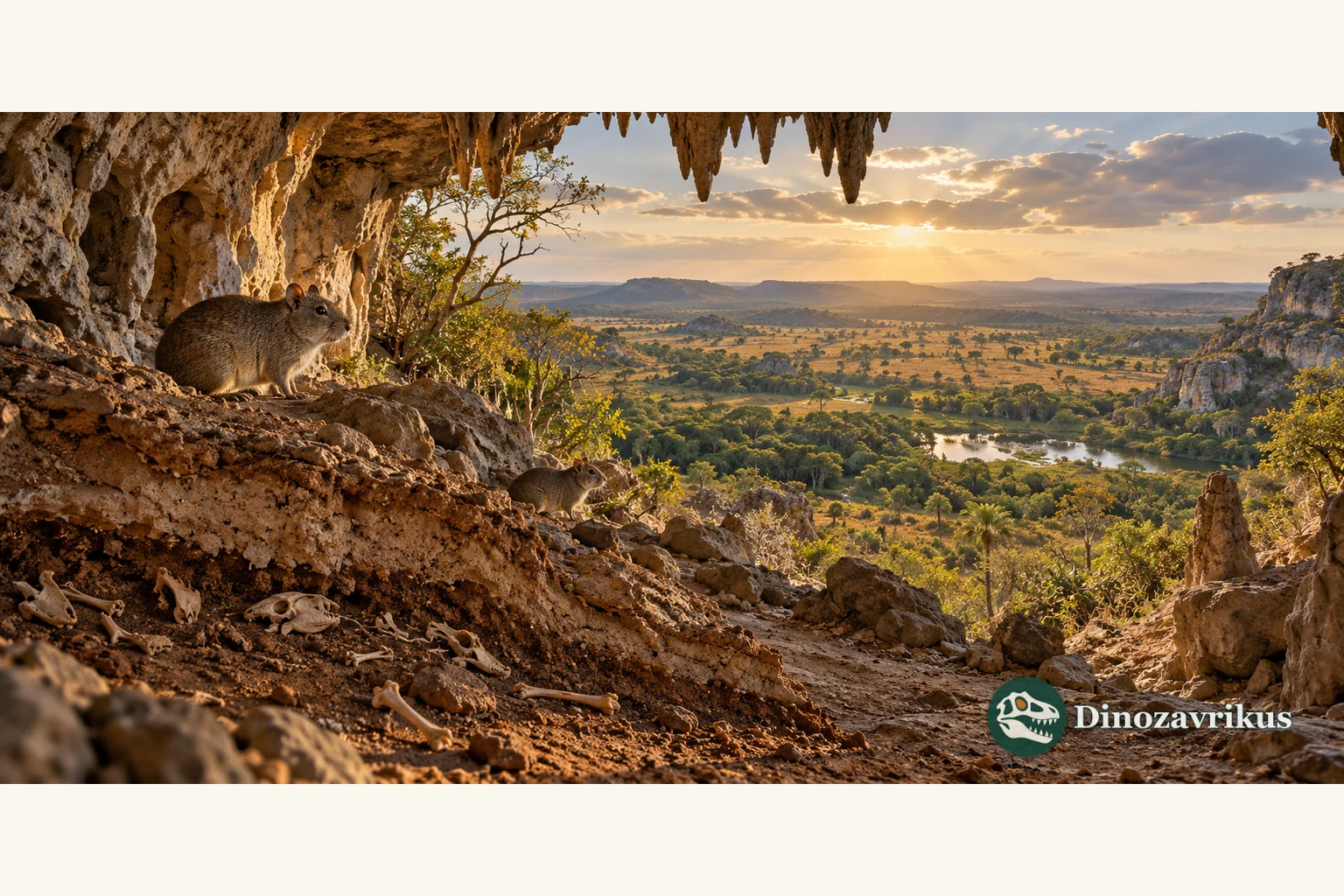
Thrichomys is a living South American spiny-rat genus. Its presence in a fossil atlas reflects Late Pleistocene teeth and jaws from Brazil; it must not be described as an extinct giant rat. The cover uses a living relative's general appearance, while the color of an ancient cave animal cannot be read from an isolated tooth.
A cave assemblage from Tocantins is particularly useful because it includes a juvenile jaw, teeth at several wear stages and a geological context shared with other small mammals.
Quick facts
| Group | Spiny rats, Echimyidae; order Rodentia |
|---|---|
| Status | Living genus with Late Pleistocene fossil records |
| Range | Brazil and neighboring South American regions |
| Fossil specimen | UNIRIO-PM 2753, a juvenile lower jaw with cheek teeth |
| Cave sample | Nineteen separate teeth and one jaw from Gruta dos Moura |
| Context age | About 20,000 ± 2,000 years before present, inferred from associated material |
| Species identification | Fossils assigned to Thrichomys sp., not a named living species |
What can the fossils tell us?
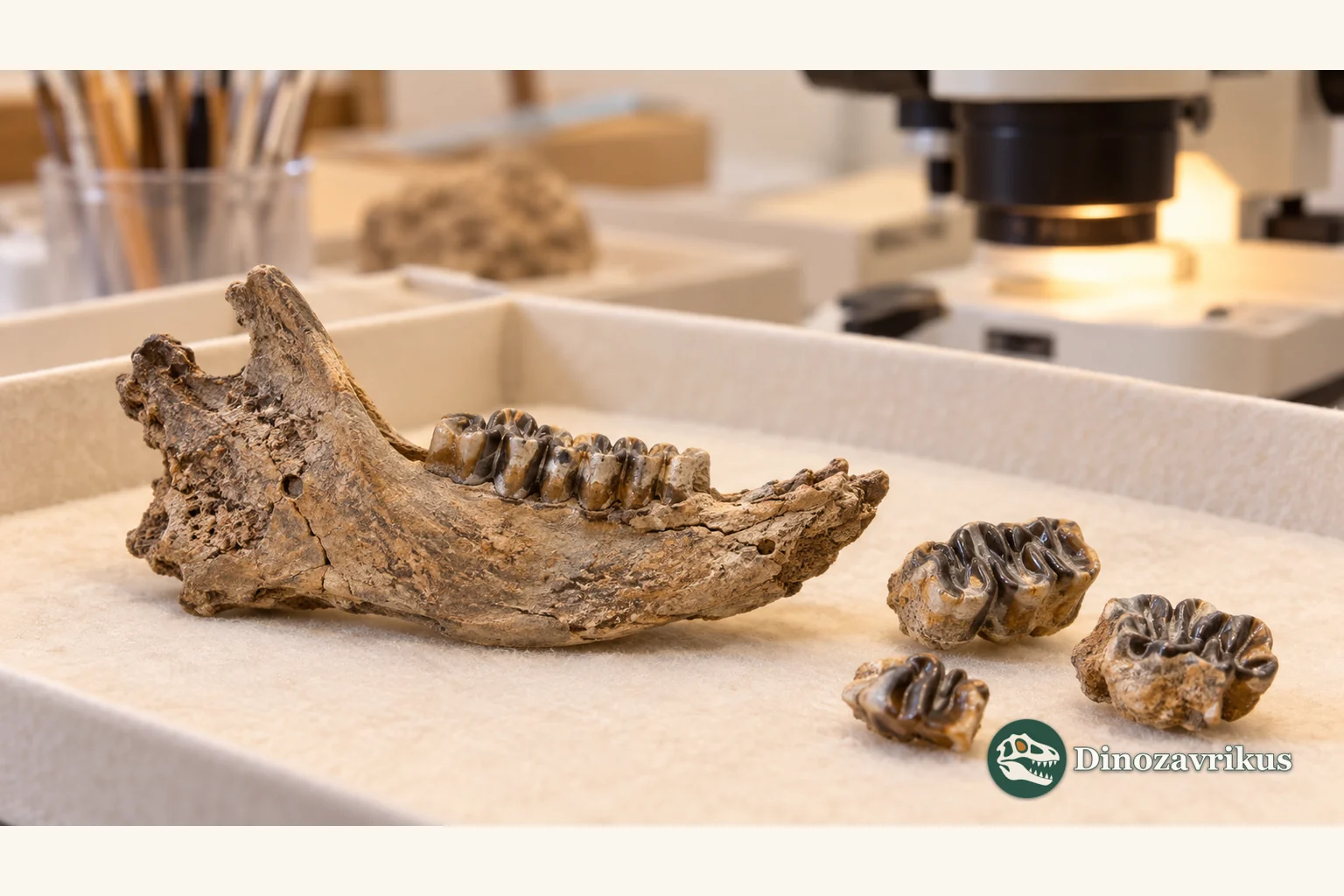
UNIRIO-PM 2753 has a right dentary with dp4–m2; its last molar had not erupted. This identifies a young animal but does not pin down the modern species.
The cave sample contains upper and lower teeth at different wear stages. Ridges and grooves identify the genus, but overlap among living forms keeps the fossil assignment at Thrichomys sp.
An associated peccary fragment from the same stratigraphic level yielded an ESR age near 20,000 years. Applying it to the rodents uses their shared context, not direct dating of a Thrichomys tooth.
A Tocantins cave sample
At Gruta dos Moura, near Aurora do Tocantins, researchers studied a carbonate block from the cave's main chamber and a related stratigraphic level. They described 19 separate Thrichomys teeth and one right lower jaw, UNIRIO-PM 2753. The jaw carries deciduous and permanent cheek teeth; an unerupted final molar shows that its owner was young.
Small-mammal fragments were preferentially preserved in this deposit. Nineteen teeth therefore do not mean nineteen animals. The authors recorded the fossils as Thrichomys sp. because their characters resemble more than one living lineage without identifying one securely.
Why worn teeth complicate species names
The pattern of enamel ridges and closed depressions changes as chewing wears the crown. A lightly worn upper tooth, UNIRIO-PM 4795, and the deciduous fourth premolar in jaw 2753 expose different stages. Species comparisons must take age and wear into account rather than matching one groove to a modern name.
Neves and Pessôa compared skull and dental characters of three living species across juvenile, subadult, adult and old age classes in 2011. Some traits changed through growth, while combinations of cranial structures distinguished species. Later genetic and shape studies support multiple lineages, but cannot supply a DNA identification for these cave teeth.
An associated age and a mixed landscape
An extinct peccary fragment from the same cave level was dated by electron spin resonance to about 20,000 ± 2,000 years before present. The study applies that age to the associated rodent assemblage. This is a reasoned stratigraphic assignment, not a direct measurement on jaw 2753.
The cave also yielded Makalata and Proechimys. The mixture of rodents associated with open country and wetter habitats may reflect a local mosaic, gallery forest or environmental shifts. It does not identify every plant around the cave. This Brazilian Quaternary setting was affected by the ice-age climate without being covered by a local glacier.
A lineage that survived
Living Thrichomys occupy parts of the Caatinga, Cerrado and Pantanal. A 2025 comparison of 56 modern individuals used skull and postcranial shape plus mitochondrial identification to distinguish T. inermis and a lineage related to T. laurentius. Those observations belong to living animals; they do not establish the cave animal's precise species, diet or coat.
Other Brazilian Quaternary sites contain fossils assigned to the genus. Molecular models may place deeper lineage splits in the Miocene, but a calculated split time is not a Miocene Thrichomys fossil. Its record is one example of how Cenozoic history combines dated remains with evolutionary estimates.
Frequently asked questions
Is Thrichomys extinct?
No. Several Thrichomys lineages live in South America today; the cave fossils represent ancient members of the genus.
What was found at Gruta dos Moura?
The described sample includes nineteen separate teeth and one lower jaw, not a count of nineteen individuals.
How old is the cave material?
An associated fossil from the same level gave an ESR age around 20,000 ± 2,000 years. The Thrichomys teeth were not dated individually.
Can the cave animal be named to species?
The authors used Thrichomys sp. because wear and overlap among living forms prevent a secure species identification.