

Thylacoleo carnifex was a large Pleistocene marsupial predator from mainland Australia. It is often called the marsupial lion, but it was not a cat. Its skull combined large canines with unusually enlarged shearing premolars, while limb bones document a powerful, specialised animal. Unlike many extinct Australian mammals, it is known from more than isolated teeth: museum collections include parts of skulls and articulated skeletons.
Tooth shape supports a carnivorous interpretation, but it cannot reconstruct a particular hunt. Bite models, limb comparisons and rare skeletal associations address different questions and carry different limits. Thylacoleo belongs in the ancient mammals catalogue. It shared Australia with the giant herbivore Diprotodon, but coexistence does not show that adult Diprotodon were routine prey.
Quick facts
| Scientific name | Thylacoleo carnifex Owen, 1859 |
|---|---|
| Group | Thylacoleonidae, Marsupialia |
| Age | Pleistocene |
| Range | Mainland Australia |
| Evidence | Skulls, teeth, limb bones and articulated skeletons |
| Diet | Carnivore; enlarged shearing premolars |
What can the fossils tell us?
Richard Owen described Thylacoleo carnifex in 1859 from fossil remains found in southeastern Australia. Finds remained fragmentary for decades; later skulls and skeletons refined its anatomy. Each museum specimen has its own collecting history and should not be conflated with the name-bearing material.
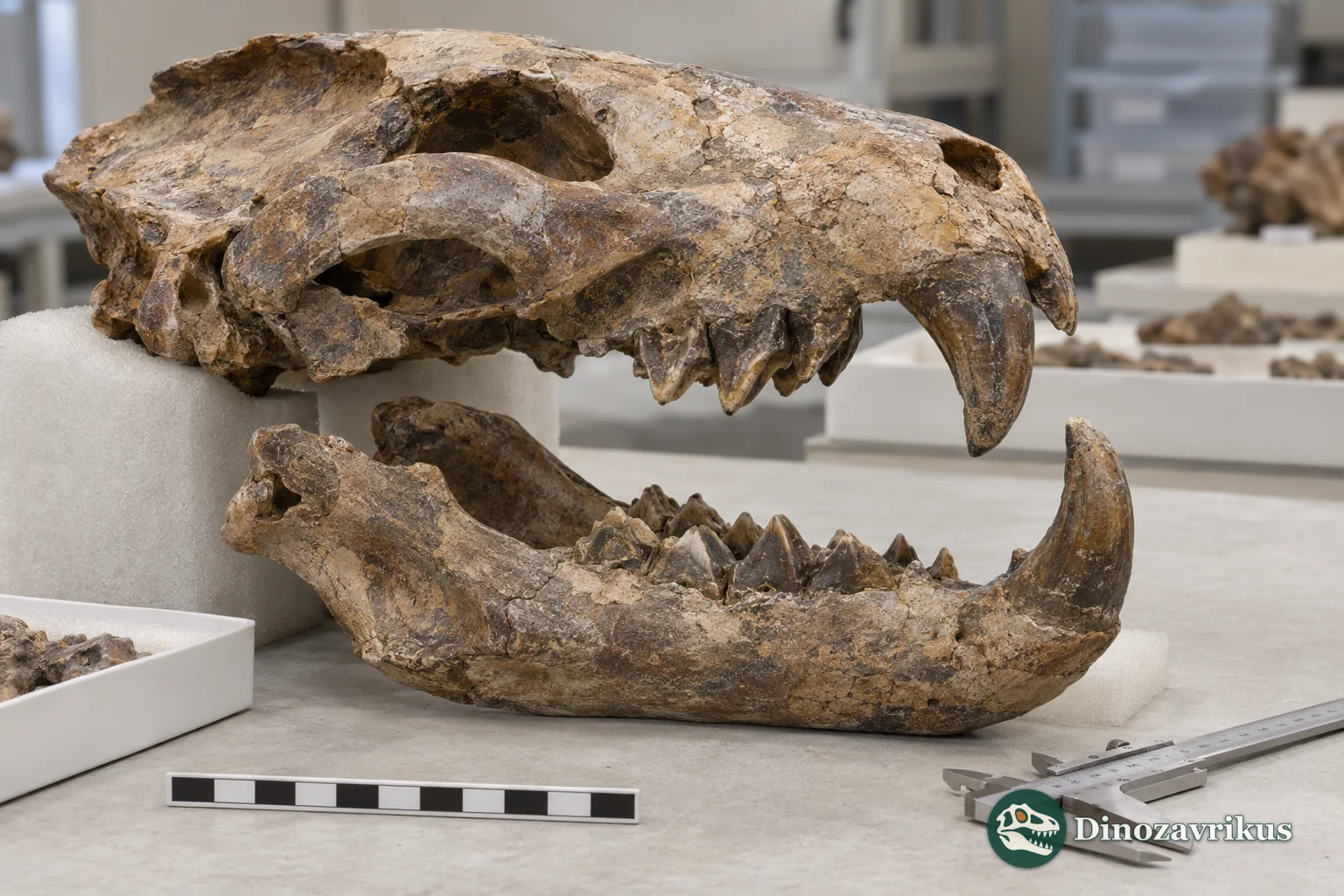
The skull carries large canines and enlarged third premolars with cutting edges. This combination, together with jaw anatomy, is consistent with meat processing. Bite-force estimates and a precise method of killing prey remain model-based inferences.
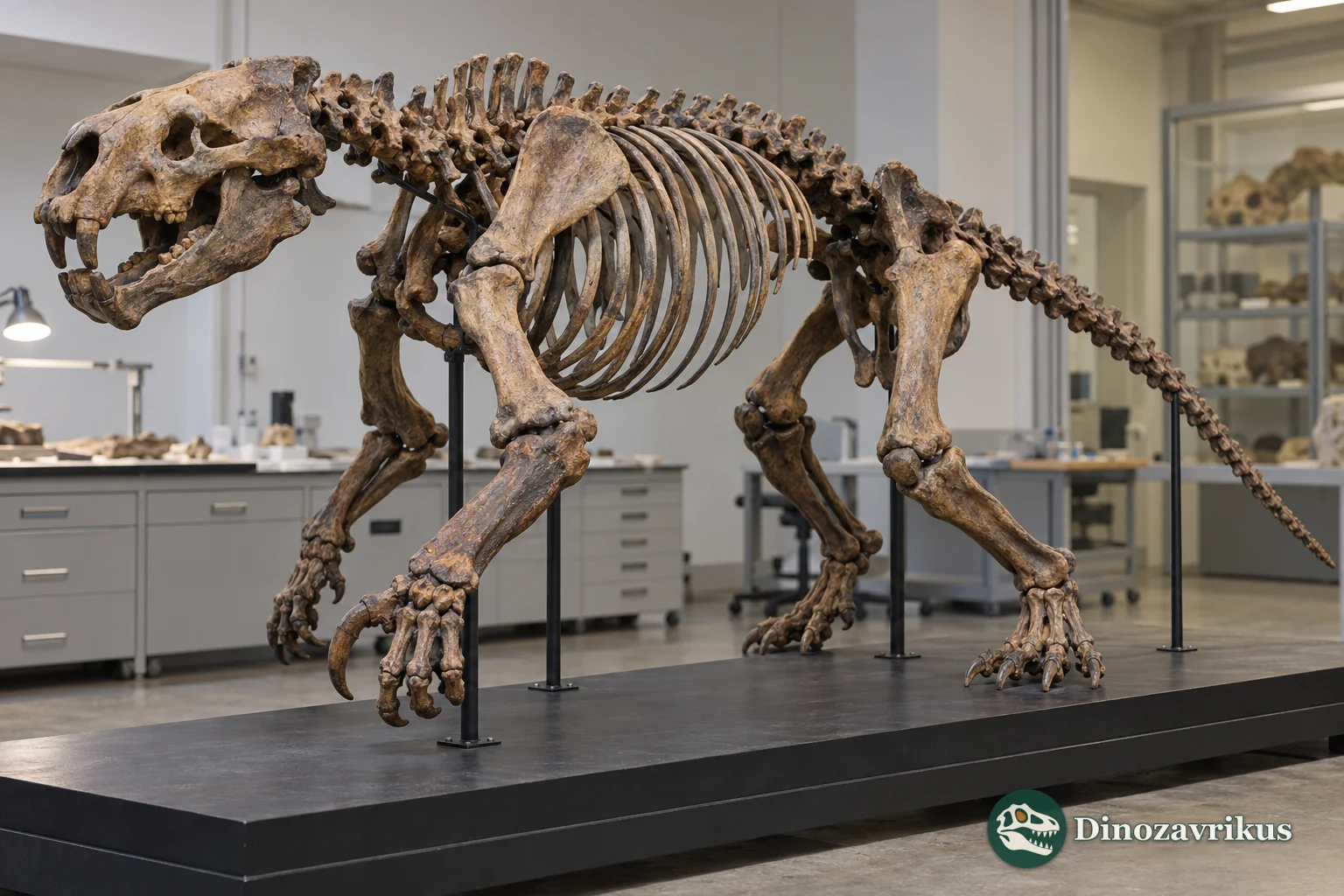
Articulated material from Naracoorte and the Nullarbor documents the limbs, feet and tail. Joint mobility and proportions may have helped on uneven ground. Climbing or using the tail as a brace are hypotheses informed by comparisons with living marsupials.
A near-complete adult female from the Moree area was found with pouch young and an older juvenile. This is important evidence of age association, but it does not establish how long the animals stayed together or how they died.
Discovery and naming
In 1859 the British anatomist Richard Owen described Thylacoleo carnifex from fossil material found in limestone deposits southwest of Melbourne. The early remains were incomplete, so understanding of the animal grew gradually. Additional skulls and bones from across Australia helped distinguish anatomical features from damage and individual variation.
A more complete skull described in the mid-twentieth century clarified the tooth rows. Later finds included near-complete skeletons from the Moree area and caves at Naracoorte and the Nullarbor. These specimens add to, but should not be confused with, the original name-bearing material.
The name “marsupial lion” describes a lion-like ecological role and large predatory appearance, not close relationship. Thylacoleo belonged to a separate Australian marsupial family, Thylacoleonidae.
Age and distribution
Remains are known across mainland Australia, from eastern plains and cave systems to the dry south and west. Important localities include Darling Downs, Wellington Caves, Naracoorte and Thylacoleo Cave in the Nullarbor region. These deposits formed in different landscapes and are not one time-slice.
The species lived during the Pleistocene. Some dated remains place it close to the period when people reached Australia, but the last occurrence depends on the quality and context of each specimen. Old museum bones without precise stratigraphy do not provide dates as secure as directly dated material.
Skull, teeth and bite
The skull’s defining feature is its enlarged third premolars, which formed a shearing pair. They worked with large canines and powerful jaws. The combination differs from the teeth of living cats and is well suited to cutting flesh. Tooth form, wear and jaw anatomy together support a specialised carnivorous lifestyle.
Bite-force estimates use jaw dimensions, muscle attachment areas and loading models. High values indicate potential power, but depend on assumptions about soft tissue and method. They do not reveal exactly how the animal killed prey or how often it used a particular bite.
Body size is also reconstructed from incomplete remains and comparisons with living marsupials. Thylacoleo was among the largest known marsupial predators, but a single mass value cannot represent every individual and estimation method. Fossil bones do not preserve coat colour or pattern.
Locomotion and the limbs
Near-complete skeletons provide evidence beyond the skull. Strong forelimbs, a large hand and a curved thumb claw may have helped seize prey or grip a support. This is a functional interpretation of anatomy, not direct evidence of one hunting technique.
Postcranial studies describe features of the feet, tail and joint mobility. The hind foot and fibula may have helped the animal negotiate uneven ground. Comparisons with living arboreal and terrestrial marsupials have also prompted hypotheses about climbing and using the tail as a brace while handling food. These possibilities do not mean that the animal was exclusively arboreal or routinely climbed trees.
Hunting and possible prey
Shearing premolars, canines and a robust jaw provide separate arguments for carnivory. Researchers compare these traits with potential prey size and bite mechanics. A list of possible prey cannot be made simply from animals found in the same deposits: co-occurrence does not prove a particular kill.
Young or weakened large herbivores may have been more vulnerable than adults. This cautious hypothesis is compatible with a powerful predator, but no fossil preserves an attack in progress. Marks on prey bones must also be distinguished from damage after death and from the activity of other carnivores.
Young animals and rare associations
A Moree-area find includes a near-complete adult female, a pouch young and an older juvenile. The association is important for age structure and reproduction. It has been interpreted as a possible family group, but the cause and duration of the association are not established. Animals may have been related, died in a shared event or accumulated together through other processes.
As in other marsupials, young developed in a pouch, but fossils do not reconstruct every growth stage or adult behaviour. Juvenile bones provide anatomical evidence without establishing litter size or the usual pattern of care.
Extinction
Thylacoleo disappeared in the Late Pleistocene amid major changes in Australian ecosystems. Research discusses aridity, vegetation and water shifts, landscape change associated with people, and direct impacts on animals. Temporal overlap matters, but does not prove that hunting was the sole or primary cause.
The last-appearance date depends on how securely a specimen was dated and how closely it approaches the true disappearance of the population. It is safer to describe a Late Pleistocene extinction and evaluate regional dates individually. The loss of Thylacoleo formed part of a wider faunal transition whose details remain under study.
Frequently asked questions
Was Thylacoleo related to lions?
No. It was a marsupial in the family Thylacoleonidae. “Lion” describes its presumed predatory role and appearance, not a relationship to cats.
What made its teeth unusual?
The skull combined large canines with especially enlarged third premolars that had shearing edges. The jaws and limb anatomy also indicate a powerful specialised animal.
Did it hunt Diprotodon?
They lived in the same broad Australian ecosystems, and young or weakened large animals may have been vulnerable. Shared localities do not prove that adult Diprotodon were routine prey.
Why is it called the marsupial lion?
The name reflects its large size and predatory specialisation. Thylacoleo was not a cat and was not a close relative of living lions.