

Timimus hermani is best known from a left femur recovered at Dinosaur Cove in southern Australia. It was first assigned to the ostrich-like ornithomimosaurs. Later comparison of the femoral head and nearby projections suggested that it might instead be an early tyrannosauroid.
Quick facts
| Group | Theropods (Coelurosauria) |
|---|---|
| Age | Early Cretaceous, Albian |
| Region | Australia (Victoria) |
| Type species | Timimus hermani |
| Holotype | NMV P186303 |
| Formation | Eumeralla Formation |
| Diet | Unknown |
What can the fossils tell us?
The holotype femur is about 12.6 times as long as its minimum width from side to side. The length of the complete leg cannot be measured.
The head of the femur is inclined towards the body and the top of the bone. Alongside the shape of the trochanters, it suggests tyrannosauroid affinities, which remain provisional.
Growth marks occur in a femur tentatively linked to Timimus. They record pauses in bone deposition, with several possible causes.
The find at Dinosaur Cove
Thomas Rich and Patricia Vickers-Rich described Timimus in 1994. The type, NMV P186303, is a left femur from the Lake Copco site at Dinosaur Cove, west of Cape Otway in Victoria. It is held by Museums Victoria. A smaller femur from the same quarry, NMV P186323, was originally referred to a juvenile of the same species. Later work questioned its assignment.
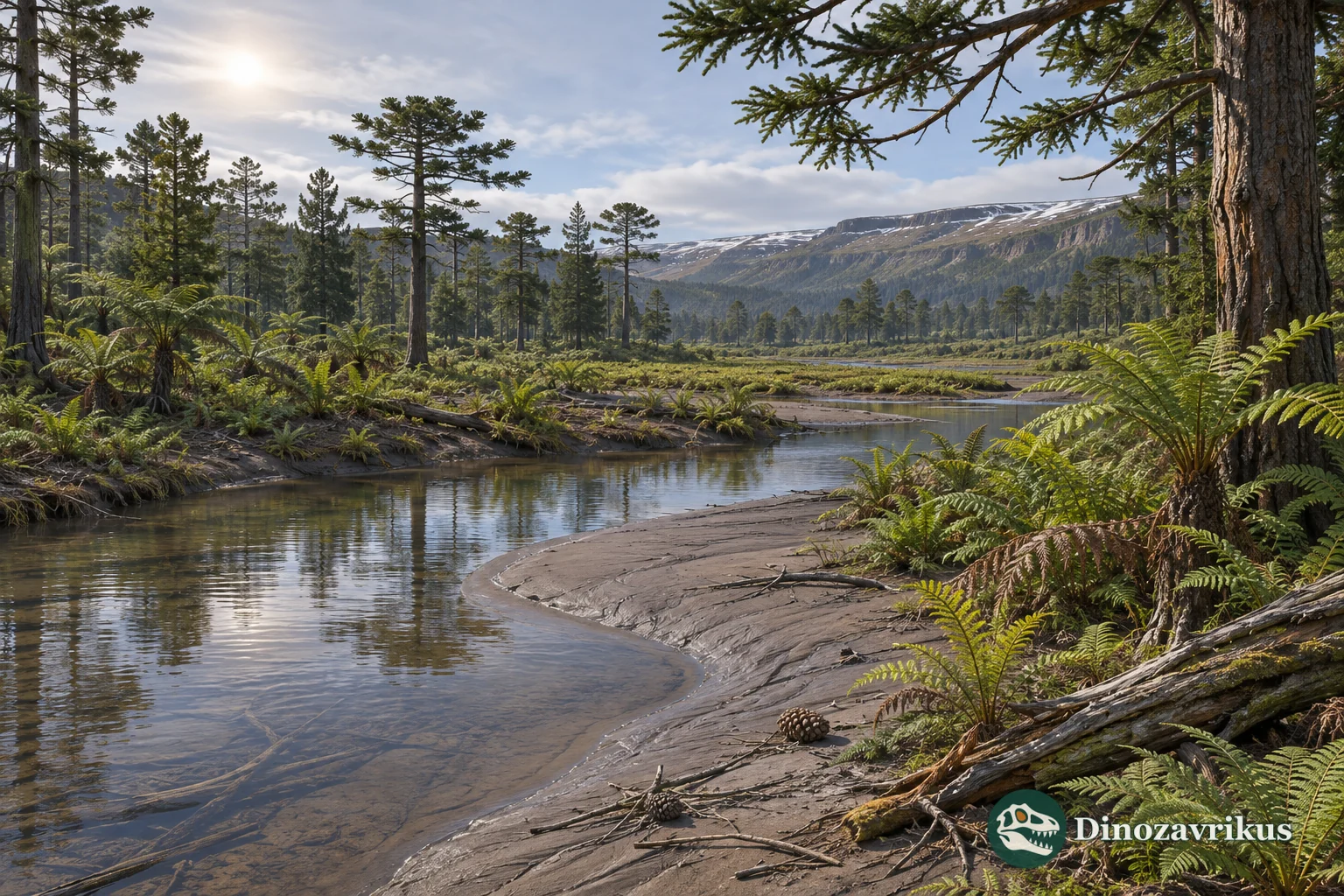
The bones come from the Eumeralla Formation. The area was historically dated to around the Aptian–Albian boundary. A 2023 review places the type locality in the early Albian using spores and pollen to correlate the rock layers. Southern Australia lay at high latitudes. The same Dinosaur Cove deposits also preserve the small herbivorous dinosaur Leaellynasaura.
Why the femur changed its classification
The shaft is slender and looks nearly straight from the front. The lesser trochanter, a projection close to the head, lacks the wing-like profile typical of ornithomimosaurs. The elevated head and the absence of a deep extensor groove near the knee led a 2012 review to place Timimus among early tyrannosauroids.
A slender femur occurs in several theropod groups. The detailed combination of characters is more informative. Additional parts of the skeleton would help resolve its placement. No skull or teeth have been securely assigned to Timimus, leaving its diet unclear.
What growth rings can reveal
Earlier work suggested that growth rings in a polar theropod femur might point to hibernation. A 2011 study of dinosaur bone sections also found growth marks in herbivorous dinosaurs from Victoria. Growth can slow or stop for several reasons, and the presence of these marks alone cannot establish seasonal hibernation. The femur sampled in that study was tentatively referred to Timimus.
Frequently asked questions
What is the type specimen of Timimus?
It is NMV P186303, a left femur from Dinosaur Cove held at Museums Victoria.
Why might Timimus be a tyrannosauroid?
The position of the femoral head and the shape of nearby projections resemble features in tyrannosauroids. Other bones are needed to test the identification.
How old is the type locality?
A correlation based on fossil spores and pollen places the site in the early Albian of the Early Cretaceous.
Do the growth marks prove that Timimus hibernated?
Growth marks record interruptions in bone growth. Several processes can produce them, including ordinary seasonal changes.