

Titanohierax was a large accipitrid known from scattered bones in the Bahamas. The genus was named from a foot bone. Wing fossils from a second island expanded its known range, while comparisons with other Caribbean raptors narrowed which specimens could confidently be assigned to it.
Quick facts
| Family | Accipitridae |
|---|---|
| Localities | Little Exuma and New Providence |
| Age | Probably Pleistocene |
| Holotype | Incomplete tarsometatarsus MCZ 2257 |
| Named by | Alexander Wetmore, 1937 |
What can the fossils tell us?
The holotype lacks the upper end of the tarsometatarsus. A wing fragment is a separate specimen and need not belong to the same individual.
Ulnae from New Providence were referred to Titanohierax. Large jaw fragments from Grand Cayman are identifiable only to the hawk family.
Mineralisation and the accompanying fauna favour a Pleistocene age. No precise direct date is available for the type occurrence.
A discovery on Little Exuma
In early 1937, Vivienne Knowles picked bones out of cave soil dug up for use as fertiliser. Alexander Wetmore named Titanohierax gloveralleni from the material later that year. The title of his paper gave Great Exuma as the locality. Subsequent work traced the bones to Upper Pasture Cave on nearby Little Exuma.
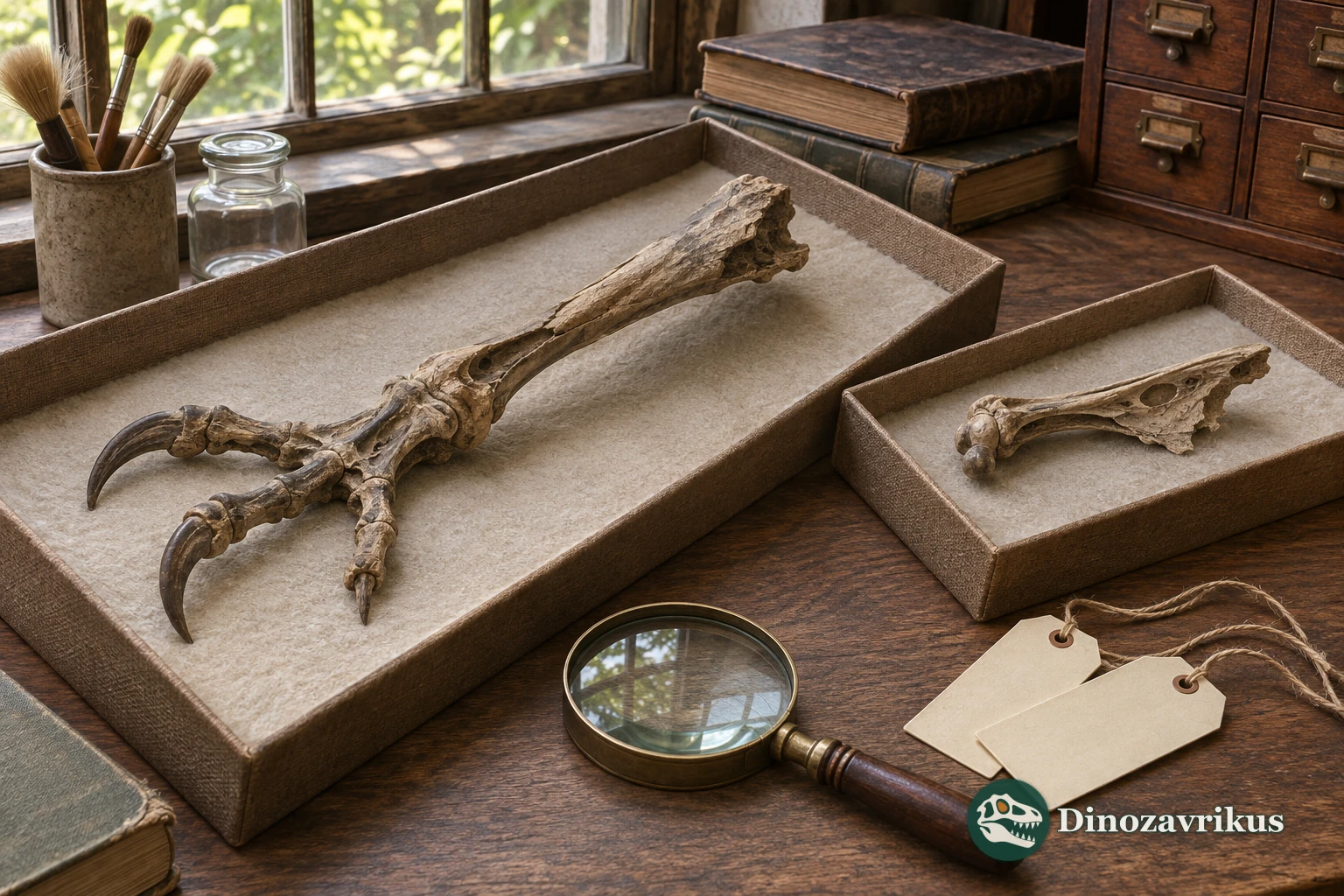
Harvard’s Museum of Comparative Zoology holds the incomplete tarsometatarsus MCZ 2257 and proximal carpometacarpus MCZ 2258. The former is a lower foot bone connecting the ankle region with the toes. The latter forms part of the wing hand. Their recovery from disturbed cave soil leaves no basis for treating them as a single skeleton.
Wing bones from New Providence
In 1982 Storrs Olson and William Hilgartner referred a nearly complete ulna and the shaft of another ulna from Banana Hole, New Providence, to the same species. The specimens are numbered UF 25640 and UF 25641. They broaden the recorded distribution beyond the type locality without establishing how many individuals lived on either island.
Strong mineralisation and the fossils found alongside the Little Exuma bones favour a Pleistocene age. Much of the cave soil had already been removed by the time an expedition returned in 1953, leaving little stratigraphic information to refine the date.
Comparing Caribbean hawks
Comparison with Cuban accipitrids shows that the Bahamian bird had a relatively short and stout tarsometatarsus compared with Buteogallus borrasi. That comparison concerns the proportions of a bone. The available specimens give no secure whole-body mass, wingspan or plumage pattern.
The Cuban species was once provisionally placed in Titanohierax. A 2007 reassessment placed it in Buteogallus and treated two partial jaws from Grand Cayman as indeterminate accipitrids. Large bones occur in several Caribbean raptors, including Amplibuteo, so size offers too little evidence by itself to identify a genus.
Olson and Hilgartner suggested Bahamian hutias as likely prey based on the available island fauna. The suggestion rests on ecological reasoning. No preserved meal or other direct dietary trace establishes the prey of Titanohierax.
Frequently asked questions
Why did the original description name a different island?
Wetmore relied on the original locality information. Later work located the type site at Upper Pasture Cave on Little Exuma.
What part of the holotype survives?
MCZ 2257 preserves a tarsometatarsus without its proximal end, where it would meet the bone above it.
Has the genus been confirmed from Cuba?
The Cuban species once provisionally assigned to Titanohierax was moved to Buteogallus. The securely referred Titanohierax material is Bahamian.
When did the bird die out?
The known fossils are regarded as Pleistocene. The dating does not resolve the extinction to a particular time or tie it securely to human activity.