

Titanoides was a large mammal of the Late Paleocene in North America. George Gidley initially compared its teeth with those of titanotheres, inspiring the name. Later material showed that it belonged among pantodonts, an extinct group of large placental mammals. Despite its prominence in discussions of the period, the genus is not known from a universally accepted complete skeleton: much of its record consists of rare teeth and jaw fragments.
The genus appears in the ancient mammal catalogue. Its record covers several intervals, and the named species are represented unequally. It is especially important to separate evidence from individual fossils from early guesses about missing parts of the skull.
Quick facts
| Scientific name | Titanoides Gidley, 1917 |
|---|---|
| Type species | T. primaevus Gidley, 1917 |
| Group | Pantodonta; family Titanoideidae |
| Age | Late Paleocene: Tiffanian through Clarkforkian records |
| Range | North Dakota and Wyoming, USA |
| Holotype | USNM 7934, lower cheek teeth and fragments of the jaw symphysis |
| Body size | No complete skeleton establishes a precise total length |
| Open question | How reliably rare fossils record species and size change |
What can the fossils tell us?
George Gidley described Titanoides primaevus from USNM 7934 near Buford, North Dakota. The material comprised lower cheek teeth and pieces of the jaw symphysis, not a full skull or skeleton.
The lower teeth helped identify a large pantodont. Gidley’s first comparison with titanotheres was later rejected, and the hypothetical upper teeth in his original reconstruction were not part of the holotype.
Titanoides is known from sparse material across several Late Paleocene intervals. T. nanus was described from four specimens at two localities; other named forms also vary in completeness and synonymy.
The type material is Tiffanian, while T. nanus extends the known record into the middle Clarkforkian. These are Late Paleocene biochronological intervals, not exact calendar dates for every fossil.
The holotype and first description
In 1917 George Gidley described Titanoides primaevus from Paleocene deposits near Buford, North Dakota. Specimen USNM 7934 includes lower cheek teeth and fragments of the front of the lower jaw. It anchors the species name but is not a complete skull: the original reconstruction of the upper tooth row was conjectural.
Gidley compared the teeth with those of titanotheres and proposed an affinity with perissodactyls. He explicitly noted that the suggested upper teeth were hypothetical. Additional material changed the classification: Titanoides is placed among pantodonts, not titanotheres. Later discoveries of skull fragments and upper teeth helped test parts of the early proposal, but they did not turn the holotype into a complete skeleton.
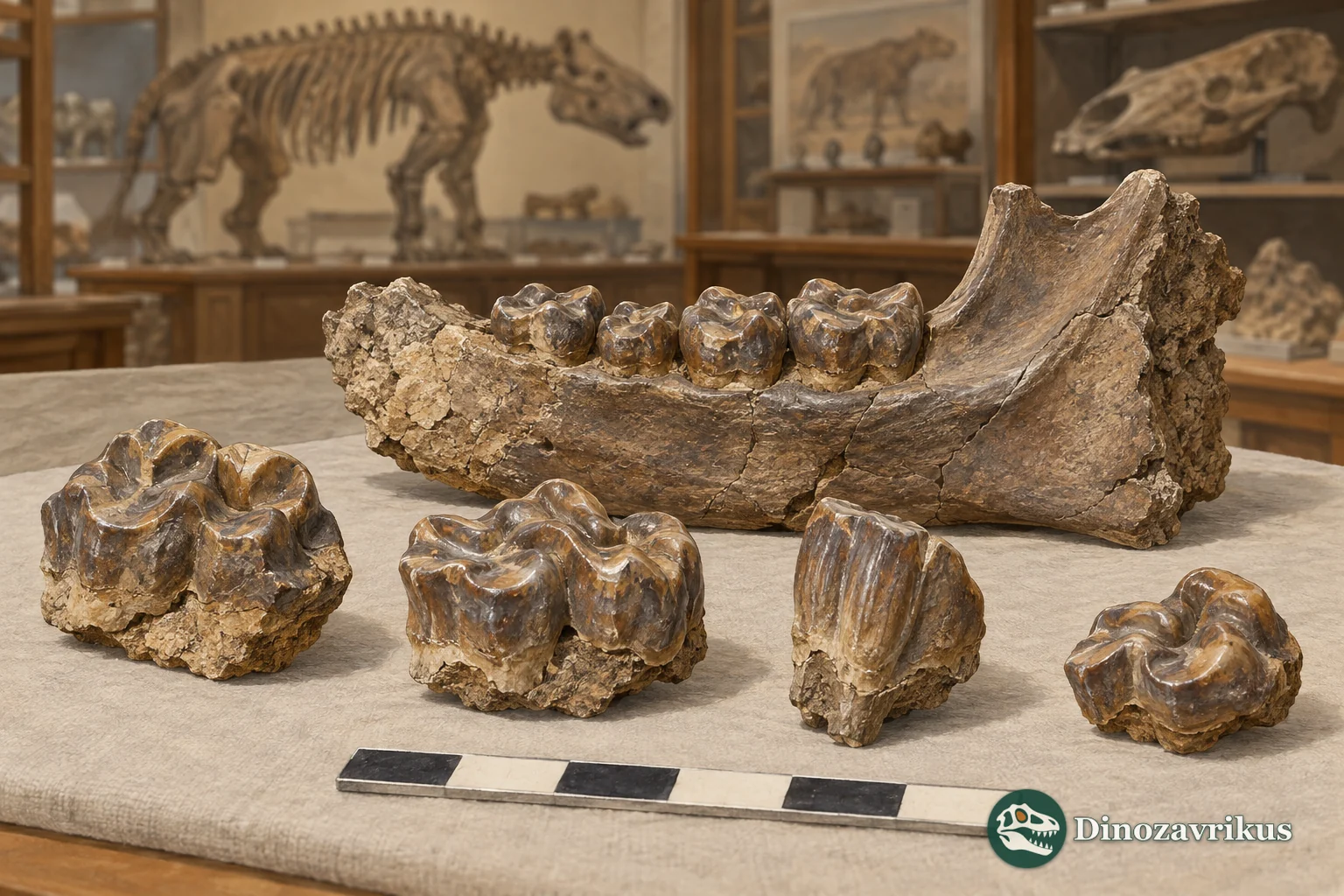
What teeth and jaws can tell us
Lower molars and jaw fragments were the main evidence for the type species. Later finds assigned to T. primaevus added information about the upper dentition. Teeth record the structure of the chewing apparatus and permit comparisons among specimens. They do not reveal every body proportion or an exact menu.
Pantodonts are generally interpreted as predominantly herbivorous mammals, and the teeth of Titanoides are consistent with plant eating. The particular plants, feeding technique and proportion of different foods are not directly established. There is no widely accepted complete skeleton of the genus from which body length and mass could be independently measured.
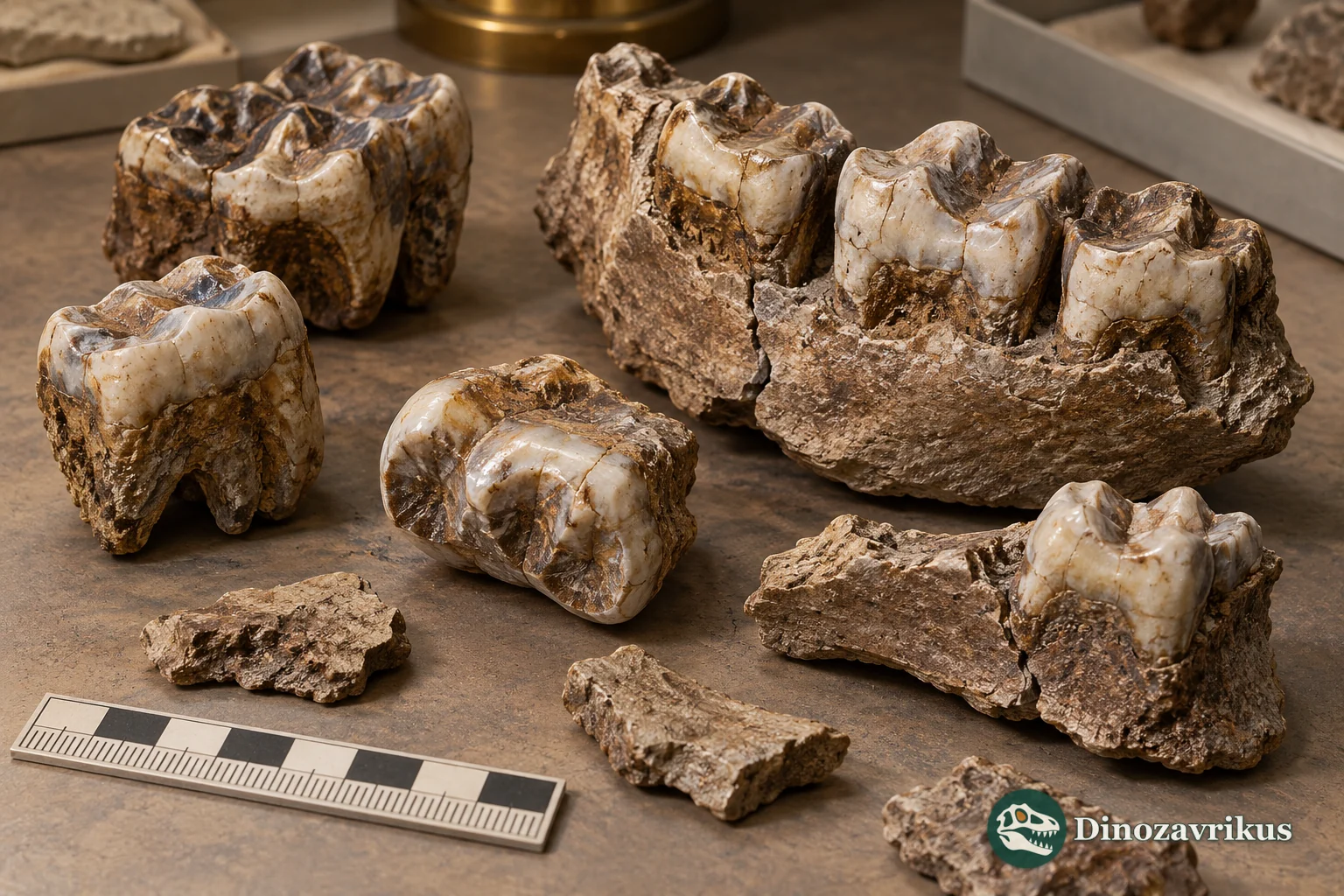
Species, size and sparse finds
Several species have been named, including T. primaevus, T. gidleyi, T. zeuxis, T. major and T. nanus. Their status and relationships are not equally secure. Some names rest on limited material, and synonymies or possible mergers have been discussed. Fragmentary fossils do not reduce every question to one settled list.
In 1996 Philip Gingerich described T. nanus from four specimens at two middle Clarkforkian localities in Wyoming’s Clarks Fork Basin. It is the smallest named species of the genus by tooth size; a smaller body is inferred rather than measured from a complete skeleton. Canine proportions and molar features also distinguish it from other known samples.
Titanoides occurs at many localities but is nowhere common. With few specimens, it is difficult to distinguish individual variation from age, sex or evolutionary change. A trend toward smaller size along one lineage is therefore an interpretation of sparse samples, not a continuously documented sequence of generations.
Late Paleocene time and habitat
The type specimen of T. primaevus comes from Tiffanian deposits in North Dakota. The later record includes the middle Clarkforkian of Wyoming, where T. nanus is known. Tiffanian and Clarkforkian are North American Late Paleocene land-mammal ages. They help compare faunas and strata but do not give an exact date in millions of years for every tooth.
Finds from different basins occur in terrestrial deposits and faunas of western North America. Sediments and associated fossils help reconstruct those landscapes. The rare teeth of Titanoides do not show that every population lived in one type of forest or ate the same plants.
How its classification changed
The history of Titanoides illustrates how a classification based on incomplete material can change when more anatomy becomes available. Gidley’s original comparison with titanotheres relied on lower teeth and conjectures about the upper row. Additional teeth and cranial material later supported pantodont affinities. The genus is now placed in Titanoideidae within Pantodonta.
Species boundaries and synonyms remain a separate challenge. Some species have several specimens, while others rest on a single incomplete find. Even visible tooth differences must be tested against age, sex, wear and variation within a species. A careful account should state both the current placement and the limits of the evidence.
Frequently asked questions
When did Titanoides live?
It lived during the Late Paleocene. The type species is known from Tiffanian deposits, while T. nanus is from the middle Clarkforkian; these intervals are not one exact calendar date.
Why was it first compared with titanotheres?
Gidley used similarities in the lower teeth and proposed a hypothetical upper tooth row that the holotype did not preserve. Additional fossils helped establish pantodont affinities.
Is a complete Titanoides skeleton known?
There is no widely accepted complete skeleton for the genus. Teeth and jaw fragments provide most of the evidence for the type species and several other names.
Was Titanoides herbivorous?
Its pantodont classification and teeth are consistent with plant eating. The precise diet, plant species and feeding behaviour are not directly established.