

The Cambrian trilobite Tomagnostus has an elongate node on the head and a tapering axis on the tail shield. At Manuels River in Newfoundland, the first occurrence of its type species marks the base of a biostratigraphic zone.
Quick facts
| Group | Agnostida |
|---|---|
| Material age | Middle Cambrian |
| Genus established | Howell, 1935 |
| Type species | Tomagnostus fissus |
| Neotype | SGU 4840, Sweden |
| Whole shells | 4 and 7.9 mm |
What can the fossils tell us?
The original holotype was lost. Specimen SGU 4840 from Scania was designated as the neotype.
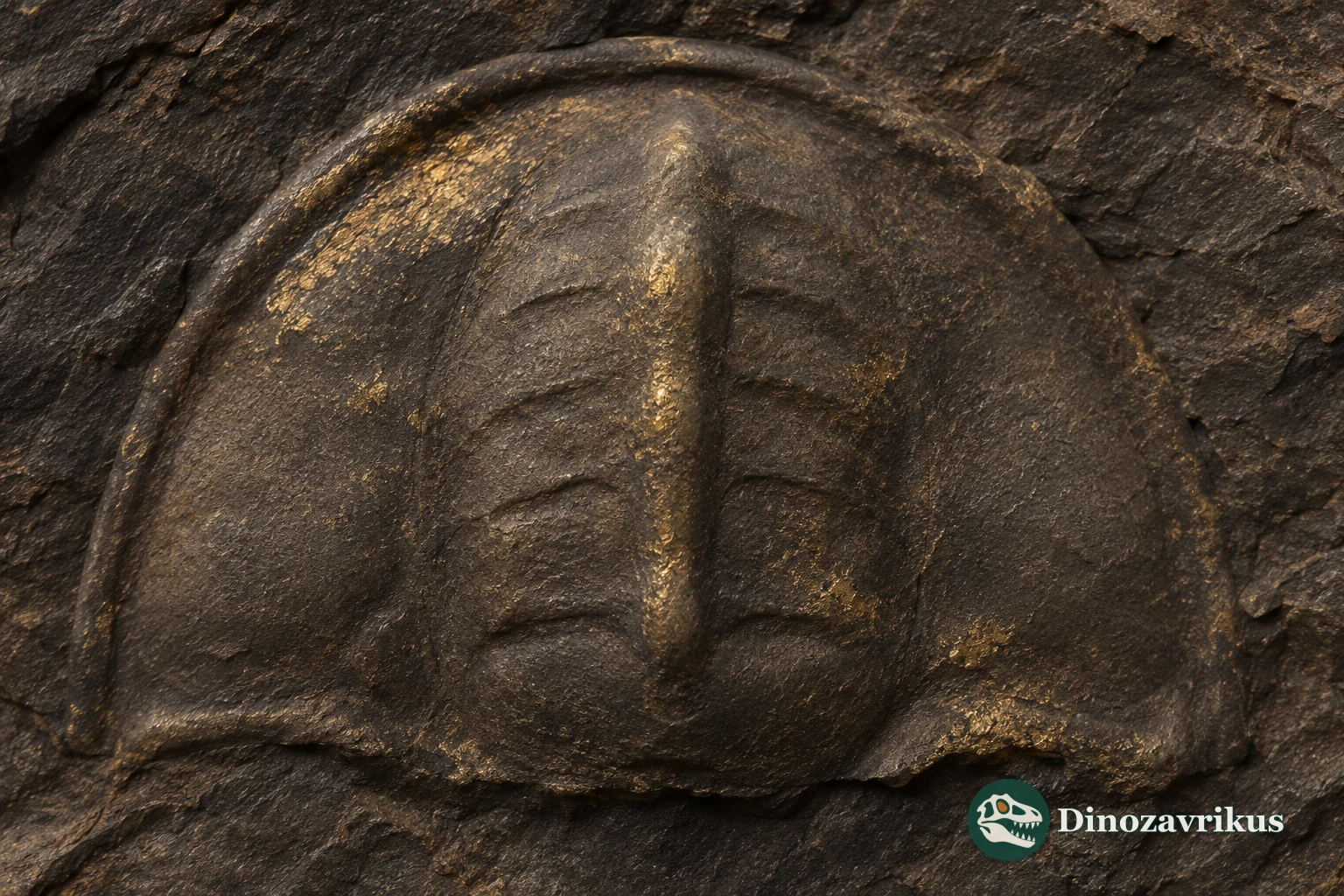
Larger head shields have shallow cheek grooves. A transverse groove across the axis bends strongly forward.
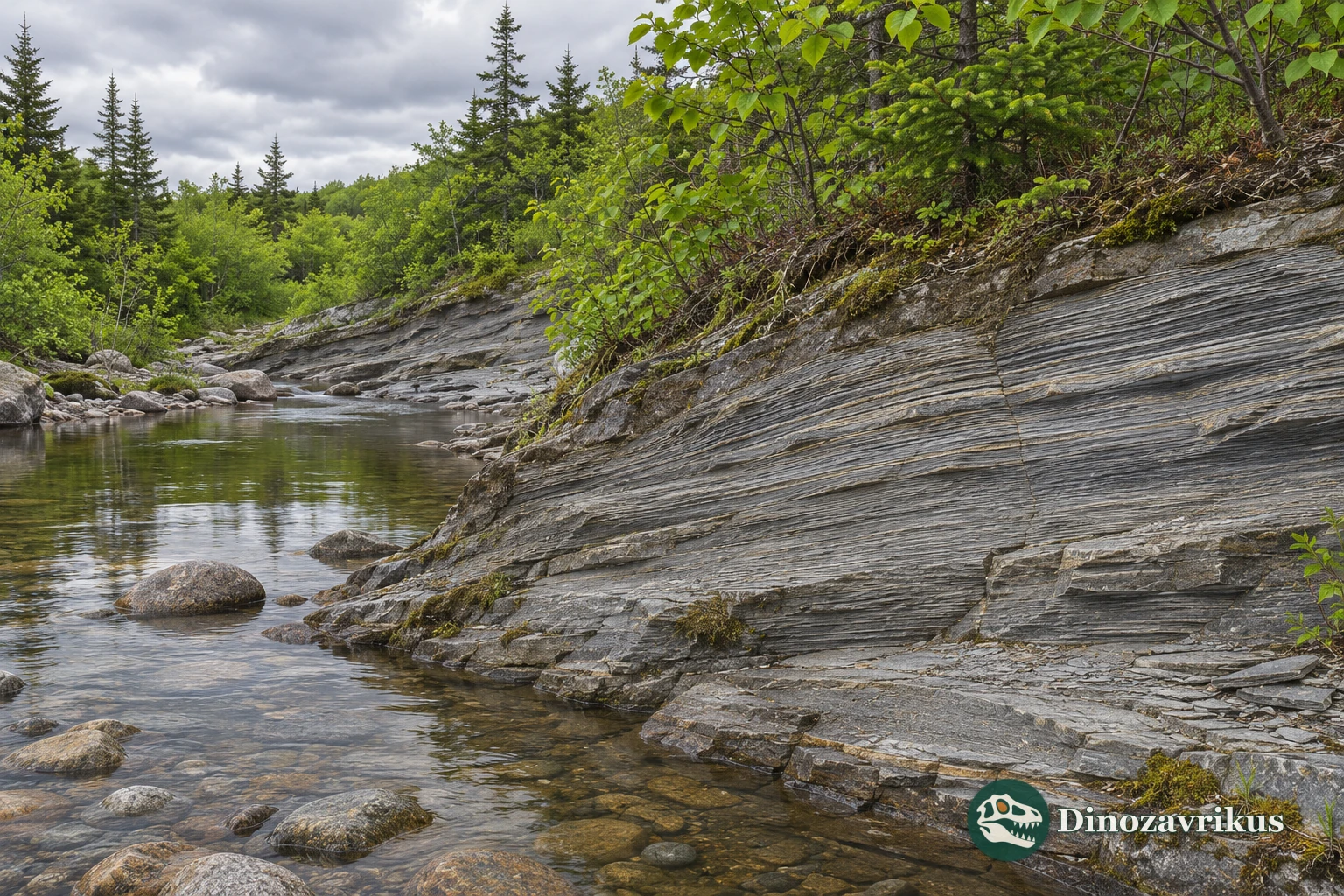
T. fissus first occurs at 3.89 m in the measured section. Its namesake zone extends to 10.96 m.
The Swedish type and the Newfoundland series
Benjamin Howell established the genus in 1935. Its type species, T. fissus, was first described in 1879 as Agnostus fissus from the Exsulans Limestone near Brantevik in Scania, Sweden. The original holotype was lost. Anders Westergård designated SGU 4840 as neotype in 1946.
The lower Manuels River Formation of eastern Newfoundland yielded two complete exoskeletons, 4 and 7.9 mm long, together with 56 head shields and 23 tail shields. They are catalogued as NFM F-1651–F-1731.
Recognizing the shields
Smaller specimens have smooth or lightly sculptured cheeks. In larger specimens the grooves are deeper, and a median groove near the front can extend beyond the glabella. A long axial node and a strongly forward-curving transverse groove are especially useful for identifying the species.
A lance-shaped axis narrows toward the rear of the tail shield. A second, small axial node is visible in some examples. Pyrite in the shale accounts for the yellow surface on some of the fossils. A close relative, T. perrugatus, has more strongly sculptured cheeks and a pair of spines on the tail margin.
Defining the fossil zone
The specimens identified as T. fissus occur between 3.89 and 7.70 m in the measured section. Its namesake zone starts at 3.89 m but extends up to 10.96 m, where Hypagnostus parvifrons first appears. The boundary thus lies above the last documented occurrence of T. fissus in that section.
Frequently asked questions
Where was the species first found?
The original material came from the Exsulans Limestone near Brantevik, southern Sweden.
How long are the complete specimens from Newfoundland?
The two studied exoskeletons measure 4 and 7.9 mm.
Why are some of the fossils yellow?
The yellow surface of some specimens comes from pyrite in the shale.
What marks the top of the zone at Manuels River?
The first occurrence of Hypagnostus parvifrons at 10.96 m in the measured section.