

Tornieria was a Late Jurassic diplodocid from Tanzania. Fossils assigned to it preserve parts of the skull, limbs and backbone. Its tail vertebrae offer a way to investigate both its relationships and the extent of air-filled spaces in its skeleton.
Quick facts
| Group | Sauropods, diplodocids (Diplodocidae) |
|---|---|
| Age | Late Jurassic |
| Region | Africa (Tanzania) |
| Diet | Herbivorous |
| Type species | Tornieria africana |
| Type material | Part of skeleton A from Tendaguru |
| Strata | Tendaguru Formation |
What can the fossils tell us?
The original material includes a front tail vertebra, a rib fragment and several bones of the pelvis and hind limb.
A specimen assigned to Tornieria preserves part of the braincase. Comparisons of those bones inform its place among diplodocids.
Scans show that deep external recesses connect to internal cavities. This is evidence that air-filled extensions of the respiratory system entered the bone.
How Tornieria got its name
Eberhard Fraas described the Tendaguru fossils in 1908 as Gigantosaurus africanus. The genus name was already in use for another sauropod, so Richard Sternfeld proposed the replacement name Tornieria in 1911.
Werner Janensch later assigned the African fossils to the North American genus Barosaurus. In 2006 Kristian Remes revised the material and restored Tornieria as a separate genus. Comparisons of skull, tail and limb bones continued to place it close to Barosaurus.
Air chambers deep in the tail
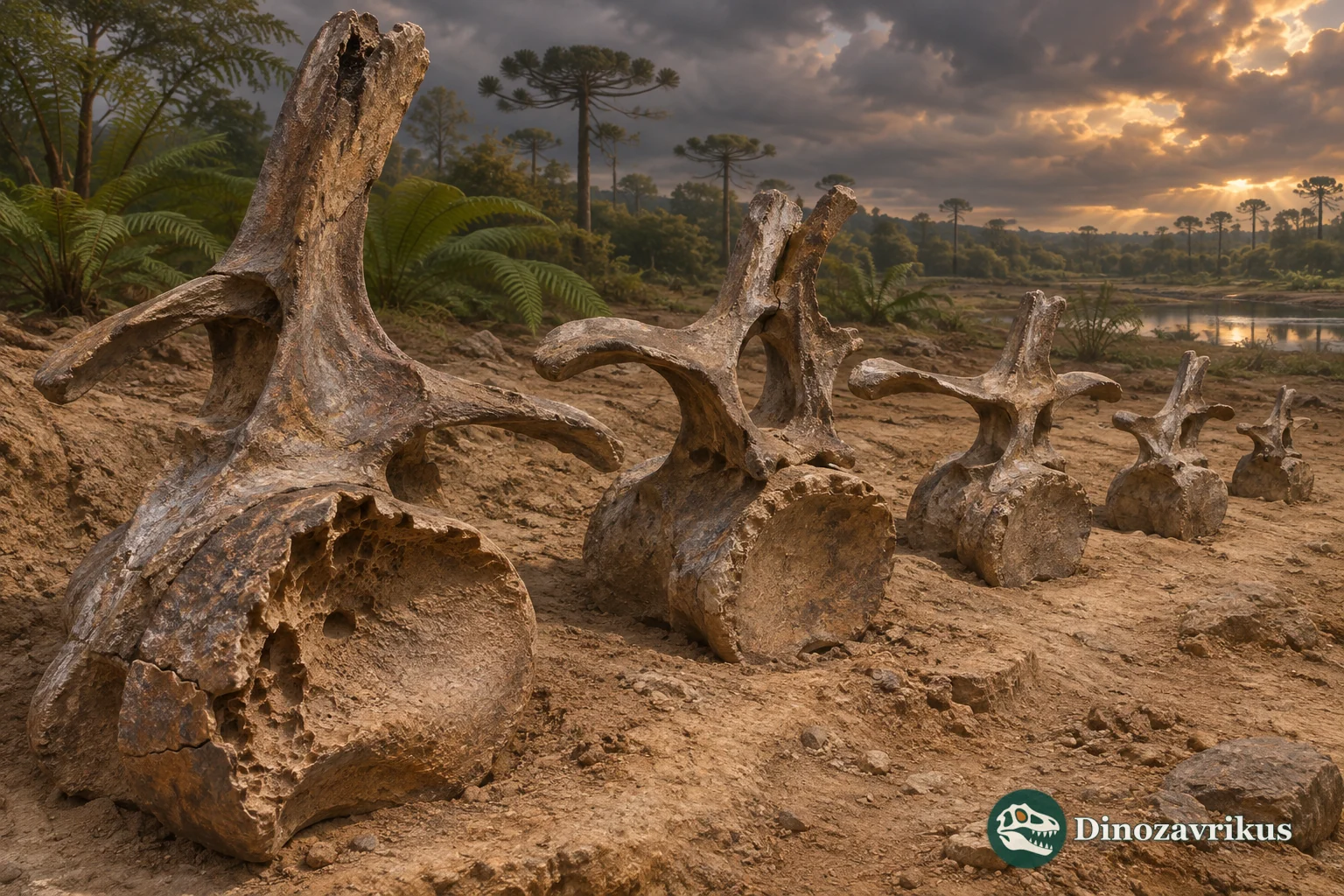
CT scans of seven vertebrae from the Berlin collection revealed internal chambers in front, middle and rear portions of the tail. The chambers connect to recesses on the bone surface. The front vertebra had more extensive chambers than the sampled vertebrae from the beginning of the middle tail.
The cavities are interpreted as the work of extensions of the respiratory system that invaded the bone. The soft tissues themselves are gone. Comparable extension of chambers down the tail occurs in some other sauropods and may have evolved independently in multiple groups.
What the fossils suggest about its appearance
A long neck, relatively short forelimbs and an extended tail are consistent with its place among diplodocids. Its usual neck posture and colouring remain uncertain. As a sauropod it was herbivorous, though the bones do not identify the plants it ate.
Frequently asked questions
Where was Tornieria found?
Its fossils come from the Late Jurassic Tendaguru Formation of southern Tanzania.
Why was Tornieria once called Barosaurus?
Early comparisons emphasised similarities between African and North American diplodocid bones. Later work supported a separate African genus.
What did the CT scans reveal?
Specimens assigned to Tornieria have internal chambers in front, middle and rear tail vertebrae.
Was it a herbivore?
Yes. Herbivory follows from its sauropod affinities. The plants it ate are unknown.