

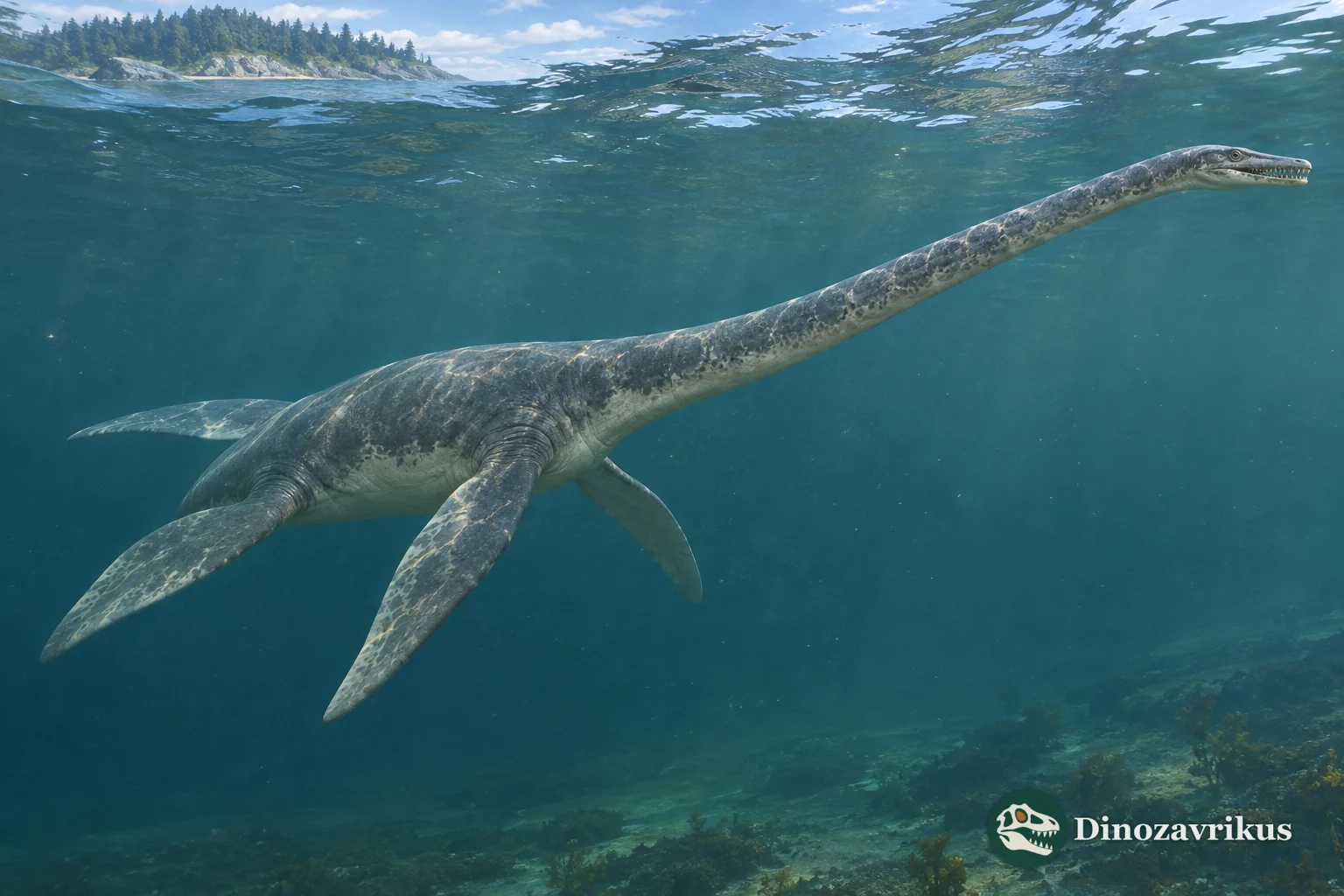
Traskasaura sandrae was a Late Cretaceous elasmosaurid plesiosaur from Vancouver Island, British Columbia. Three fossils from the Haslam Formation preserve different parts and growth stages: a poorly preserved holotype, a better-preserved but osteologically immature skeleton, and an isolated right humerus. Together they revealed an unusual combination of anatomical traits that had remained difficult to interpret for decades.
Quick facts
| Type species | Traskasaura sandrae |
|---|---|
| Age | Late Cretaceous, Upper Santonian |
| Locality | Vancouver Island, British Columbia, Canada |
| Formation | Haslam Formation, Nanaimo Group |
| Type specimen | CDM 002, an incomplete and poorly preserved skeleton |
| Additional material | An immature skeleton and an isolated right humerus |
| Estimated length | About 39 ft (12 m) in an institutional summary; not measured from a complete skeleton |
Evidence guide
CDM 002 is the holotype. CDM 161 preserves a more legible but osteologically immature skeleton, while CDM 2006.8.1 is an isolated right humerus. The fossils must not be combined as a single individual.
The described series includes at least 36 cervical vertebrae with vertebral length indices over 100. The total number of neck vertebrae is unknown, so a complete neck length cannot be measured from the fossils.
The holotype mandible has a broad symphysis and large teeth. These are direct anatomical observations; they do not identify a specific prey item or provide a complete diet.
The 2025 phylogenetic analysis recovered Traskasaura near the base of Elasmosauridae. Similarities between some limb bones and derived aristonectines were interpreted as convergence, not evidence of direct ancestry.
A riverbank find and a name decades later
Michael Trask and his daughter Heather found the first skeleton beside the Puntledge River near Courtenay in 1988. It entered the Courtenay and District Museum collection as CDM 002. The bones were difficult to interpret because they were poorly preserved, and a 2002 account treated the fossil as an indeterminate elasmosaurid rather than naming a new genus.
A second skeleton, CDM 161, was found near the Trent River in 2020. It preserves more anatomical detail, although its degree of skeletal fusion shows that the animal was not fully mature. A separate right humerus, CDM 2006.8.1, adds another point of comparison. In 2025, F. Robin O'Keefe and colleagues used these specimens to establish Traskasaura sandrae. The genus honours Michael and Heather Trask; the species name honours Sandra Lee O'Keefe.
All three specimens come from the Haslam Formation of the Nanaimo Group on Vancouver Island, assigned to the Upper Santonian of the Late Cretaceous. CDM 002 is the name-bearing holotype; the additional fossils broaden the anatomical sample but remain separate animals and finds.
A long neck and an unusual jaw
The holotype preserves a relatively narrow lower jaw with large teeth and a broad symphysis, the joined region at the front of the two mandibular halves. This combination is less specialised than the expanded oral anatomy found in some derived aristonectines. Tooth size and shape may inform hypotheses about prey capture, but the described fossils do not provide stomach contents or a direct record of a particular meal.
At least 36 cervical vertebrae are preserved, and their vertebral length indices exceed 100. The neck therefore included many elongated centra, but its total vertebral count is unknown. The fossils do not establish an exact neck length. The cervical ribs point forward, a trait that occurs in some derived elasmosaurids, while other features of the neck retain a more plesiomorphic pattern.
That mixture matters because anatomical features do not all have to evolve together. A long neck, a relatively unspecialised jaw and unusual limb traits can coexist in one animal. The mosaic does not make Traskasaura an ancestor of later plesiosaurs.
Shoulder girdle, flippers and evolutionary placement
The coracoid has a distinctive reduced recess positioned toward its rear. The humerus has a relatively straight shaft, a pronounced ventral curve and an unusual relationship between the facet on its leading edge and the radial facet. These features help diagnose the taxon. They do not preserve a swimming stroke or show exactly how the flippers moved through a cycle.
The 2025 revised phylogenetic analysis placed Traskasaura in a basal position within Elasmosauridae. Some appendicular features resemble those of more derived aristonectines, but the authors interpreted these similarities as convergent adaptations. That conclusion concerns the distribution of skeletal characters in the analysis; it is not a claim that one group descended directly from Traskasaura.
Plesiosaurs had four paddle-like limbs. Their bones support a broad reconstruction of the swimming apparatus, while the exact speed, manoeuvres and preferred depth remain unknown. For a contrast with a short-necked Cretaceous plesiosaur, see the profile of Dolichorhynchops.
Size, the Santonian sea and missing evidence
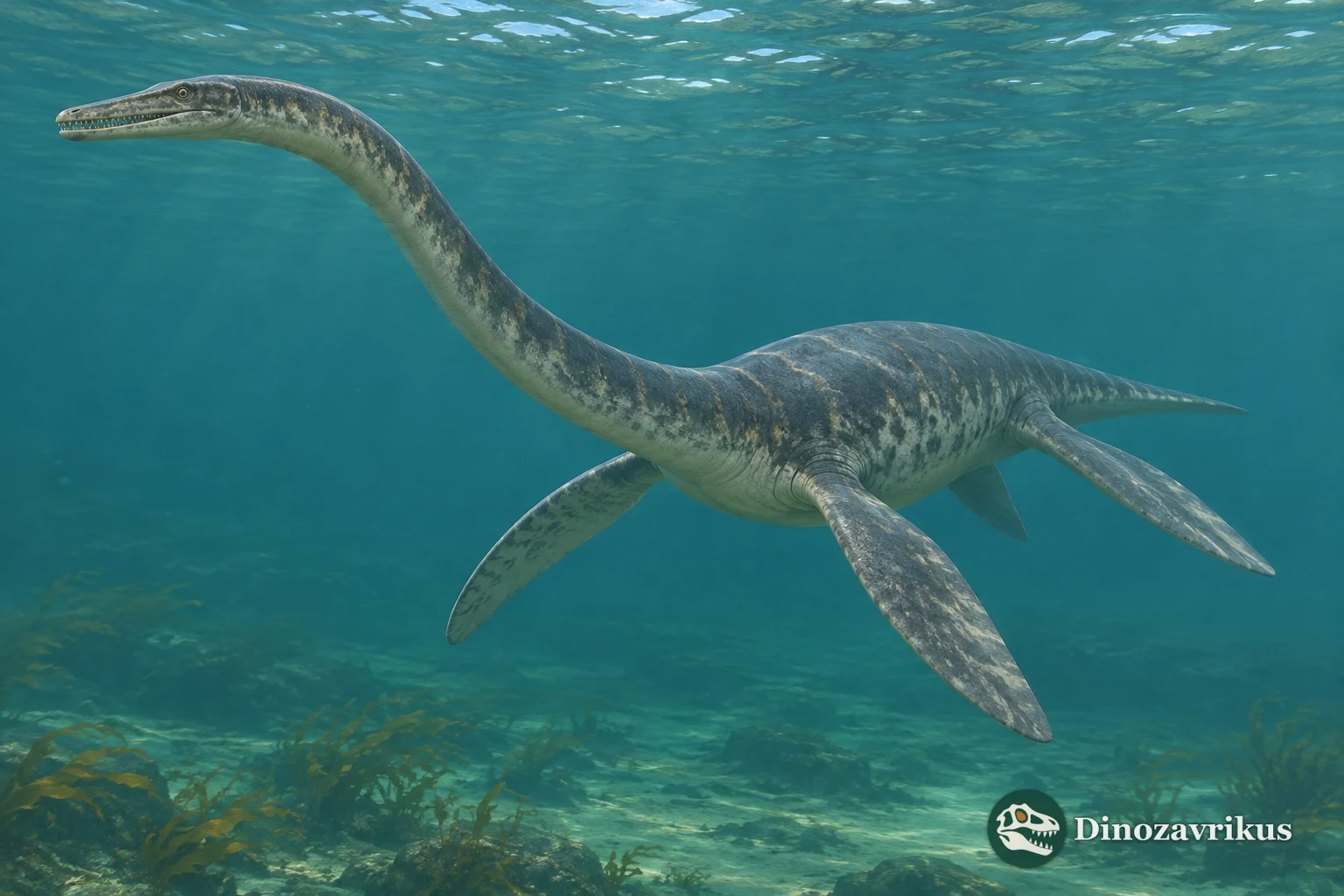
Marshall University, whose researchers co-authored the naming study, described Traskasaura as about 39 feet (roughly 12 m) long. This is an approximate reconstruction reported by the institution, not a direct measurement of a complete articulated skeleton. The holotype is incomplete, and the other skeleton belongs to an immature individual, so exact proportions remain uncertain.
The Haslam Formation places the fossils in a Late Cretaceous marine setting along the Pacific margin of North America. The geological context does not determine the animal's exact water depth or behaviour. No direct evidence described here establishes its skin colour, reproductive biology, swimming speed or specific prey.
The taxon's long research history reflects the limits of preservation: a fossil can be scientifically important before its anatomy is clear enough for a formal diagnosis. The later skeleton added evidence, but did not erase the preservation problems of CDM 002. The broader overview of plesiosaurs and pliosaurs provides context for this diversity without turning anatomical resemblance into a family tree by itself.
Frequently asked questions
Who discovered Traskasaura?
Michael Trask and his daughter Heather found the first known skeleton beside the Puntledge River in 1988. Later fossils from the Haslam Formation helped establish the genus.
Why was it named only in 2025?
The first skeleton was poorly preserved and was initially identified only as an indeterminate elasmosaurid. Additional material allowed researchers to compare more anatomical features and formally diagnose the taxon.
How many neck vertebrae are known?
At least 36 cervical vertebrae are preserved, but the total number is unknown. The complete neck length cannot be measured from the known material.
How long was Traskasaura?
Marshall University reported an approximate length of 39 ft (about 12 m). This is a reconstruction estimate, not a direct measurement of a complete skeleton.