

Trematolestes was an aquatic amphibian from the Middle Triassic of southern Germany. It had a long, narrow snout, very small forelimbs and a tail with tall vertebral spines. An almost complete juvenile skeleton was the first to show those parts together in a member of the trematosaurid family.
Quick facts
| Group | Temnospondyls, trematosaurids |
|---|---|
| Age | Middle Triassic, late Ladinian |
| Region | Europe, Germany (Baden-Württemberg) |
| Type species | Trematolestes hagdorni |
| Scientific name | Trematolestes |
| Diet | Aquatic predator |
What can the fossils tell us?
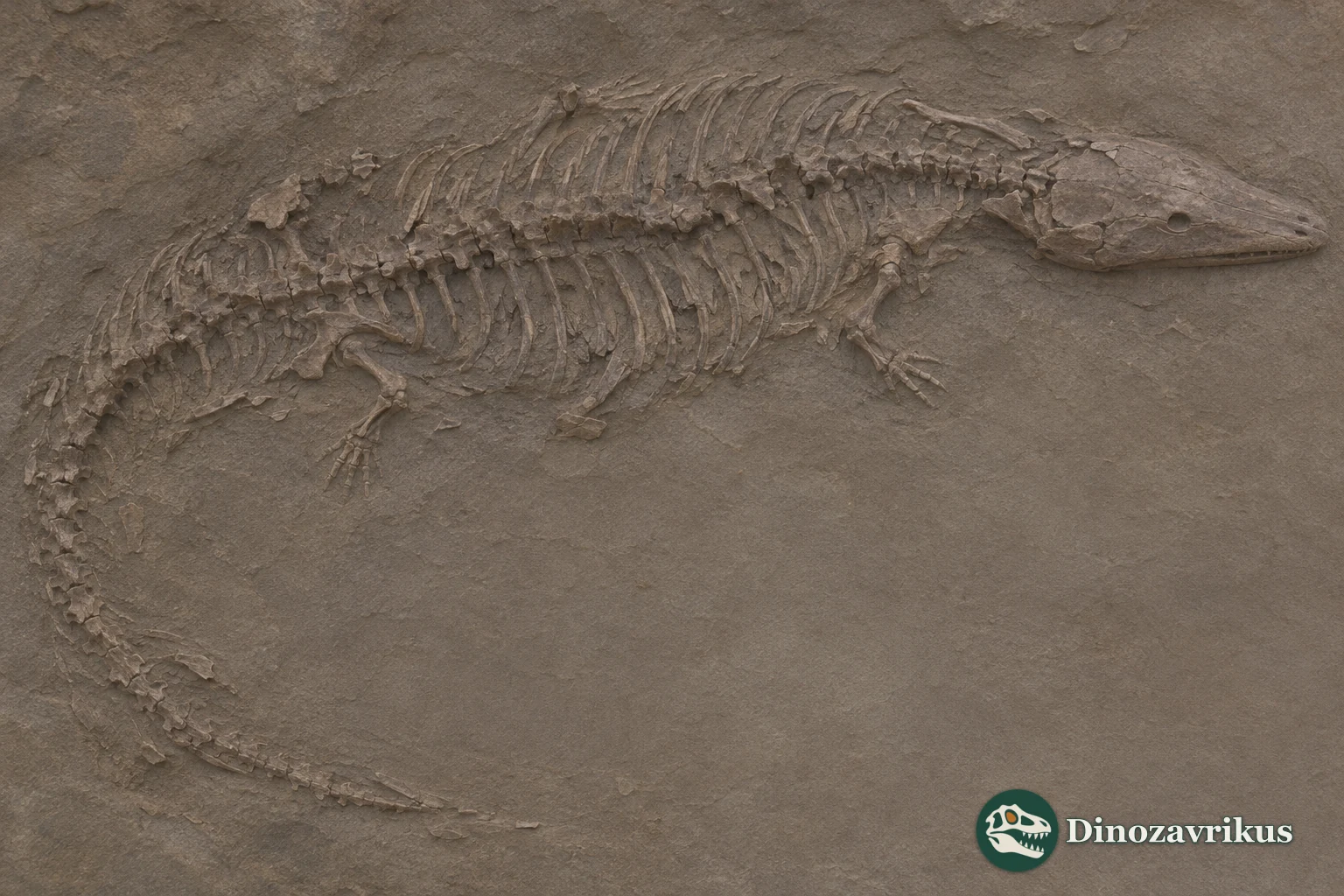
The holotype from Michelbach an der Bilz preserves a skull about 11.8 cm long, the trunk, limbs and much of the tail.
Tall spines on the tail vertebrae, small forelimbs and the proportions of the skeleton are consistent with propulsion by sweeping the tail.
The snout and teeth suggest it could catch fish. Their shape does not reveal all the prey it ate or how much fish made up its diet.
The skeleton from Michelbach an der Bilz
Hans Hagdorn and Willy Ockert discovered the type locality and found the skeleton in 1979. Rainer Schoch described it in 2006 as Trematolestes hagdorni, naming the species after Hagdorn. The holotype, SMNS 81790, is at the State Museum of Natural History Stuttgart. It comes from silty marl in the Erfurt Formation, deposited during the late Ladinian.
What a nearly complete skeleton reveals
The skeleton preserves all 22 trunk vertebrae and at least 24 tail vertebrae. The end of the tail is incomplete, and some of its bones were displaced. The ribs have prominent projections, and the forelimbs are small with notably short upper arm bones. The hand probably had four digits. These details show how an elongated head was combined with small limbs and a long tail in a trematosaurid.
The snout and teeth
The long snout ends in a slight expansion, and a single frontal bone sits between the eyes. Small, slender teeth line the jaw margins, while the palate bears large fangs. Those fangs are flattened from side to side and have a distinct cutting ridge. That arrangement could have helped the animal hold slippery prey such as fish. The teeth do not establish how much of the diet was fish.
Changes during growth
The Erfurt Formation has yielded juvenile skulls and considerably larger adult skulls. In the smallest individuals, lateral-line grooves appear as disconnected traces near the eye socket. In larger ones these grooves form long, continuous channels in the skull roof. The biggest animals are estimated to have reached about 1.5 metres. That figure is an estimate for large individuals, separate from the measurements of the juvenile holotype.
Different waters for juveniles and adults
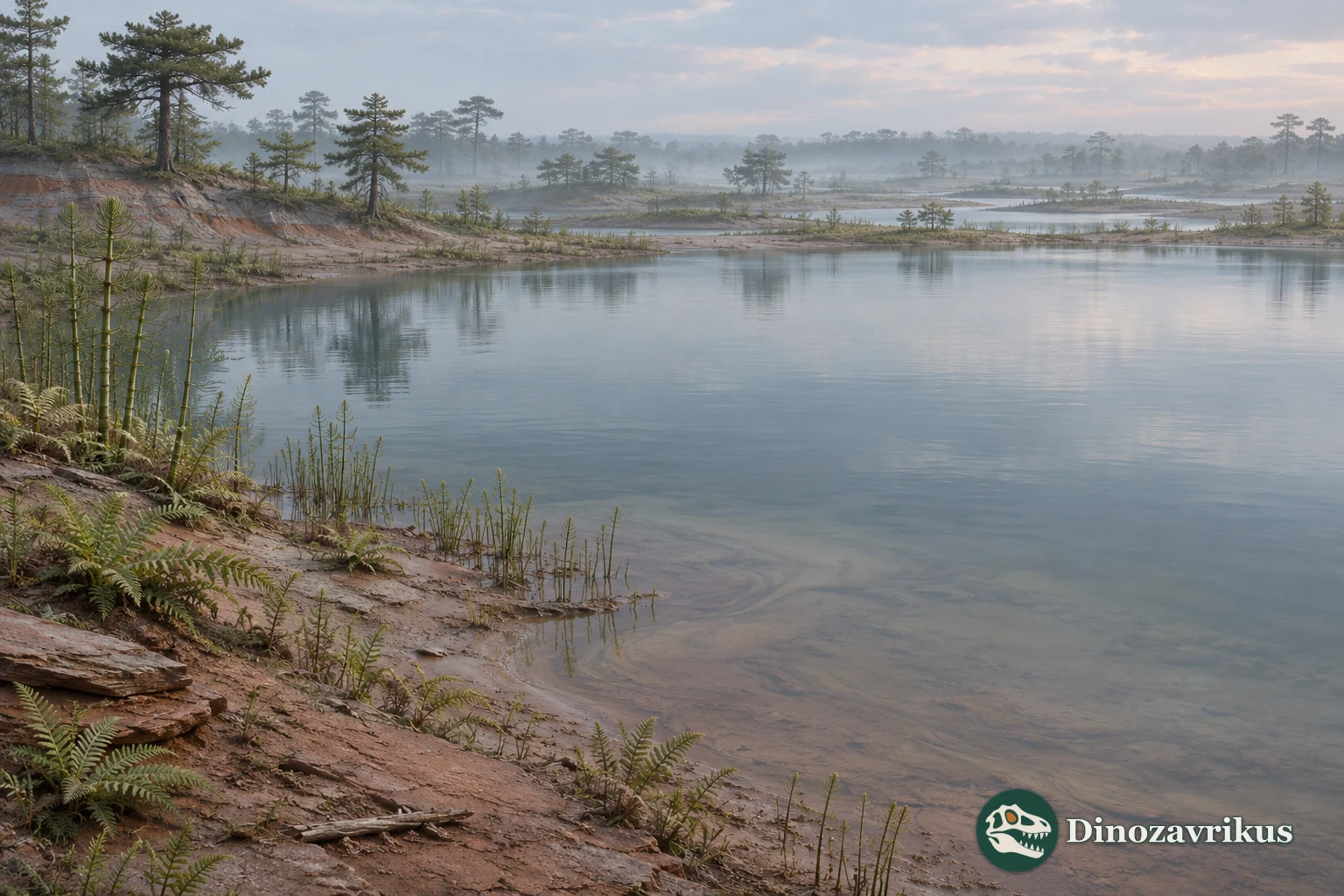
Beyond Michelbach, fossils are known from Gaildorf, Kupferzell and Vellberg. The sediment around the holotype also contains fish scales and material from other amphibians. Fossils of different ages are distributed unevenly among the lake deposits. Researchers interpreted adults as inhabitants of larger freshwater lakes and juveniles as more common in smaller waters with fewer kinds of large predator. Mastodonsaurus was another predatory amphibian in the same formation.
How its affinities were established
The earliest material from Gaildorf consisted of a few vertebrae and was long assigned to other amphibians. The more complete skeleton provided the features needed to recognise it as Trematolestes. The original phylogenetic analysis placed it with slender-snouted trematosaurids and recovered the Madagascan Tertremoides as its nearest relative in that analysis.
Frequently asked questions
Where was Trematolestes first found?
The type skeleton was discovered in 1979 near Michelbach an der Bilz, in Baden-Württemberg, Germany.
How large was Trematolestes?
The largest animals have been estimated at about 1.5 metres long. The type specimen is a juvenile with a skull about 11.8 cm long.
What did Trematolestes eat?
It was an aquatic predator. The long snout and large teeth on the palate suggest that it could catch fish.
What makes the type skeleton important?
The skull was preserved together with the vertebrae, ribs and limbs. These parts of trematosaurids had previously been known mainly from separate finds.