

The width of the tail axis and the length of its marginal spines help distinguish species assigned to Trilobagnostus. The head offers a separate set of characters. Revisions of the type species show why it matters whether the detached parts once described together belong to the same species.
Quick facts
| Group | Agnostida |
|---|---|
| Age of the material described here | Late Cambrian |
| Type species | Trilobagnostus innocens |
| Genus established | Horacio Harrington, 1938 |
| Type locality | Lévis, Quebec, Canada |
| Material | Head and tail shields |
What can the fossils tell us?
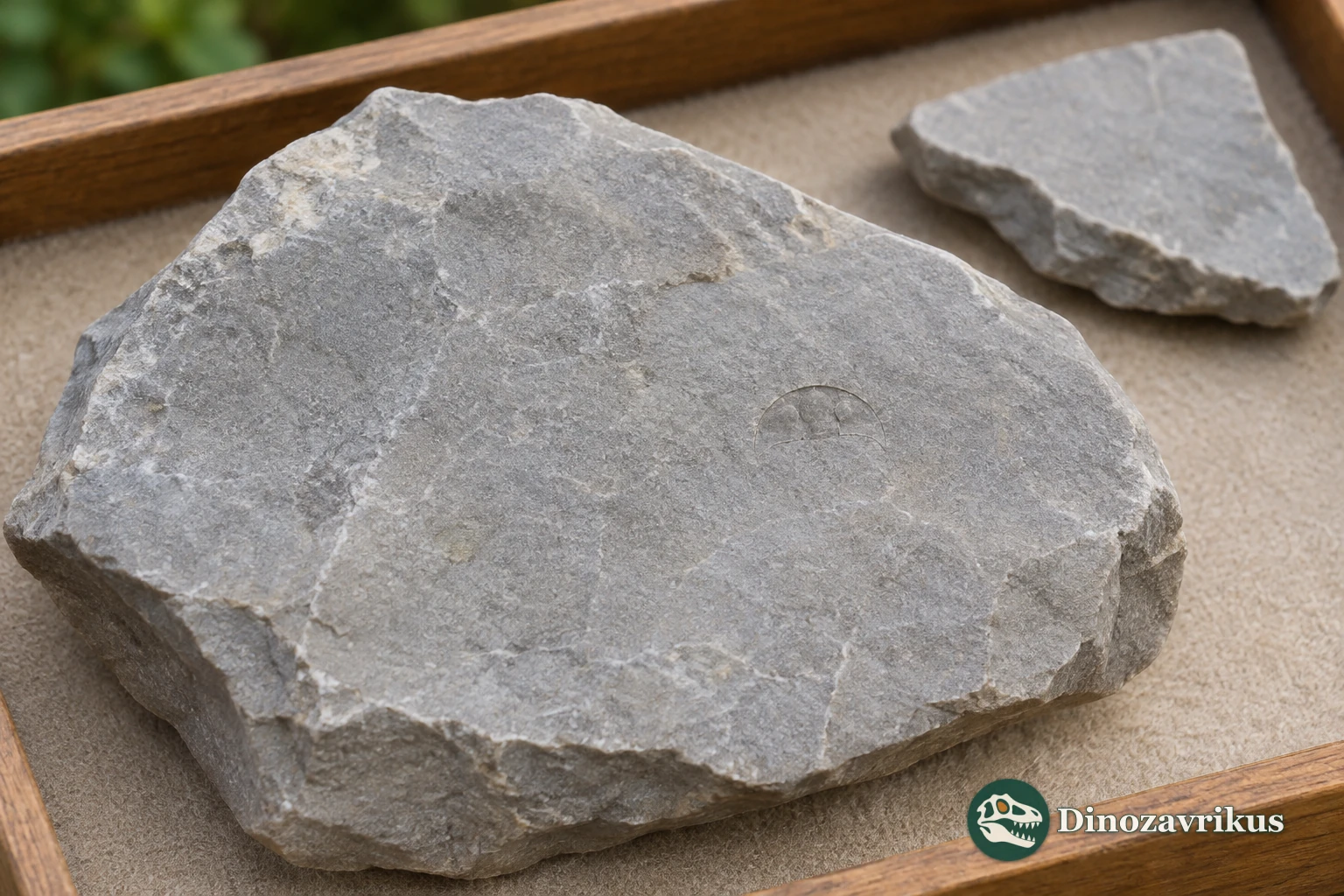
The smooth cheeks and the surface in front of the raised head axis are visible in the material of T. holmi from Degerhamn.
The pygidium of T. holmi also carries a pair of short marginal spines near the rear.
The authors described the specimens as Trilobagnostus sp. 1 and left the species unnamed.
The shields from Degerhamn
Three cephala and one pygidium of T. holmi were described from the Parabolina lobata Zone on Öland, Sweden. The head is almost as wide as it is long, with smooth cheeks and no median groove in the area between the glabella and the front margin.
In the pygidium, the middle axis occupies about half the width. The shield bears paired short marginal spines. T. herrigi has a narrower axis and longer spines, a difference that can be seen even when only the tail is preserved.
Why the name has moved between genera
In 1938 Horacio Harrington established Trilobagnostus for a species described as Agnostus innocens from Lévis, Quebec. Its holotype is a pygidium. A head from the original type series was later referred to Lotagnostus americanus, which changes which fossils can be used to describe the type species.
One revision interpreted the type species as a member of Micragnostus. The Degerhamn study published T. holmi under Trilobagnostus. The differing treatments explain why the species may be found under different combinations in the literature.
A sample from south-western Tasmania
Late Cambrian beds near Birch Inlet yielded four detached cephala and three pygidia. The material was described as Trilobagnostus sp. 1. The head shields have a rounded front and smooth cheeks, while the tails have a narrow median axis. The Tasmanian and Swedish fossil series are both Late Cambrian, and the width of the axis helps distinguish the material.
Frequently asked questions
Which shield is the holotype of the type species?
Innocens is based on a pygidium from Quebec.
Where was T. holmi found in Sweden?
The specimens from Degerhamn on Öland come from the Late Cambrian Parabolina lobata Zone.
How do the tail shields of T. holmi and T. herrigi differ?
T. holmi has a wider median axis and shorter marginal spines.
How many shields were described from Tasmania?
Four cephala and three pygidia were assigned to an unnamed species.