

Trogosus was a large North American member of the extinct order Tillodontia during the middle Eocene. It combined a heavy body, strong limbs and unusually enlarged incisors. Those front teeth can look superficially rodent-like, but tillodonts were a separate extinct placental lineage.
Its record includes jaws, teeth, several informative skulls and postcranial bones from western North America, with isolated tillodont teeth also reported in Japan. The genus is included in the ancient mammal catalogue. The earlier tillodont Esthonyx offers a useful comparison, while the evidence for each genus remains distinct.
Quick facts
| Scientific name | Trogosus Leidy, 1871 |
|---|---|
| Type species | T. castoridens Leidy, 1871 |
| Group | Tillodontia; family Esthonychidae, subfamily Trogosinae |
| Age | Middle Eocene records |
| Range | Western North America; isolated records from Japan |
| Main evidence | Jaws, teeth, skulls and postcranial bones |
| Body size | Among the largest tillodonts; mass is estimated comparatively |
| Open question | Species limits and rostral variation remain debated |
What can the fossils tell us?
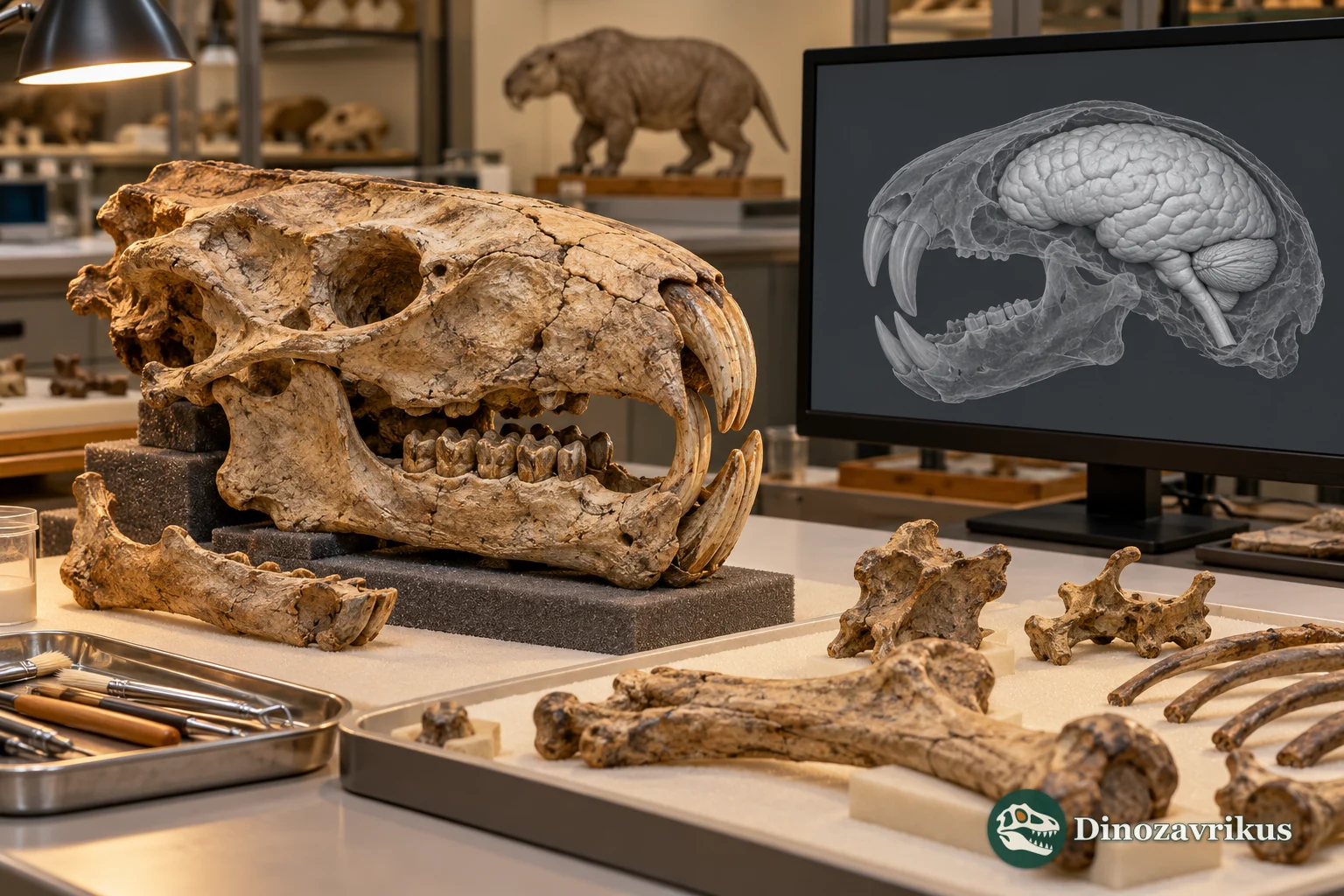
The holotype of Trogosus castoridens, ANSP 10337, preserves the front portions of both lower jaw rami with enlarged incisors and parts of the cheek-tooth row. It anchors the type species, not a complete reconstruction of the genus.
AMNH 17008, USNM 17157 and SDSNH 40819 provide important cranial evidence for named species. Differences in rostrum length and other features have been interpreted in more than one way, and the small sample limits taxonomic conclusions.
Virtual endocasts based on CT scans of three skulls describe the space inside the braincase and associated bony features. They do not preserve the brain itself in full and cannot directly measure intelligence or prove why the group became extinct.
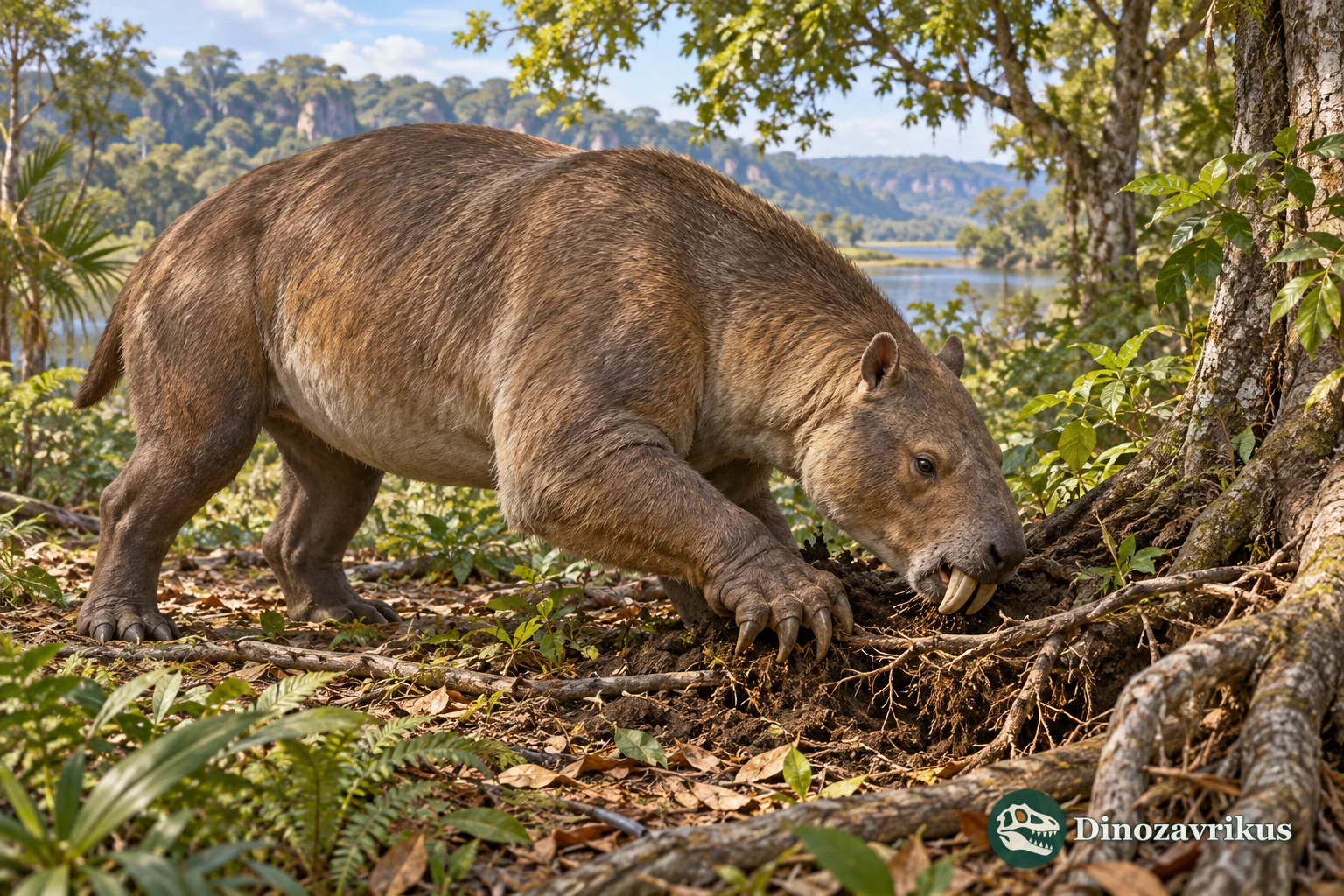
Ever-growing second incisors, robust limbs and curved terminal phalanges are consistent with plant processing and digging. Roots and tubers are a functional hypothesis, not preserved stomach contents.
The name and the type jaw
Joseph Leidy named Trogosus castoridens in 1871 from Grizzly Buttes in Wyoming’s Bridger Basin. The holotype, ANSP 10337, is held by the Academy of Natural Sciences of Philadelphia. It consists of the anterior portions of both lower jaw rami, enlarged incisors and fragments or alveoli of cheek teeth. It fixes the name of the type species, but it is not a complete skull.
Early Eocene and middle Eocene mammal teeth were initially assigned to several genera as their relationships were still being worked out. Charles Gazin’s 1953 Smithsonian monograph compared tillodont teeth and skeletons in detail and recognized several species of Trogosus. Later studies revised some assignments and extended the genus record beyond Wyoming and Colorado. Discoveries from Japan show that the group’s documented range was not exclusively North American, although those records are represented by fragmentary teeth.
Incisors, cheek teeth and a possible diet
The most conspicuous dental feature is the enlarged second incisor. Tillodont incisors grew continuously and carried enamel mainly on the front surface, a pattern that could maintain a cutting edge as the tooth wore. A gap separates the front teeth from the cheek-tooth row, whose crowns provided broader surfaces for processing food.
The dental pattern is consistent with a plant-based diet. Heavy wear in some early tillodonts has been interpreted as the result of eating vegetation contaminated with grit, and the robust forelimbs and curved terminal phalanges of Trogosus have prompted a hypothesis that it dug for roots or tubers. These are functional interpretations from teeth and bones. No stomach contents or feeding trace establishes a specific menu or proves how often the animal dug.
Species and the problem of rostrum length
Gazin recognized T. castoridens, T. hyracoides, T. grangeri, T. hillsii and T. latidens; later work added T. gazini. The evidential basis differs among names. Some are associated with more complete skulls, while others depend more heavily on jaws or isolated teeth, so the list should not be read as a set of equally well documented species.
One longstanding problem is the difference in rostrum length among fossils from the same basins. Gazin proposed that some long- and short-faced forms might represent sexual dimorphism. Other authors retained them as separate species because they also differ in cranial or dental details. A 2024 study of virtual endocasts found broadly similar overall endocranial shapes in the best-preserved specimens, while noting possible variation in the openings for the optic nerve and orbital fissure. The authors emphasized that limited preservation and small samples prevent a firm resolution.
The careful summary is that several named species have been used, but their boundaries remain open to further comparison. Rostrum length alone cannot demonstrate either separate species or sexual dimorphism.
Body size and locomotion
Postcranial proportions indicate a heavy, terrestrial animal with powerful forelimbs. Comparative estimates place the largest tillodonts among the heaviest members of the order; published mass estimates above 200 kg rely on allometric comparisons rather than a complete weighed skeleton. The result depends on the bones measured and the living or fossil comparison set, and should not be treated as a direct measurement.
Curved terminal phalanges are compatible with digging, while limb proportions do not imply a specialized fast runner. The fossil record constrains the basic weight-bearing anatomy much more securely than it reveals a single daily gait or activity pattern.
What the CT endocasts reveal
Bertrand and colleagues described CT-based virtual endocasts for specimens assigned to T. grangeri, T. hillsii and T. castoridens. An endocast records the broad internal surface of the braincase, not the complete brain with its soft tissues. The study noted relatively large olfactory bulbs and a comparatively small neocortex, alongside several features shared with other archaic mammals.
The authors interpreted those proportions as consistent with an important role for smell in a terrestrial animal. They also discussed whether relatively small neocortical expansion might have mattered in changing ecological communities. That is a hypothesis about evolutionary pressures, not a direct demonstration that brain anatomy caused tillodont extinction. A braincase cannot by itself reveal intelligence, social behaviour or a precise sensory ranking.
Middle Eocene habitats and extinction
Well-studied occurrences come from the Bridger Basin of Wyoming and the Huerfano Basin of Colorado, with other records from California, Utah and British Columbia. Each locality and formation has its own stratigraphic age. A genus-wide interval combines distinct sites and species and should not be transferred unchanged to every specimen.
Tillodonts disappeared before the late Eocene, while several other mammal lineages continued to diversify. Ecological change, competition and predator–prey interactions have all been proposed as contributing factors. The CT endocast study added anatomical observations to that discussion, but no fossil establishes a single cause for the order’s extinction.
What a reconstruction must supply
Skulls and limb bones constrain the jaws, teeth, major body proportions and powerful forelimbs. They do not preserve fur colour, external ear shape, soft facial tissues or a specific foraging routine. An illustration may place Trogosus in an Eocene woodland or show it investigating roots, but those details are artistic choices based on a plausible ecology rather than direct snapshots of behaviour.
Frequently asked questions
When did Trogosus live?
The best-known North American fossils are middle Eocene. Ages should be tied to particular species and horizons rather than applied indiscriminately to every occurrence.
Was Trogosus a rodent?
No. It belonged to Tillodontia, an extinct placental order. Enlarged incisors are a functional resemblance, not evidence of close relationship to rodents.
What is the type fossil?
The type species Trogosus castoridens is anchored to ANSP 10337, the anterior parts of both lower jaw rami from Grizzly Buttes, Wyoming.
Do the CT endocasts explain why tillodonts went extinct?
No. They document internal skull anatomy and support ecological hypotheses. They do not directly show behaviour, intelligence or a single cause of extinction.