

Typotheriopsis is a genus of South American mesotheriid notoungulates known from Argentine fossil sites. Its classification has been difficult because many comparisons relied on teeth, including one premolar groove once treated as the main distinction from Pseudotypotherium. Later work re-examined that character, and newly reported associated bones add a broader anatomical sample.
The genus is included in the ancient mammal catalogue. Its best-supported species-level discussion involves T. chasicoensis and T. silveyrai, whose records come from different South American land-mammal ages.
Quick facts
| Scientific name | Typotheriopsis Cabrera & Kraglievich, 1931 |
|---|---|
| Type species | T. chasicoensis Cabrera & Kraglievich, 1931 |
| Group | Mesotheriidae, Mesotheriinae |
| Age | Chasicoan and Huayquerian South American Land Mammal Ages |
| Range | Several Argentine provinces, including Buenos Aires and Mendoza |
| Principal species | T. chasicoensis and T. silveyrai |
| Key question | How reliably teeth distinguish it from Pseudotypotherium |
How do palaeontologists identify Typotheriopsis?
A lingual groove on the last upper premolar was long treated as diagnostic against Pseudotypotherium. The 2018 study re-evaluated this and other traits across samples; a single worn or isolated tooth needs context.
T. chasicoensis is tied to the Chasicoan and Arroyo Chasicó, while T. silveyrai is known from Huayquerian faunas extending from the Late Miocene into the Early Pliocene. These are regional intervals, not one exact date for the genus.
IANIGLA-PV 1203 includes portions of an adult skull and postcranial skeleton, provisionally assigned to T. chasicoensis. Cranio-dental characters separate it from Pseudotypotherium, while species-level skull diagnosis remains under discussion.
Older works used alternate generic combinations and proposed synonymies. Recent reviews focus on T. chasicoensis and T. silveyrai; other names require type-based reassessment.
The name and principal species
Ángel Cabrera and Lucas Kraglievich established Typotheriopsis in 1931 for material from the Arroyo Chasicó area of Buenos Aires Province. The type species is T. chasicoensis. Cabrera named T. silveyrai in 1937 from younger deposits. A 2018 review of Mesotheriidae treated these as the two principal species of the genus.
Historical literature also used the name Acrotypotherium and included species combinations that later authors reassigned or synonymized. A change of combination does not create a new fossil species, and a proposed synonymy is a taxonomic judgement that must be tied to its revision. Names with weakly diagnostic types should not be counted as equally secure species.
Age and distribution in Argentina
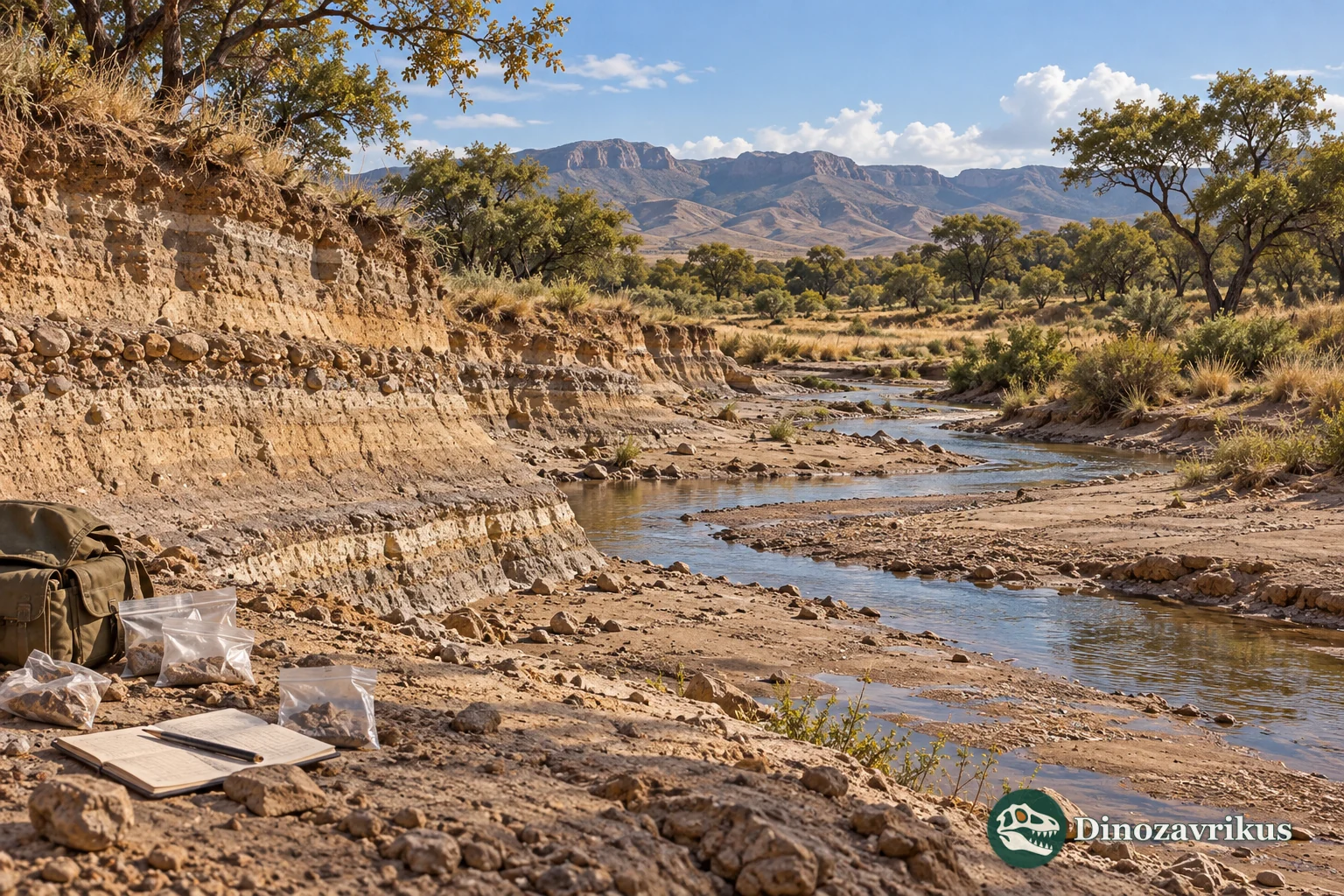
T. chasicoensis is associated with the Chasicoan South American Land Mammal Age and the Arroyo Chasicó Formation in Buenos Aires Province. Later records reported from the Cerro Azul Formation in La Pampa and sites in Mendoza broaden the geographic picture. Each occurrence belongs to its own locality and stratigraphic context.
T. silveyrai is associated with Huayquerian faunas, generally Late Miocene but extending into the Early Pliocene at some localities. Regional formations discussed in the literature include Epecuén, Cerro Azul and Río Quinto, among others. These units should not be collapsed into one horizon or exact date for all specimens.
A fossil database lists a broad Serravallian-to-Piacenzian interval for the genus. That range is wider than the age assignments in species-focused reviews and appears to combine records with different levels of taxonomic and stratigraphic confidence. The Chasicoan and Huayquerian context is more informative for discussing the two principal species.
Dental diagnosis and the Pseudotypotherium comparison
Late Neogene Mesotheriinae in Argentina are commonly discussed under Typotheriopsis and Pseudotypotherium. Armella and Ercoli’s 2018 study noted that both genera had been poorly diagnosed and were sometimes based on juvenile individuals. The traditional distinguishing feature was a lingual groove on the last upper premolar.
The authors reassessed qualitative and quantitative dental characters across samples. Crown form changes with wear, and isolated fragments do not always preserve every diagnostic surface. The study therefore encourages evaluating combinations of features rather than assigning a specimen from one groove alone. This does not make the teeth uninformative; it clarifies how much context is needed to use them reliably.
Historical diagnoses also noted the form of P4 and the arrangement of lower cheek teeth. The value of any feature depends on its distribution within each species and on comparisons with well-preserved material. A fragmentary tooth can support a provisional identification without resolving every generic boundary.
An associated skeleton and what remains uncertain
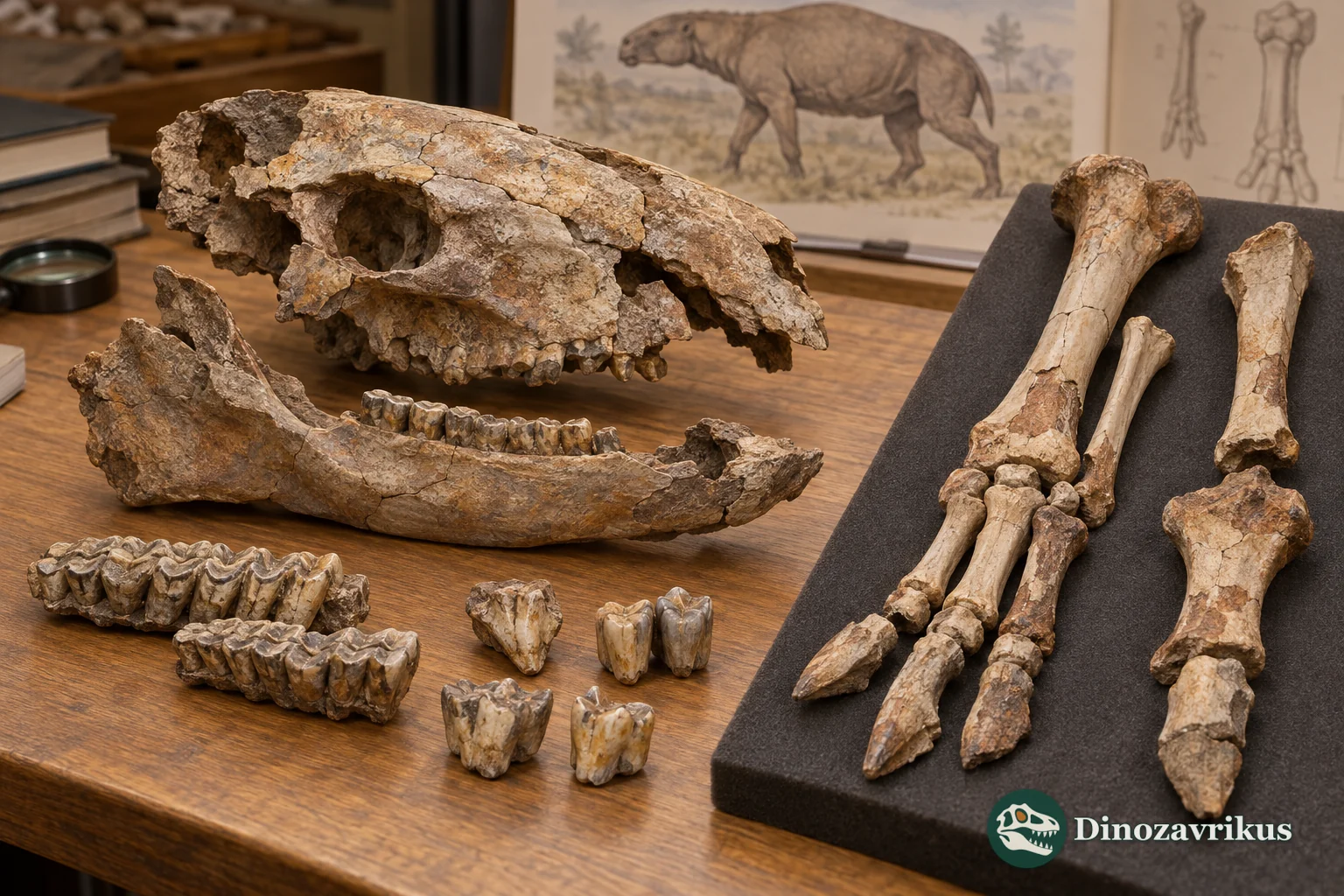
A 2024 meeting abstract reports adult specimen IANIGLA-PV 1203, an associated set including portions of the skull, vertebral column, pelvis, wrist and ankle, metapodials and phalanges. The authors provisionally attributed it to T. chasicoensis. Cranio-dental features, including postorbital constriction and a P4 without a lingual groove, distinguish it from Pseudotypotherium.
Comparisons with the type and newer material of T. silveyrai revealed some postcranial differences. The authors also stressed that clear cranial diagnostic characters separating the two Typotheriopsis species remain to be established. Because the announcement is a conference abstract, its identification is a developing research result rather than a final comprehensive revision.
Associated limb bones offer material for anatomical comparison, but they do not by themselves prove burrowing, a specific running speed or a particular gait. A complete articulated skeleton has not been described for the genus.
Other notoungulates, including Toxodon, provide broader group-level comparison, not substitute family anatomy for Typotheriopsis.
Diet and reconstruction limits
Mesotheriids were herbivorous notoungulates, and their continuously growing cheek teeth were adapted to sustained processing and wear. For Typotheriopsis, no stomach contents or other direct evidence identify a detailed plant menu. Herbivory is supported by its placement and dental anatomy, while the proportions of grasses, leaves or other foods remain unknown.
The fossils directly preserve teeth, skull fragments and parts of an associated skeleton. Age and habitat come from the geology of separate localities. The cover uses a cautious mesotheriid-like body form, but coat, colour, soft tissues and exact proportions are artistic. Growth, reproduction, social behaviour and non-dental pathologies are not documented in the evidence reviewed here.
Frequently asked questions
Which species are usually included in Typotheriopsis?
Recent reviews generally discuss T. chasicoensis and T. silveyrai, from Chasicoan and Huayquerian faunas respectively.
How is it distinguished from Pseudotypotherium?
A lingual groove on the last upper premolar was traditionally used, but a 2018 study reassessed that and other characters. Researchers now need to consider combinations of traits and specimen age and wear.
Is a skeleton known?
IANIGLA-PV 1203 is an associated adult specimen with parts of the skull and postcranial skeleton, provisionally assigned to T. chasicoensis. It is not a complete articulated skeleton.
When did Typotheriopsis live?
Its principal species are associated with the Chasicoan and Huayquerian land-mammal ages. Huayquerian records are Late Miocene and in some places extend into the Early Pliocene.