

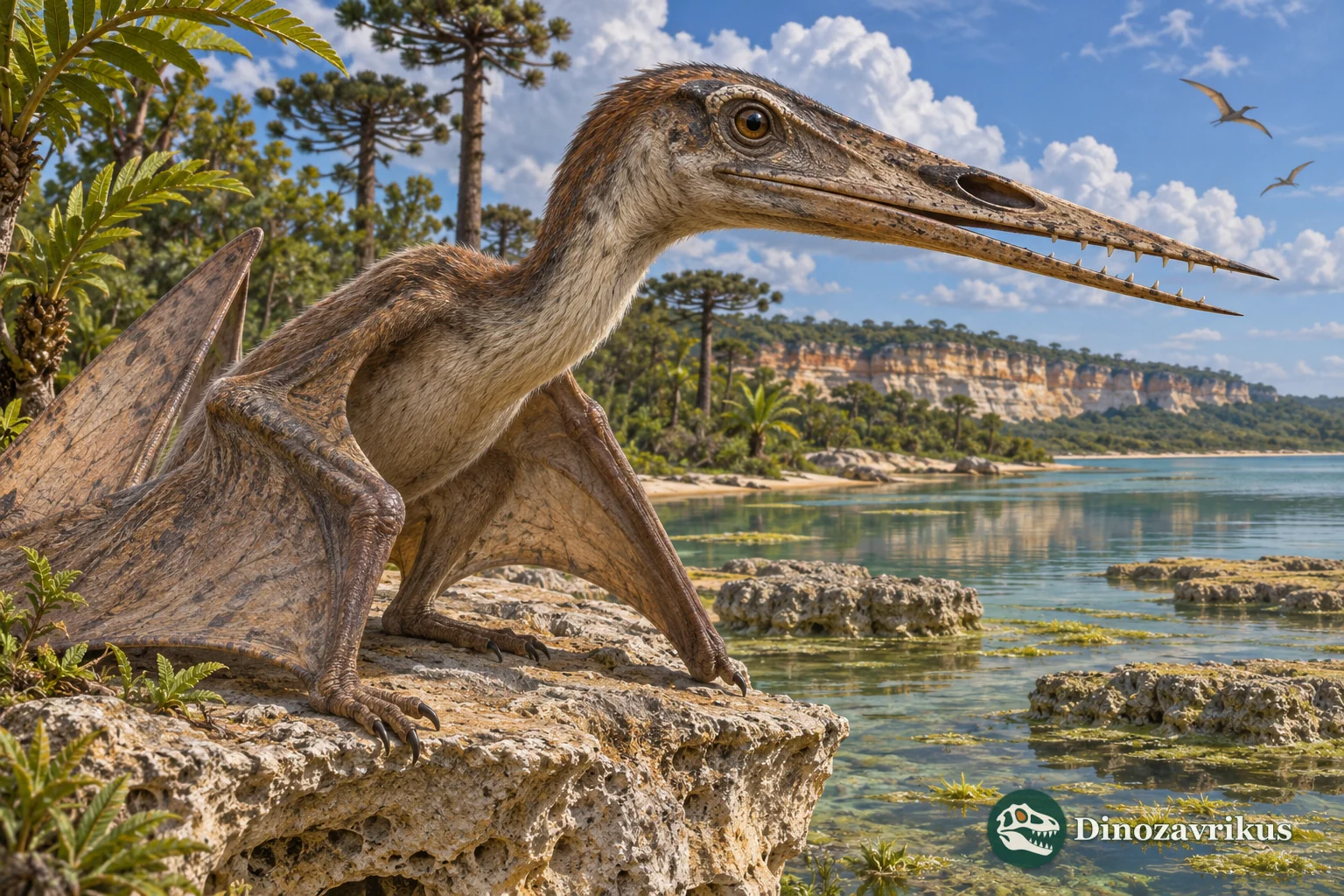
Unwindia trigonus is represented by one fragment of a long, narrow upper jaw from northeastern Brazil. Its teeth and alveoli are real fossil evidence. The wings, body and behaviour in the cover illustration are inferred or artistic, because none of those parts was found with the type specimen.
Quick facts
| Named species | Unwindia trigonus, Martill, 2011 |
|---|---|
| Holotype | SMNK PAL 6597, partial upper jaw in a limestone concretion |
| Repository | State Museum of Natural History Karlsruhe, Germany |
| Reported source | Santana do Cariri region, Ceará, Brazil |
| Probable rock unit | Romualdo Formation, formerly a member of the Santana Formation |
| Age | Late Early Cretaceous; exact fossil horizon undocumented |
| Diagnostic observation | Seven pairs of tooth sockets before the nasoantorbital opening |
| Wingspan | Not measurable without wing bones |
What can the fossils tell us?
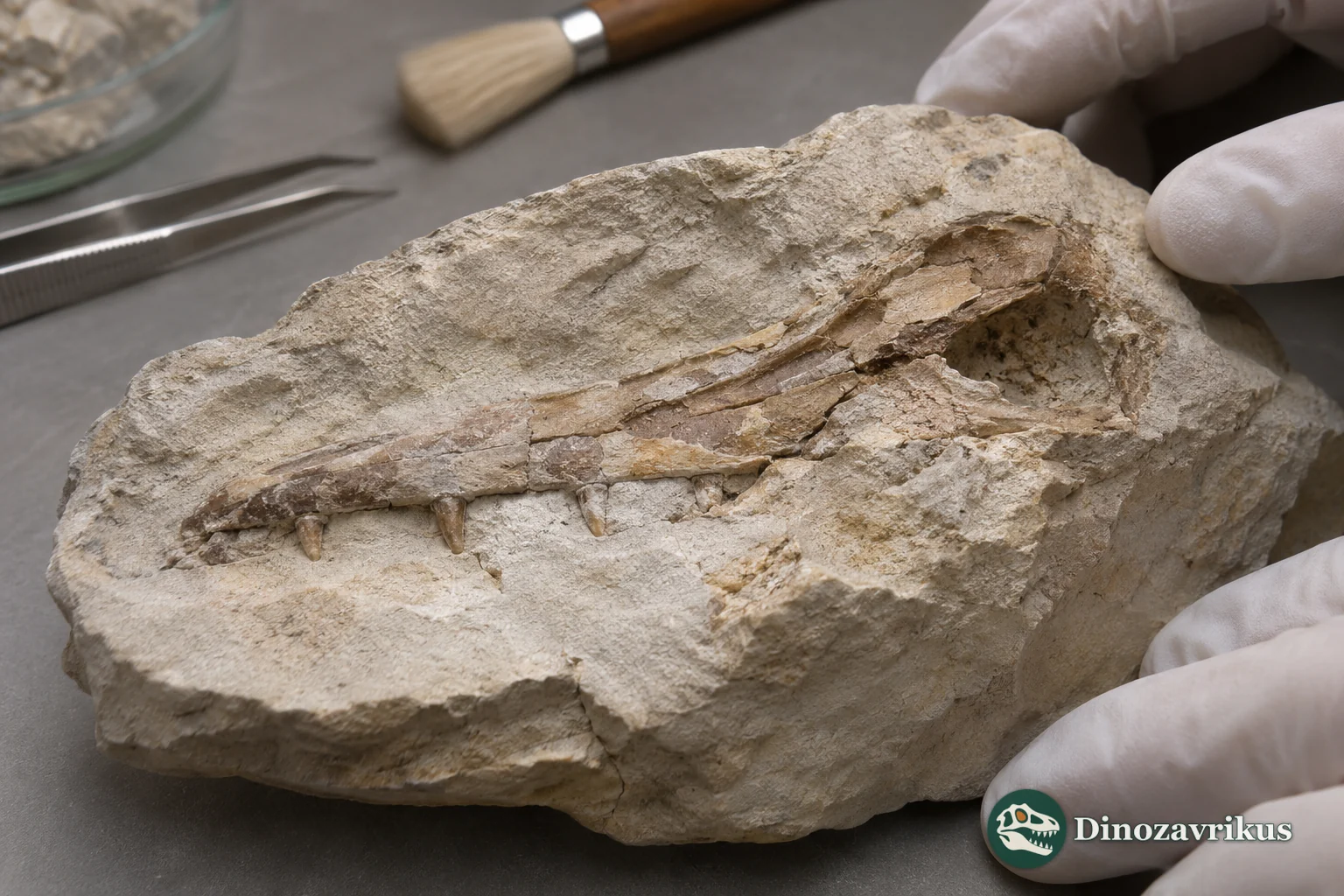
SMNK PAL 6597 contains joined premaxillary and maxillary bones and part of the palate. The nodule's counterpart is missing and fragile bone prevented complete preparation.
Four teeth remain on the right side. Their roughly similar size and short row are informative, though damage to the tip leaves a small uncertainty.
The fossil came from a local collector at Santana do Cariri. Its assignment to Romualdo strata rests on lithology and regional provenance, not an in-situ field record.
Martill assigned the jaw to Ctenochasmatoidea in 2011. A 2025 review says preservation and incomplete preparation impede confident verification of the proposed diagnostic features.
A specimen without a recorded excavation layer
David Martill named Unwindia trigonus in 2011 from specimen SMNK PAL 6597, acquired from a fossil digger in Santana do Cariri. It was not excavated in a documented bed. Its limestone nodule resembles material from what was then called the Romualdo Member of the Santana Formation, now generally referred to as the Romualdo Formation. That is a geological inference, not a precise field location.
The Karlsruhe specimen consists of joined premaxillary and maxillary bones and part of the palate. Splitting its nodule exposed mainly the right side; the counterpart has been lost. Thin bone is fragile and preparation was incomplete at first description. The genus honours pterosaur researcher David Unwin, while the species name refers to the triangular cross section of the snout.
What the teeth actually show
The original description counted seven pairs of tooth sockets in front of the large nasoantorbital opening. Four simple, slightly compressed conical teeth survive on the right. The front tip is damaged, so the very first socket has a small margin of uncertainty. About 192 mm of snout length was measured to the opening; that is a skull measurement, not body length.
The relatively short tooth row differs from several other toothed pterosaurs. Martill compared the rostral outline with Lonchodectes and discussed contrasts with the Araripe pterosaur Cearadactylus. None of these comparisons establishes Unwindia's diet. There are no stomach contents, identified prey remains, body bones or wing elements.
An unresolved branch and an inferred setting
Martill originally placed the genus among ctenochasmatoids. In a 2025 review of Araripe pterosaurs, Felipe Pinheiro and colleagues considered the holotype distinct but poorly preserved and still partly embedded in rock. They advised caution about the ctenochasmatoid placement because the proposed diagnostic characters cannot all be checked clearly. No additional specimen was referred to Unwindia in that review.
An exact age cannot be attached to a fossil whose stratigraphic horizon was never observed. The 2011 paper favoured a late Albian age for the supposed Romualdo unit, while later geological usage and dating have been refined. The staged fossil illustration and the living-animal scene both communicate possibilities rather than documenting this animal's actual colour, wings, feeding or shoreline.
Reading the pictures
The jaw fossil is the basis for the narrow, sparsely toothed muzzle. The research-table picture is staged art, not a photograph of the Karlsruhe holotype. The perched animal includes anatomical details and a habitat that remain untested by the single preserved snout.
Frequently asked questions
What fossil defines Unwindia?
The sole holotype SMNK PAL 6597 is an incomplete upper-jaw tip with teeth and tooth sockets, not a complete skull or skeleton.
Can its wingspan be measured?
No. No wing bones are known, so any wingspan would be a comparison with another pterosaur rather than a direct measurement.
Why is the locality approximate?
The fossil was acquired from a local collector, not excavated with a recorded bed. Its probable geological unit is inferred from the nodule and region.
Is its ctenochasmatoid classification settled?
No. A 2025 review cautioned that preservation and incomplete preparation make the original placement difficult to verify.