

The cave bear, Ursus spelaeus, was a large Pleistocene member of the bear family found across much of Europe. Its name comes from the many bones recovered in caves, but does not mean the animal spent its whole life underground. Skulls and limbs show a powerful bear; tooth wear, stable isotopes and ancient DNA reveal diet and population history.
The phrase “cave bears” can cover several related lineages that different studies have treated as species or subspecies. Dates and ranges therefore need to be tied to particular populations. The profile belongs in the Ice Age animals catalogue, alongside other animals whose fossils document changing Pleistocene environments.
Quick facts
| Scientific name | Ursus spelaeus Rosenmüller, 1794 |
|---|---|
| Group | Ursidae, order Carnivora |
| Age | Middle and Late Pleistocene |
| Range | Europe; related lineages extended east toward the Altai |
| Known material | Skulls, teeth, limb bones, collagen and ancient DNA |
| Diet | Plant-rich in many populations, with regional variation |
| Extinction estimate | About 26.1–24.3 thousand calibrated years ago for the cave-bear complex |
What can the fossils tell us?
Rosenmüller described Ursus spelaeus in 1794 from a skull associated with Zoolithen Cave. The whereabouts and identification of that historical specimen have been debated; thousands of later cave bones are comparative material, not automatically the original type.
Broad molars, dental wear and collagen isotopes support plant-heavy diets in many studied populations. Some bears from Peștera cu Oase in Romania have higher nitrogen values consistent with greater animal-food intake, showing regional variation rather than one universal menu.
Ancient sequences reveal multiple geographic lineages and a decline in effective female population size before extinction. DNA records ancestry and demographic change, but cannot by itself identify whether climate, human activity or both drove the decline.
A synthesis of screened radiocarbon dates places extinction of the broad cave-bear complex at about 26.1–24.3 thousand calibrated years ago. Poorly identified or contaminated samples can distort the chronology, so direct dating and specimen context matter.
Rosenmüller’s name and a disputed type history
German physician and naturalist Johann Christian Rosenmüller named Ursus spelaeus in 1794 from a skull associated with Zoolithen Cave in Bavaria. The description helped establish that large cave bones belonged to an extinct bear distinct from living species. Later work broadened the comparison using skulls, jaws, teeth and limb bones from Central European caves.
The history of the skull linked to the original name is not straightforward. It was long treated as lost; researchers later compared historical illustrations and collection records with material in a Berlin collection. The proposed identification has not been equally accepted by every author. It is therefore safer to distinguish that naming history from the many later specimens used to study the species.
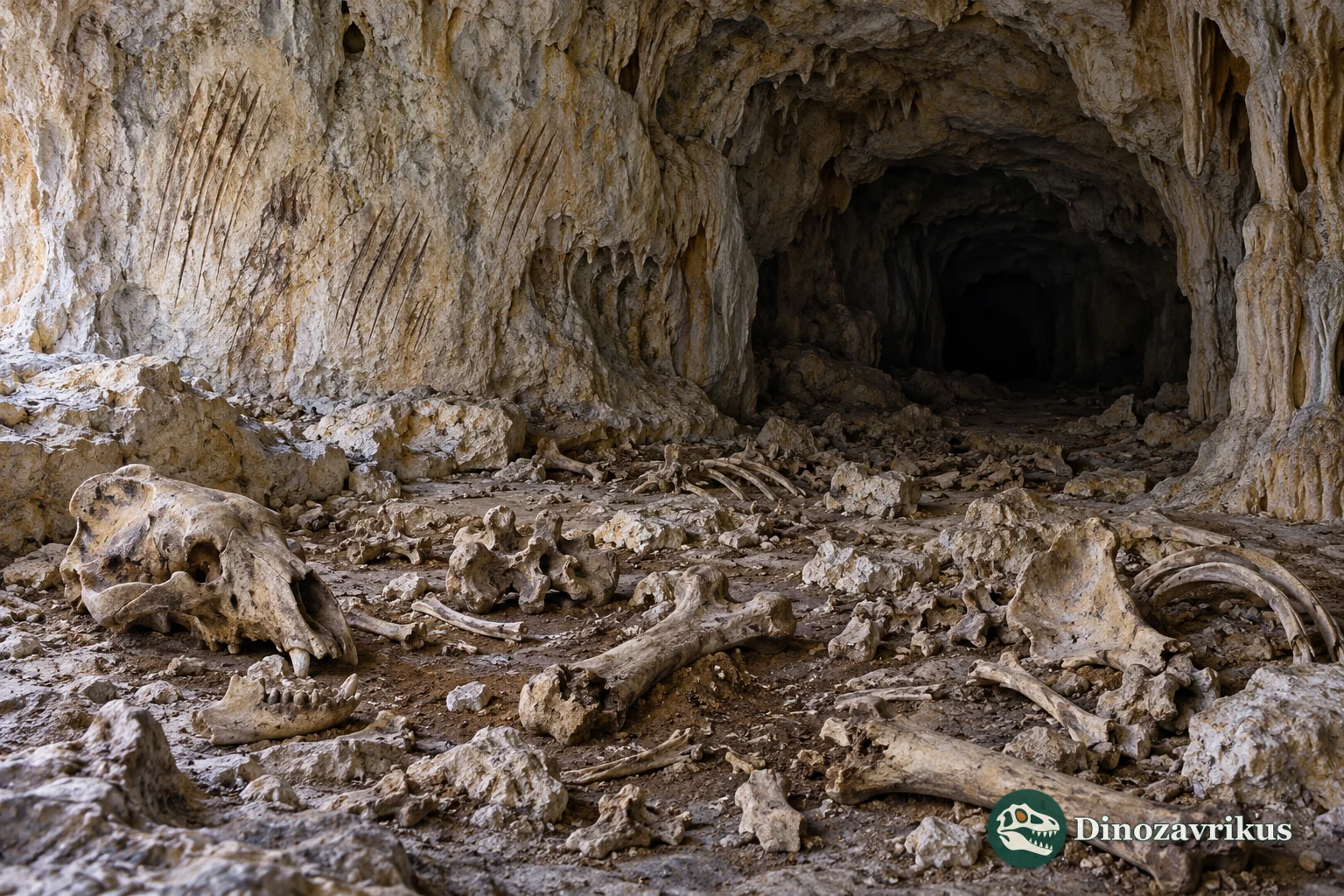
Cave deposits are archives assembled over time. A chamber can contain bones from different individuals, ages and periods, and water or carnivores can move remains. A large bone pile is not automatically one family, one winter or one mass-death event. Stratigraphy, surface damage and direct dating help reconstruct how a cave assemblage formed.
Species, relatives and range
The classic U. spelaeus lived during the Middle and Late Pleistocene in Europe. Related cave-bear forms extended east into Eurasia. Researchers often discuss U. ingressus, common in Central and southeastern Europe, and the earlier U. deningeri, close to the cave-bear lineage. Their rank and boundaries have shifted as skeletal morphology and ancient DNA have been compared.
One fossil name does not necessarily refer to the same biological unit in every paper. A “cave bear” account may combine closely related species, subspecies or mitochondrial lineages. A locality, date or dietary result should therefore be attributed to the actual specimens studied, rather than generalized to every bear that used a cave.
Skull, teeth and body size
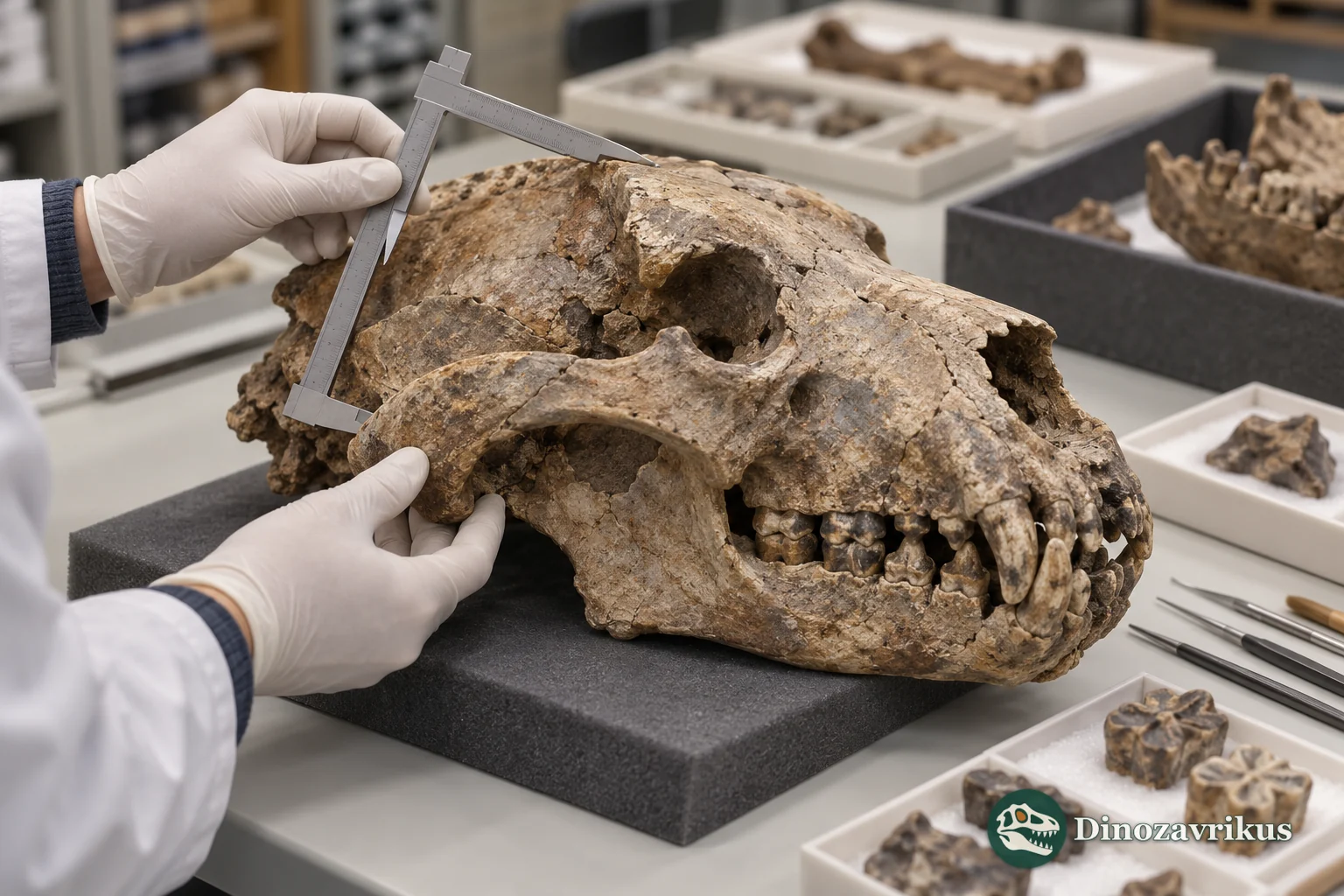
Cave-bear skulls have a high forehead and broad, powerful jaws. Large molars with rounded surfaces are consistent with grinding and crushing food. Sexual dimorphism and age affect skull size, so one exceptionally large male should not be used as the standard adult for the species.
Mass estimates are calculated from limb-bone dimensions and comparisons with living bears. Results vary by sex, age and the equation selected; no single figure describes every population. The skeleton supports a heavy, four-legged terrestrial animal. It does not show that cave bears were slow in every situation or unable to forage far from shelters.
Caves offered protected places for winter dormancy and possibly birth, but feeding took place in the surrounding landscape. The name describes a fossil record and recurring shelter use, not a permanent underground lifestyle.
Diet: plant-rich signals and local differences
For many European cave-bear populations, broad cheek teeth, dental microwear and relatively low nitrogen isotope values support a diet dominated by plants. Those data helped move the discussion beyond an old image of a uniformly dangerous cave predator. Yet there was no single menu across the entire range.
Some bears from Peștera cu Oase in Romania have higher nitrogen isotope values than many other cave bears. In context, the result is consistent with a greater contribution of animal food for part of that population. It does not show that all cave bears hunted regularly. Food availability, local ecology and individual condition could all contribute to regional differences.
Isotopes in collagen reflect assimilated diet over the tissue’s formation, while microscopic tooth textures capture a different and shorter window of feeding mechanics. Hibernation, age and physiology can also affect isotope interpretation. Combining methods gives a stronger picture, but none identifies every plant or prey item an individual ate.
Caves, dormancy and traces of life
Repeated cave use is supported by remains of different ages and by the protected character of many karst spaces. The bone assemblage may also include hyenas, wolves or later human activity, depending on the site. Taphonomic evidence helps distinguish an animal that died in shelter from a carcass transported by water or another predator.
Like living bears, cave bears likely used sheltered places for seasonal dormancy. Changes in collagen isotope values can reflect fasting and use of body reserves during winter, which matters when interpreting diet. This is an indirect physiological signal, not a direct observation of a particular bear sleeping in a specific cave.
Healed fractures, worn joints and dental disease show that individuals survived injury and illness. They document biological events, but not the frequency of conflict or the usual social structure of the population. A damaged bone needs a specific diagnosis before it can be turned into a story about a fight or a failed hunt.
Ancient DNA and extinction
Mitochondrial genomes reveal several geographic lineages and a more complex population history than skull shape alone suggested. Genetic reconstructions indicate a decline in effective population size in some lineages around 40,000 years ago. This overlaps with the spread of modern humans in Europe, but timing alone does not establish direct cause.
A synthesis of screened radiocarbon dates places the disappearance of the broad European cave-bear complex around 26.1–24.3 thousand calibrated years ago, before the Last Glacial Maximum. Cooling, habitat fragmentation and declining plant productivity may have reduced food and suitable shelter. Some models also consider hunting and competition with people for caves, but the relative contribution of each factor remains debated.
Cave bears were close relatives of living bears, not established direct ancestors of brown or polar bears. Shared membership in Ursus does not make modern species their descendants. The nearby profiles of the woolly mammoth and woolly rhinoceros show other Pleistocene lineages whose disappearances also require more than a single-cause explanation.
Frequently asked questions
Why is it called a cave bear?
Many fossils come from caves, which also served as sheltered seasonal dens. The name does not mean cave bears lived underground throughout the year.
Did cave bears eat only plants?
Many studied populations show a plant-rich diet, but isotope evidence from some Romanian bears is consistent with more animal food. Diet varied, and one locality cannot define every cave-bear population.
Were cave bears ancestors of brown bears?
No direct ancestor–descendant relationship has been established. Cave bears and living brown bears are related members of the bear family but represent separate evolutionary lineages.
When did cave bears go extinct?
A synthesis of screened dates places the disappearance of the broad cave-bear complex at about 26.1–24.3 thousand calibrated years ago. Climate change likely mattered, while the roles of people and other ecological pressures remain debated. Many fossils come from caves, which also served as sheltered seasonal dens. The name does not mean cave bears lived underground throughout the year. Many studied populations show a plant-rich diet, but isotope evidence from some Romanian bears is consistent with more animal food. Diet varied, and one locality cannot define every cave-bear population. No direct ancestor–descendant relationship has been established. Cave bears and living brown bears are related members of the bear family but represent separate evolutionary lineages. A synthesis of screened dates places the disappearance of the broad cave-bear complex at about 26.1–24.3 thousand calibrated years ago. Climate change likely mattered, while the roles of people and other ecological pressures remain debated.Frequently asked questions
Why is it called a cave bear?
Did cave bears eat only plants?
Were cave bears ancestors of brown bears?
When did cave bears go extinct?