

Vahiny depereti was a titanosaur from north-western Madagascar. Its braincase preserves parts of the skull base and openings that transmitted cranial nerves. Those features allowed researchers to distinguish it from Rapetosaurus, a much more common sauropod in the same rock formation.
Quick facts
| Group | Sauropods (Titanosauria) |
|---|---|
| Age | Late Cretaceous, Maastrichtian |
| Region | Africa (north-western Madagascar) |
| Diet | Herbivore |
| Type species | Vahiny depereti |
| Holotype | UA 9940 |
| Formation | Maevarano Formation, Anembalemba Member |
| Width across basal tubera | 62.4 mm in the holotype |
What can the fossils tell us?
The basal tubera of the holotype are formed chiefly from the basioccipital. Their shape and composition can be compared across titanosaurs.
The positions of the openings for cranial nerves are preserved. Their arrangement differs from that of closely compared taxa.
The holotype is a partial braincase. A separate juvenile skull bone was referred from another locality. Isolated tail bones are still unassigned.
Two specimens near Berivotra
Kristina Curry Rogers and Jeffrey Wilson described the species in 2014. The holotype braincase UA 9940 came from locality MAD 96-07 near Berivotra in the Mahajanga Basin. It is held at the Université d’Antananarivo. Vahiny means visitor or traveller in Malagasy, a reference to the scarcity of its fossils. The species name honours Charles Depéret, who described some of the first dinosaur material from Madagascar.
A separate specimen, FMNH PR 3046, is the basioccipital of a juvenile. It came from MAD 93-18, another site in the Anembalemba Member of the Maevarano Formation, and is held at the Field Museum. Isolated tail vertebrae once grouped with unusual Malagasy titanosaur bones have yet to be linked securely to the species.
Anatomy that distinguishes Vahiny
Across the basal tubera, a pair of projections near the floor of the skull, the type specimen measures 62.4 millimetres. The basioccipital forms most of these projections. The openings for cranial nerves V, VII and XII are also arranged roughly along a line. These features of the braincase distinguish Vahiny from Rapetosaurus.
The authors found similarities to the Indian titanosaur Jainosaurus and to some South American forms. This comparison is based mainly on the available skull bones. A plant diet is inferred from its sauropod affinities. The body length, teeth and plants eaten remain unknown.
How the fossils accumulated
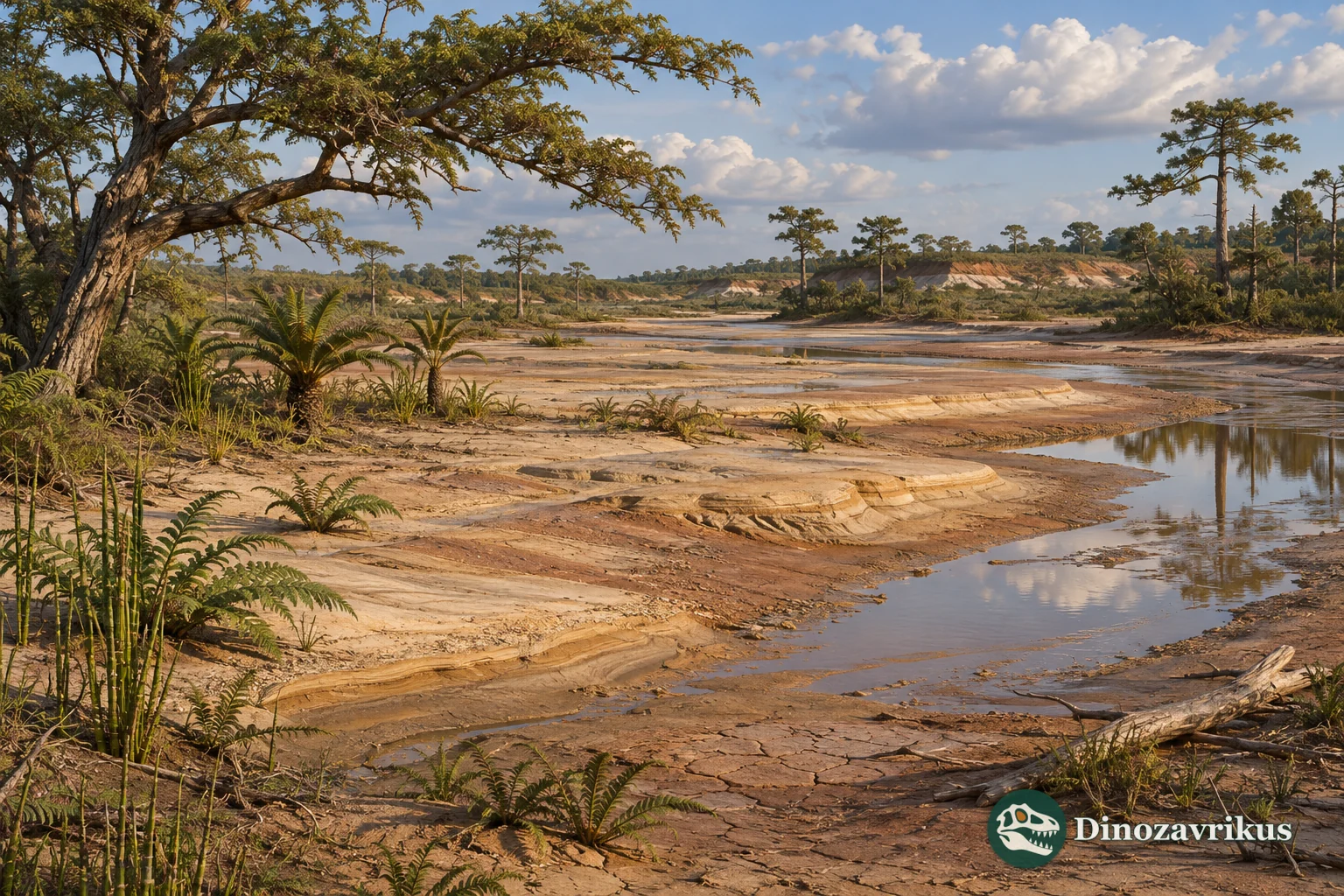
The braincase was associated with fragmentary remains of turtles, crocodyliforms and dinosaurs, including theropod teeth. The researchers interpreted the assemblage as time-averaged, meaning the remains accumulated over an interval. A bone found nearby therefore needs anatomical evidence before it can be assigned to the same dinosaur. The braincase came from the sedimentary facies interpreted as fine-grained debris flows triggered by heavy rain. The assemblage preserves a mixture of vertebrates, and an adjacent bone can only be assigned to the same animal with additional anatomical evidence.
Frequently asked questions
Which parts of Vahiny are known?
The best-preserved material is from the braincase. The type specimen lacks the jaws, teeth and parts of the skull roof.
How was Vahiny distinguished from Rapetosaurus?
Researchers compared the shape of the base of the skull and the positions of several openings for the cranial nerves.
What does Vahiny mean?
It means visitor or traveller in Malagasy, referring to the rarity of the fossil.
Can the fossils tell us its total length?
They provide measurements for parts of the skull. A reliable whole-body length cannot be established from them.