

Vegavis lived around the Antarctic Peninsula near the end of the Cretaceous. Its legs suggest an ability to dive, a skull provides clues to catching prey underwater, and another fossil preserves parts of the vocal organ. These discoveries came from several individuals whose species assignments have changed as new comparisons became possible.
Quick facts
| Group | Early waterfowl relative |
|---|---|
| Age | Late Cretaceous, Maastrichtian |
| Localities | Vega and Seymour islands, Antarctica |
| Type-species holotype | Partial skeleton MLP-PV 93-I-3-1 |
| Genus named | Julia Clarke and colleagues, 2005 |
What can the fossils tell us?
Hindlimb proportions and muscle attachment sites support foot-propelled diving. The bones do not show whether the feet were webbed or exactly how they moved.
CT scans revealed fused rings and asymmetry near the division of the airway. These features inform comparisons with living birds, but the call itself is unknown.
A Vega Island skull contributed new traits to the evolutionary analysis. In 2026 its jaw and skull base were used to distinguish it as the type of a separate species.
A skeleton from Vega Island
An Argentine Antarctic expedition found the type skeleton on Vega Island in the 1992–1993 field season. It was discussed in 1995 and formally named Vegavis iaai by Julia Clarke and colleagues in 2005. The name refers to Vega Island and the Instituto Antártico Argentino.
The Museo de La Plata holds the holotype, MLP-PV 93-I-3-1. The rock preserves portions of the trunk, shoulder girdle, wings and hindlimbs. CT imaging revealed some bones that were hard to see from the surface. The skull is not represented by diagnostic material, so the initial analysis of relationships relied heavily on the rest of the skeleton.
Diving and feeding
The shape of the hindlimbs supports diving propelled by the feet. Loons and grebes offer comparisons for this type of locomotion. The resemblance concerns how the birds moved through water and can evolve independently in different lineages.
Christopher Torres and colleagues described skull AMNH FARB 30899 in 2025 from deposits dated to around 69.2–68.4 million years ago. It preserves parts of the bill, palate and skull base, with a nearly complete lower jaw. A slender pointed bill and substantial jaw muscle attachment areas suit the capture of moving prey underwater. Fish are plausible prey, but there is no preserved stomach content to demonstrate that diet.
The fossils were buried in marine sediments around the Antarctic Peninsula. Those sediments record a coastal sea in a warmer climate than that of the modern Antarctic. They tell us about burial conditions and do not establish where the birds bred.

A vocal organ preserved in three dimensions
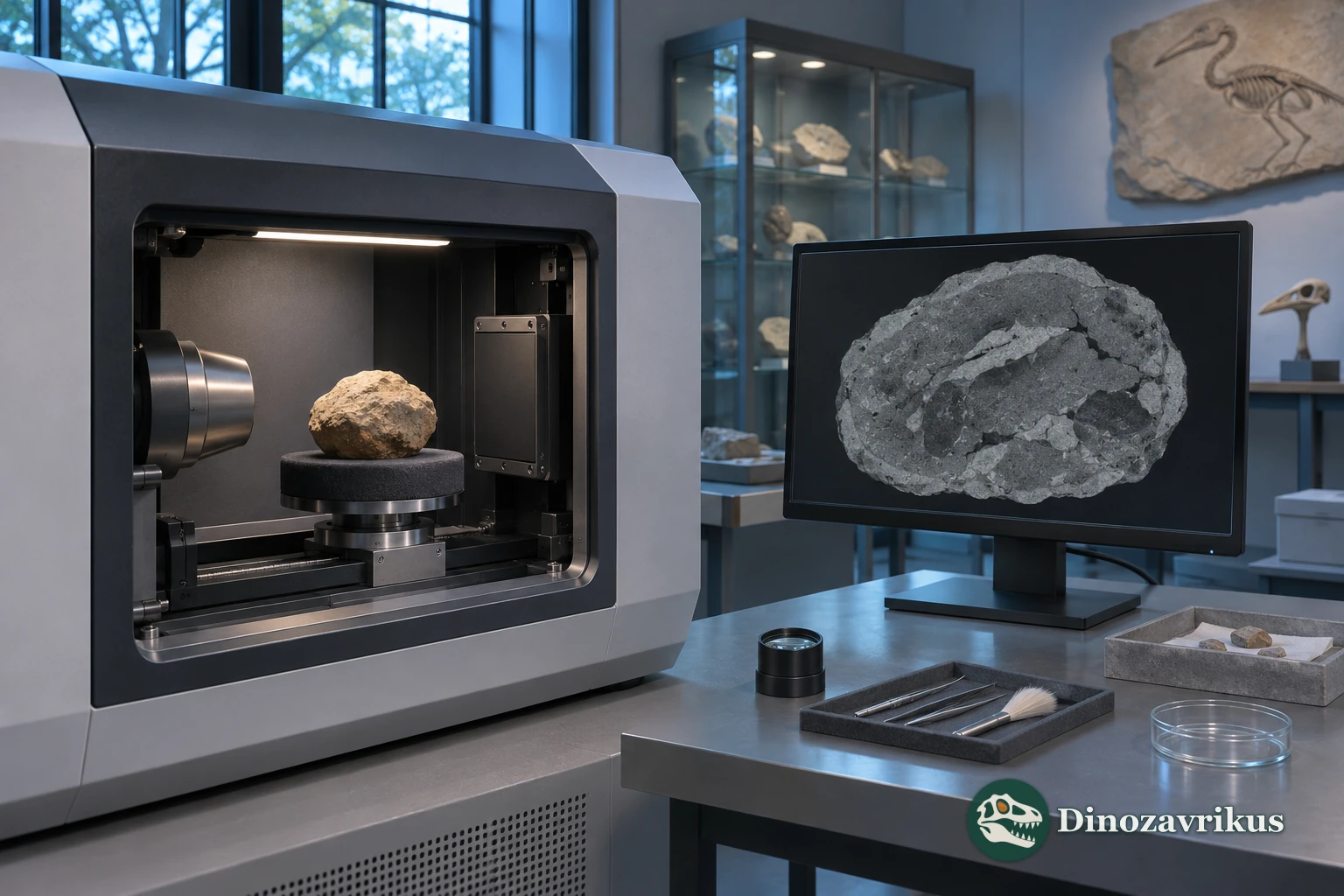
The separate Vega Island specimen MACN-PV 19.748 preserves parts of the syrinx, the vocal organ at the branching point of a bird’s windpipe. In 2016, CT imaging revealed rings fused into a mineralised bar and an asymmetrical arrangement near the bronchi.
Among living birds, this kind of asymmetry occurs in forms with two sound sources. It gives a basis for comparing vocal anatomy while leaving the particular note, pitch and call pattern unknown. The syrinx is one line of evidence in the broader question of what dinosaurs might have sounded like.
Two species proposed in 2026
The 2025 study initially referred AMNH FARB 30899 to Vegavis iaai. The analysis incorporating the skull favoured a position inside crown Anseriformes, the clade uniting living waterfowl and their last common ancestor. Other analyses had returned positions outside that clade. A crown-waterfowl result does not require placing Vegavis in the modern duck family.
In 2026 Facundo Irazoqui and colleagues proposed the same skull as the holotype of Vegavis notopothousa, on differences in the jaw joint and skull base. The jaw of the V. iaai holotype could not be used for a direct comparison. The corresponding jaw anatomy was compared with the specimen that preserves the syrinx.
The team also named Vegavis geitononesos from MLP-PV 15-I-7-52, a specimen from Seymour Island, also called Marambio. Its skull, pelvis and hindlimb fragments provide a different combination of useful characters. The revised species assignments reflect differences between the specimens. The exact position of the genus within the bird tree remains open to testing.
Frequently asked questions
Did Vegavis have a broad duck bill?
The skull described in 2025 indicates a narrow pointed bill, consistent with seizing moving prey underwater.
How did Vegavis swim?
The hindlimbs support foot-propelled diving. The precise motion of the feet and their soft tissues are unknown.
Can the call of Vegavis be reconstructed?
The mineralised parts of the syrinx provide evidence of its anatomy. They do not preserve the call itself.
Which species does the skull published in 2025 represent?
It was initially assigned to Vegavis iaai. A 2026 reassessment proposed it as the type of Vegavis notopothousa.