

Vetelia was an extinct armadillo from Miocene deposits in Argentina and Chile. For decades, most evidence consisted of separate bony plates from its armour. Skulls described in 2021 added jaw and tooth characters and allowed the genus to be included in a detailed morphological study of armadillo relationships.
The genus is part of the ancient mammal catalogue. A new hypothesis places it near living South American armadillos such as Priodontes, but that relationship is an analytical result, not a direct observation of behaviour or appearance.
Quick facts
| Scientific name | Vetelia Ameghino, 1891 |
|---|---|
| Type species | Vetelia puncta Ameghino, 1891 |
| Group | Armadillos; Chlamyphoridae, Cingulata |
| Age | Early to late Miocene, depending on the species |
| Range | Argentina and Chile |
| Known species | V. puncta, V. perforata and V. gandhii |
| Best skull material | PVSJ-289 and PVSJ-154, assigned to V. gandhii |
| Body size | Reliable total length and mass are unknown |
What does the Vetelia record preserve?
Fixed, semi-mobile and mobile osteoderms provide diagnostic characters and evidence of the carapace. An isolated plate does not reveal the animal's total length and is not automatically part of a complete skeleton.
PVSJ-289 and PVSJ-154 from the Loma de Las Tapias Formation were described as the most informative skull material then known and assigned to V. gandhii. They show cranial and mandibular anatomy, not a complete articulated body.
The 2021 morphological analysis placed Vetelia within Tolypeutinae and Priodontini, as sister to the Cabassous + Priodontes clade. This is a result of one analysis and depends on the sampled taxa and preserved characters.
The genus and its three species
Florentino Ameghino established Vetelia in 1891; V. puncta is the type species. The 2021 revision considered three species: V. puncta, V. perforata and V. gandhii. Their records differ in age, locality and the mix of osteoderm characters available for comparison.
Earlier classifications commonly placed the genus in Euphractinae because its fossils were mostly armour plates. Barasoain and colleagues revised the diagnoses and described skull material referred to V. gandhii. That referral is a taxonomic interpretation; it does not mean all previously collected plates belonged to one individual.
Where and when Vetelia lived
V. puncta is associated with the early to middle Miocene, V. perforata with the middle to late Miocene, and V. gandhii with the late Miocene. These intervals summarize localities and formations. They are not precise dates for the origin or extinction of the genus.
Material of V. puncta includes the Karaiken locality in Santa Cruz Province and the Santa Cruz Formation. Osteoderms of V. perforata were described from the Arroyo Chasicó Formation of Buenos Aires Province. Records of V. gandhii include Catamarca and San Juan; the skulls PVSJ-154 and PVSJ-289 come from the late Miocene Loma de Las Tapias Formation. The age belongs to the geological unit, not to an individually dated bone.
Armour, skull and teeth
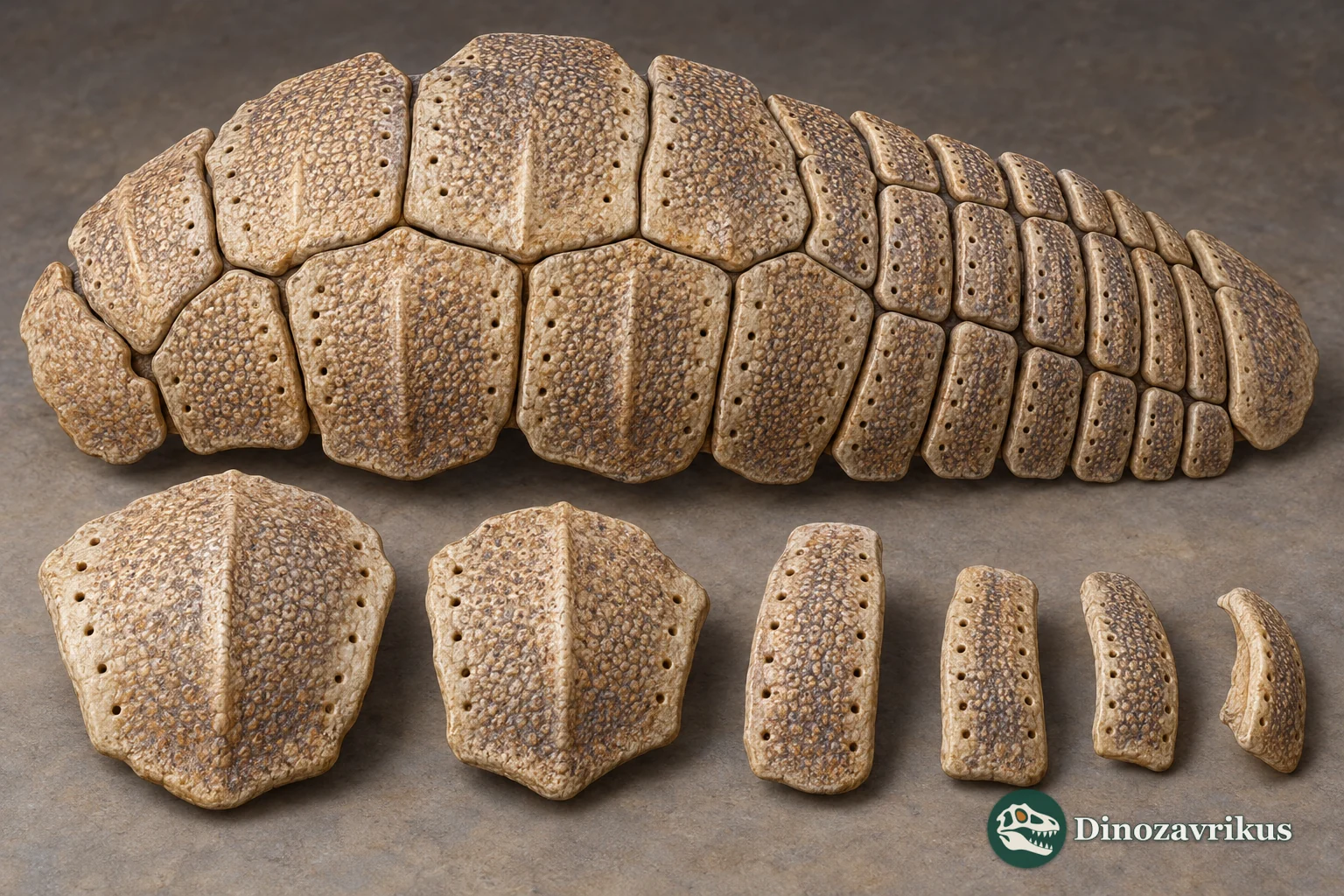
Osteoderms are the bony elements of the armadillo carapace. Researchers distinguish fixed plates in the shoulder and pelvic shields from mobile plates in the transverse bands. Surface ornament, proportions, margins and foramina help separate species. In V. gandhii, the shoulder shield was described with two fixed rows and mobile bands of at least five rows.
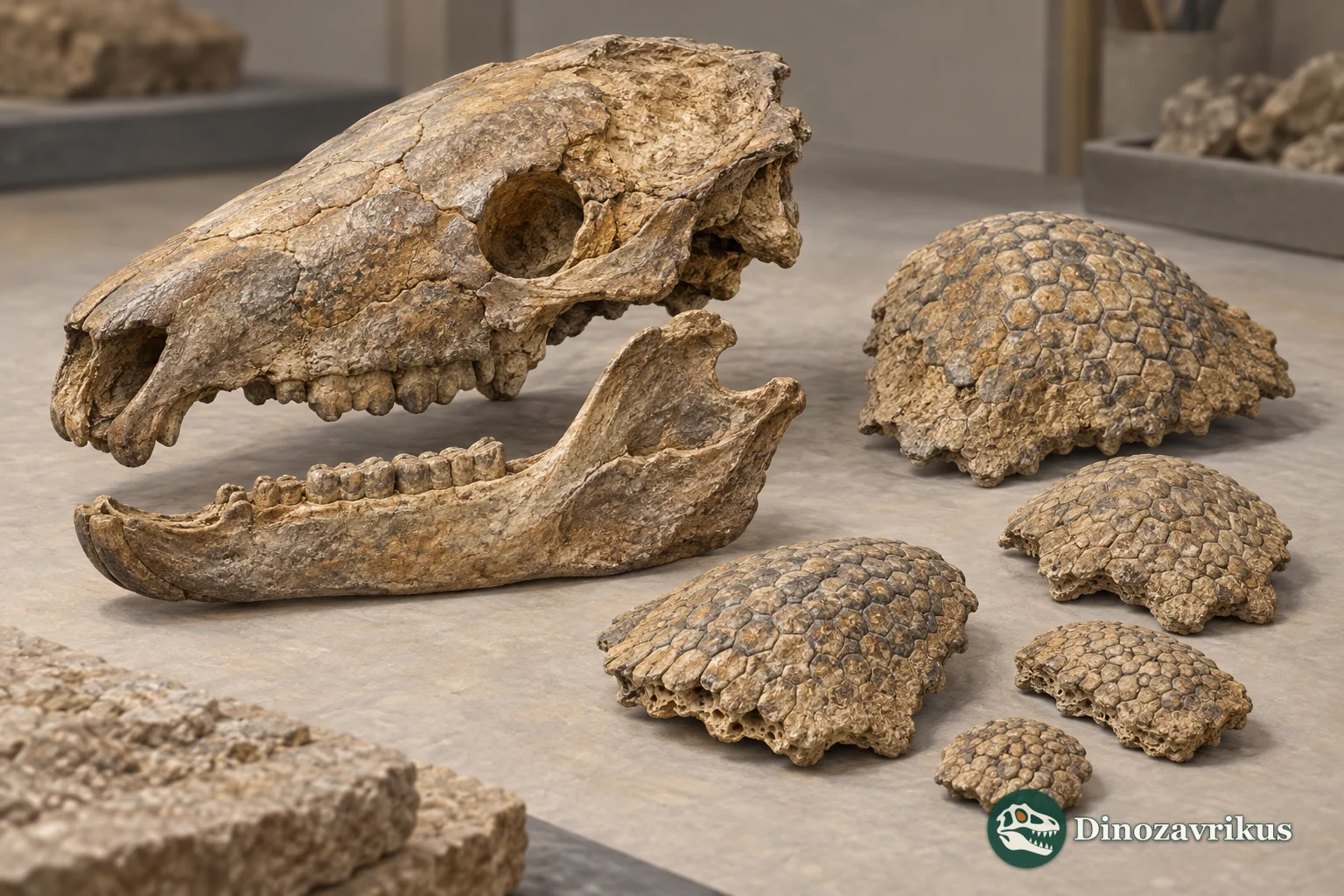
PVSJ-289 was the most complete Vetelia specimen reported in the revision. The skull lengths of PVSJ-154 and PVSJ-289 are 110.71 and 97.85 millimetres, respectively. Those measurements describe two skulls, not body length. The material shows a short rostrum, a robust lower jaw with a low vertical ramus and nine oval or chisel-shaped cheek teeth. The described jaws lack the toothless anterior gap found in some other armadillos.
Armour, skull and teeth together establish a heavily armoured mammal with robust jaws. They do not provide a dependable total body length, mass, coat, colour or the details of soft tissues.
Phylogeny and palaeobiology
The 2021 study coded 148 morphological characters across 24 taxa. It included V. gandhii and V. perforata; V. puncta was excluded because isolated osteoderms did not preserve most of the cranial characters in the matrix. The resulting tree recovered Vetelia within Tolypeutinae and Priodontini, on the sister branch to the clade containing Cabassous and Priodontes.
This proposal differs from the older Euphractinae assignment but remains a result of a particular character matrix. The placement depends on which fossil and living taxa are compared and which characters can be scored. New fossils or a revised analysis could change details of the tree.
Jaw and tooth form indicate food processing, but no stomach contents, coprolites or isotope evidence identify a specific diet. Membership among armadillos also cannot establish an exact digging style, burrowing routine or social behaviour.
What a reconstruction can show
The fossils directly preserve osteoderm shapes, skull measurements, jaws and tooth rows. The proposed relationship to tolypeutine armadillos is an inference from a morphological analysis. Coat, skin colour, soft-tissue outline and the landscape in the artwork are artistic choices; none is preserved in the known Vetelia fossils.
Frequently asked questions
How many species of Vetelia are recognized?
The 2021 revision discusses three species: V. puncta, V. perforata and V. gandhii. They are distinguished using combinations of osteoderm and cranial characters.
Has a complete Vetelia skeleton been found?
No complete articulated skeleton has been described. The most informative material includes skulls and jaws as well as separate carapace plates.
How large was Vetelia?
The reported skulls measure about 98 and 111 millimetres long. Those measurements do not establish total body length or mass.
Why is Vetelia linked with giant armadillos?
A 2021 morphological analysis placed it within Priodontini, near the branch containing Cabassous and Priodontes. This is a testable phylogenetic result, not a settled fact independent of the analysis.