

Westergaardodina was a paraconodont genus known from microscopic phosphate elements. Some have the outline of a narrow fork. Others have a third projection between the two arms. Internal openings and cavities can help distinguish otherwise similar specimens.
Quick facts
| Group | Conodonts (paraconodonts) |
|---|---|
| Age | Middle and Late Cambrian, with some Ordovician records |
| Region | Europe, Asia, North America, South America, Australia, Antarctica |
| Diet | Unknown |
| Type species | Westergaardodina bicuspidata |
| Genus named by | Klaus Müller, 1959 |
What can the fossils tell us?
The two arms are closely spaced, leaving a narrow slit. The central projection is strongly reduced.
In W. dimorpha one arm is much longer. The two variants occur in about equal numbers, but their position in the living animal remains uncertain.
Material from Springer Peak includes elements assigned to the type species and to W. moessebergensis.
The shape of the fork
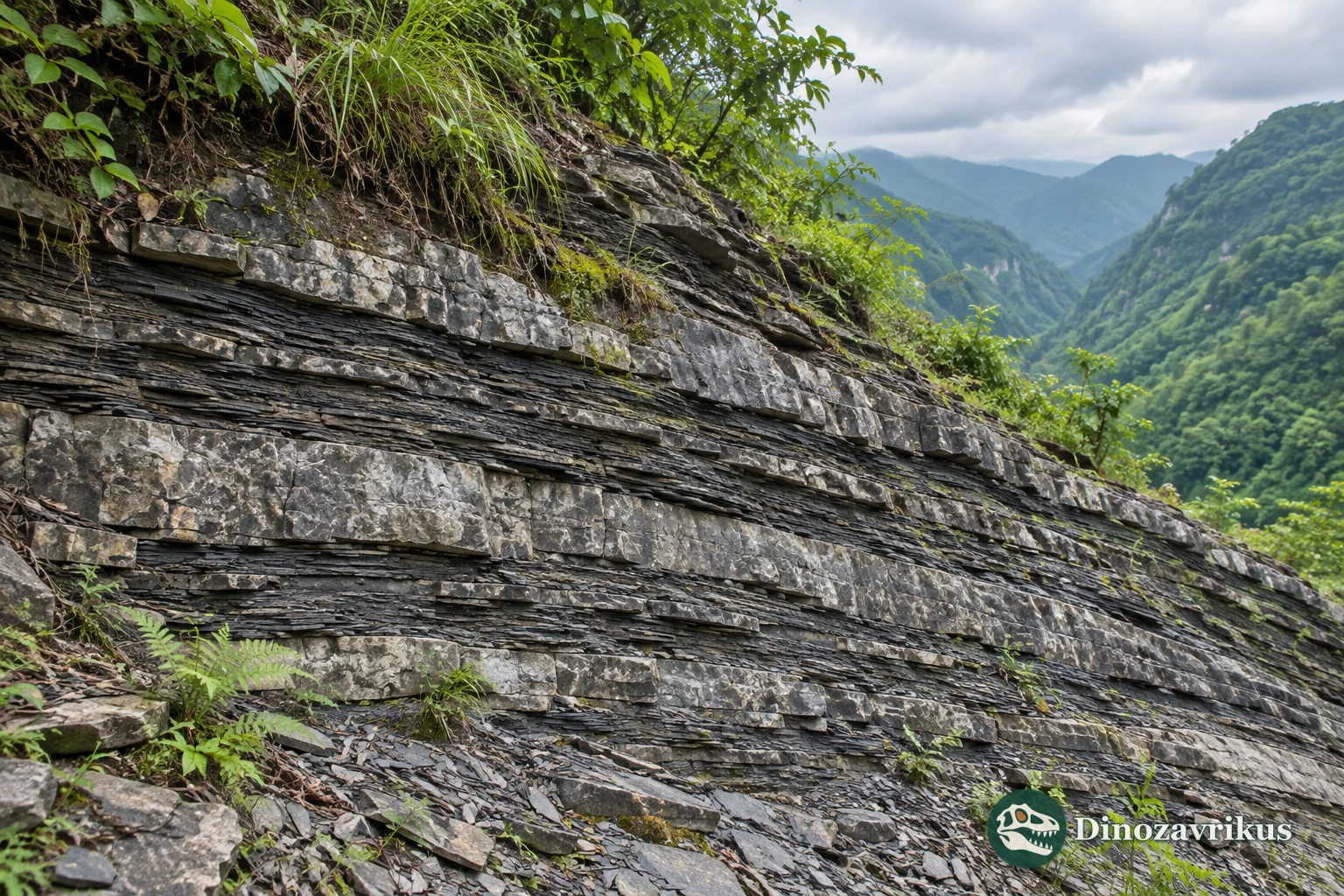
Klaus Müller established Westergaardodina in 1959. The type species, W. bicuspidata, was named from a dark limestone boulder found in northeastern Germany. Ice transported the boulder, so its findspot differs from the place where the limestone formed.
Identification draws on the number and angle of the projections and on the openings into internal cavities. In the type species, the two long arms lie close together. In W. tricuspidata, a central projection is also well developed. Compare this form with the single cones of another paraconodont, Furnishina.
Mirror forms and geographical records
Xi-ping Dong and Huaqiao Zhang described 200 elements of W. dimorpha from the Bitiao Formation at Wangcun. Left and right variants differ in which arm is longer. Repetition across the sample shows a consistent distinction. Isolated elements do not reveal their original arrangement.
Cambrian material also documents the genus in North America, the Argentine Precordillera, Queensland and the Ellsworth Mountains of West Antarctica. Elements assigned to the type species occur in the Middle Ordovician Mójcza Limestone of Poland. The age and distribution of a particular species need to be established bed by bed because the genus spans a broad interval.
Frequently asked questions
Where was the type material found?
In a dark limestone boulder carried by ice and found in northeastern Germany.
How many projections can an element have?
The type species has two developed arms. In some other species, there is also a well-developed central projection.
Why are there left and right forms of W. dimorpha?
One arm is longer than the other. The longer arm lies on each side in about equal numbers across the sample.
Has the genus been reported from the Ordovician?
Yes. Elements identified as W. bicuspidata occur in the Middle Ordovician Mójcza Limestone in Poland.