

Modern birds are the only dinosaurs alive today. A pigeon, chicken, ostrich and penguin belong to Dinosauria in the same way that humans belong to Mammalia. Calling birds “descendants of dinosaurs” is broadly correct but incomplete: in evolutionary classification, descendants remain members of the branch in which they arose.
Birds evolved among small theropod dinosaurs, many of which carried feathers. This conclusion rests on matching evidence from skeletons, fossil body coverings, eggs, nests, development and family-tree analysis. It is not based on a chicken foot merely looking a little like the foot of a large predator.
Interactive evidence guide
Four independent links between birds and dinosaurs
Simple filaments and complex vaned feathers occur in non-avian theropods. Insulation and display preceded or accompanied aerodynamic use.
The furcula, folding wrist, hollow bones, three-toed limbs and many detailed joints connect birds with maniraptoran theropods.
Eggshell microstructure, organised clutches and adults brooding over nests provide behavioural evidence independent of feathers.
Hundreds of characters consistently place birds inside Theropoda. New fossils can move individual branches without removing birds from dinosaurs.
Which dinosaur descendants live today?
All living birds are avian dinosaurs, including flightless species. Losing flight does not erase ancestry: ostriches, kiwi and penguins remain birds and theropods even though their wings no longer work like those of a swallow.
| Living animal | Relationship to dinosaurs | Common misunderstanding |
|---|---|---|
| Chicken, pigeon, sparrow | Birds, therefore living dinosaurs | They do not descend from one known Tyrannosaurus species |
| Ostrich and cassowary | Flightless birds | Large size does not make them more dinosaurian than small birds |
| Penguin | A swimming bird | Marine life does not connect it to plesiosaurs |
| Crocodilian | Living archosaur outside Dinosauria | A close relative, not a dinosaur descendant |
| Monitor or iguana | Squamate reptile | An ancient-looking body does not establish dinosaur ancestry |
All these animals share ancestors at deeper points on the tree. The relevant question is where each organism sits inside the branching hierarchy. Humans and dogs are related too, but neither evolved from the other.
Where birds sit on the evolutionary tree
Archosaurs divide into the crocodilian line and the line containing dinosaurs, pterosaurs and extinct relatives. Within dinosaurs, birds fall among theropods and more specifically among maniraptorans. Dromaeosaurids and several other feathered groups sit close by as side branches rather than direct modern descendants.
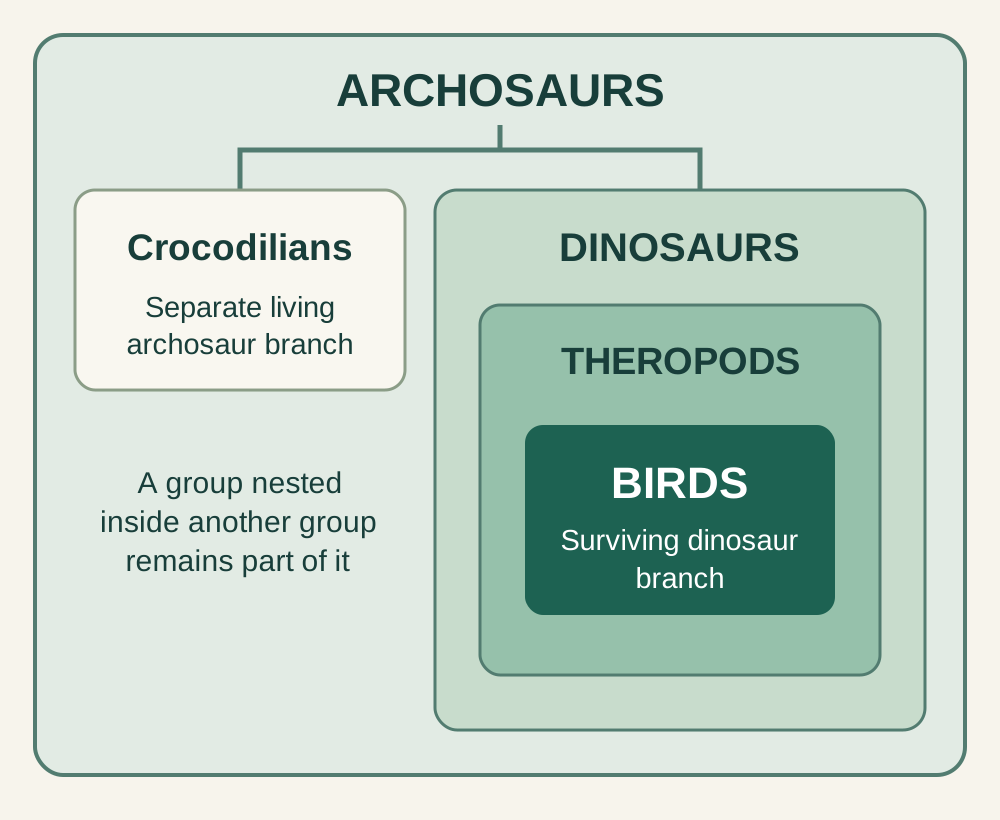
Traditional names can mislead. Birds did not descend from “bird-hipped” dinosaurs such as Stegosaurus or Triceratops. That historical label refers to similarity in parts of the pelvis, and similar traits can evolve independently. Relationships are inferred from a large combination of anatomical characters, as explained in dinosaur classification.
Feathers evolved before modern birds
Chinese fossils demonstrate that feathers and simpler filamentous coverings existed among varied non-avian dinosaurs. Some preserve a down-like halo; others have developed feathers with a central shaft and vanes. These structures were not all flight equipment.
Feathers could retain heat, protect skin and form visual displays. Aerodynamic use appeared on only some branches. Bird origins therefore were not one instant in which a naked dinosaur suddenly gained complete wings. Different components changed at different times.
Sinosauropteryx is an important non-avian theropod with a directly preserved filamentous covering. Microraptor shows a different combination, with long feathers on both forelimbs and hind limbs. Neither animal must be treated as one obligatory step on a straight road to the sparrow. They document experiments across a branching diversity of feathered forms.
The earliest history of feathers remains debated, especially when filament-like structures from more distant dinosaur or pterosaur branches are compared. That uncertainty does not erase the well-documented complex feathers among theropods close to birds. The evidence and its limits are reviewed in feathers, skin and colour.
Quill knobs can survive when feathers do not
Soft feathers are seldom fossilised. A Mongolian Velociraptor ulna carries small bumps in the position where large feathers attach in living birds. Six such structures were visible on the preserved portion when the specimen was described in 2007.
This is indirect but anatomically precise evidence. Researchers observed a bony feature and compared its location and form with living animals. Absence of knobs does not prove naked skin because many feathered birds lack prominent marks. Their presence in the correct place, however, strongly supports substantial forelimb feathers.
Velociraptor does not become a flying bird merely because its arms were feathered. Flight also requires suitable wing proportions, muscle mechanics, mass and control surfaces. A flightless feathered dinosaur is a coherent combination, not a contradiction.
The skeleton retains a shared construction
A bird wing contains a humerus, radius, ulna and modified hand bones corresponding to the forelimb of other theropods. Some components became smaller or fused in bird evolution, yet intermediate combinations preserve their correspondence.
The furcula, or wishbone, consists of joined clavicles and occurs in non-avian theropods as well as birds. A specialised wrist joint allowed the hand to fold towards the forearm. Details of the shoulder, pelvis, hind limb, air-filled bones and vertebrae add further matches. Reliability comes from the combination, not one spectacular feature.
Posture changed as an integrated system. Long bony tails shortened, and later bird lineages developed a pygostyle supporting tail feathers. The centre of mass shifted as the trunk and hind limbs changed. Birds did not result from simply shrinking a large carnivore; locomotion, breathing and balance were remodelled together.
No single feature settles ancestry. Hollow bones occur outside birds and bipedalism evolved repeatedly. A family tree becomes robust when many independent characters appear in a consistent branching order.
Eggs, nests and adults add behavioural evidence
Several oviraptorosaur skeletons occur directly above organised clutches, their forelimbs spread over the eggs. Relative positions matter more than bones merely being nearby: the arrangement is difficult to produce by random transport and closely resembles brooding in birds.
Mongolian Citipati specimens are especially clear. Eggshell construction, clutch geometry and embryos contribute independent evidence. Different dinosaurs still used different nest styles, and one brooding specimen cannot establish the full parental cycle for every group.
Small theropods also preserve compact resting postures with tucked legs, wrapped tails and the head turned towards the forelimb. The chapter on how dinosaurs slept separates the direct skeletal pose from inference about sleep. Behavioural similarities reinforce anatomy while retaining their own taphonomic limits.
Why Archaeopteryx remains important
Archaeopteryx lived about 150 million years ago in the Late Jurassic. German fossils combine developed flight feathers with teeth, a long bony tail and separate fingers. This mosaic made it one of the most visible demonstrations that bird features and other theropod features once coexisted in one animal.
Calling it “half bird” is only a rough teaching phrase. Archaeopteryx was a complete animal adapted to its environment, not an unfinished pigeon waiting for evolution to continue. Nor must it be the direct ancestor of every modern bird. A fossil can occupy a nearby side branch and still reveal combinations present around the origin of a lineage.
Analyses sometimes move particular early avialans when new fossils and characters are added. Those shifts test fine branching order. They do not restore a large anatomical gap between birds and other theropods.
When modern-type birds appeared
Mesozoic birds were diverse. Many retained teeth, had shoulder arrangements unlike living species and belonged to branches that left no descendants. “Bird” and “member of the modern bird radiation” therefore do not identify the same evolutionary level.
Asteriornis maastrichtensis from Belgium lived about 66.8 to 66.7 million years ago. Its three-dimensionally preserved skull and associated bones illuminate an early branch close to the group containing chickens and waterfowl. This shows that important modern lineages had begun to separate before the end-Cretaceous catastrophe.
It does not put domestic chickens in Cretaceous forests. Modern species arose much later, and domesticated breeds are a very recent result of human selection.
Why only some birds survived the mass extinction
At 66 million years ago all known non-avian dinosaurs and many bird branches disappeared. Flight cannot be the whole answer because numerous flying birds and all pterosaurs also vanished. Researchers instead examine combinations of body size, diet, habitat and reproduction.
Surviving lineages may have benefited from small bodies and flexible diets. Seeds could persist when photosynthesis and food chains collapsed. Ground-associated habits and shorter generation times may also have helped. No single trait guaranteed survival, and the exact ecology of the ancestral survivors is reconstructed from incomplete sampling.
The event did not transform one non-avian dinosaur into a bird overnight. Birds had existed for tens of millions of years. The extinction pruned the tree so severely that the avian branch became the only dinosaurs left.
Is a chicken descended from Tyrannosaurus?
A chicken is related to Tyrannosaurus because both are theropods. It is not descended from the genus Tyrannosaurus. Their lineages separated much earlier, and Tyrannosaurus represents its own Late Cretaceous side branch.
Popular comparisons sometimes say a chicken is the closest living relative of Tyrannosaurus. Every living bird shares the relevant deep ancestry. A chicken may be convenient for genome or development studies, but an ostrich, duck and sparrow are also living dinosaurs.
This relationship cannot reconstruct a lost Tyrannosaurus genome. Living birds inherited only one transformed evolutionary path and accumulated their own mutations, gene losses and chromosome rearrangements. Common ancestry is not a frozen genetic backup.
What is established and what remains under study?
The placement of birds within theropod dinosaurs is established by a broad convergence of skeletal, feather, reproductive and phylogenetic evidence. Whether a particular fossil species lies just inside or outside Avialae can remain disputed without changing that larger conclusion.
Researchers continue to test the earliest origin of feathers, the number of transitions in flight style, the exact capabilities of Archaeopteryx and the fine order of closely related branches. These are questions inside a well-supported framework, not a choice between birds having or lacking dinosaur ancestry.
The concise answer is therefore stronger than “birds came from dinosaurs”. Birds arose within feathered theropods and remain dinosaurs today. Their survival carries one Mesozoic branch into every modern ecosystem.
Frequently asked questions
Are all birds dinosaurs or only large flightless birds?
All birds are dinosaurs, including hummingbirds, penguins and chickens. Flight, size and habitat can change without removing a species from the branch in which it evolved.
Why is a crocodilian not a dinosaur descendant?
Crocodilians and dinosaurs are neighbouring archosaur branches. They share an older common ancestor, but the crocodilian lineage separated before Dinosauria arose and remains outside it.
Does a feathered dinosaur have to be capable of flight?
No. Feathers first served several roles, including insulation and display. Many non-avian dinosaurs carried feathers but lacked the wing proportions and flight mechanics needed for powered flight.
Can scientists reconstruct Tyrannosaurus from a chicken?
No. A chicken is a living theropod, not a storage copy of the Tyrannosaurus genome. Developmental experiments can investigate ancestral traits but cannot recover the full anatomy, chromosomes or identity of an extinct species.