

Wintonotitan was a long-necked, plant-eating dinosaur from Australia. Its type skeleton includes parts of the backbone, pelvis, shoulder and forelimbs. A nearly complete left metacarpus provides an unusual opportunity to compare the weight-bearing hand with those of other sauropods.
Quick facts
| Group | Sauropods, titanosauriforms (Titanosauriformes) |
|---|---|
| Age | Early Late Cretaceous (Cenomanian to early Turonian) |
| Region | Australia (Queensland) |
| Diet | Herbivorous |
| Type species | Wintonotitan wattsi |
| Holotype | QM F7292, partial skeleton |
| Strata | Winton Formation |
What can the fossils tell us?
Keith Watts found the bones near Winton. They include vertebrae, shoulder and forearm bones, and elements of the left metacarpus.
Three neighbouring metacarpals form a recess next to the forearm. The bony shape survives while the soft tissue anatomy of the joint is unknown.
Some front and middle tail vertebrae preserve a prominent longitudinal ridge. Researchers compare it with ridges in other Australian sauropods.
From Austrosaurus to a separate genus
Keith Watts discovered the specimen and donated it to Queensland Museum in 1974. The isolated bones from the Winton Formation were initially assigned to Austrosaurus. Study of additional Australian sauropods made the comparisons more informative. In 2009 Scott Hocknull and colleagues named Wintonotitan wattsi in honour of the finder.
The description originally placed the fossils in the latest Albian. Current work treats the sauropod-bearing Winton deposits as Cenomanian to early Turonian, in the early Late Cretaceous.
What the revised anatomy shows
A deep hollow occurs where the upper ends of the first three metacarpals meet. It may have received the convex end of the radius or an element of the wrist. Shape differences in the tops of some back vertebrae and the sides of the tail vertebrae also help identify the genus.
Some pieces were once interpreted as fragments of bony skin armour. A skeletal revision identified them as processes of the back vertebrae. The find provides no confirmed osteoderms for Wintonotitan.
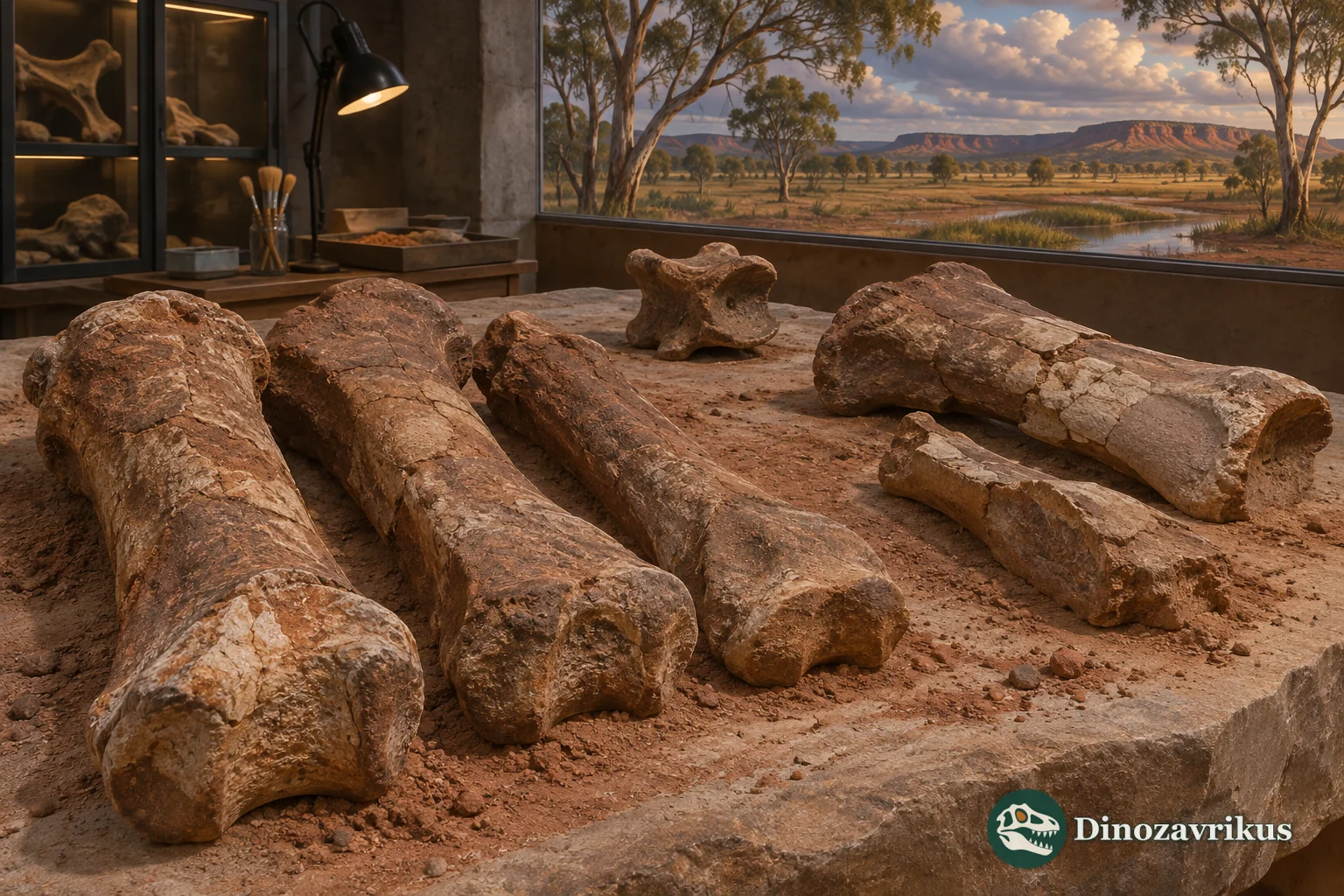
A distinct Australian sauropod
Wintonotitan is a titanosauriform. Several analyses place it among somphospondylans outside Titanosauria. Other placements vary with the characters and skeletons included in the comparison. Its sauropod anatomy supports herbivory, although the particular plants it ate remain unknown.
Frequently asked questions
Where was Wintonotitan found?
In the Cretaceous Winton Formation of central-western Queensland, Australia.
Whom does the species name honour?
Keith Watts, who found the type material and donated it to the museum.
What is unusual about the left hand?
Most of the metacarpus is preserved. Three bones form a recess near the joint with the forearm.
Did Wintonotitan have bony skin armour?
The fragments once interpreted as armour were identified as parts of back vertebrae.