

Woutersophis was an Eocene snake from Belgium. Its trunk vertebrae were found in marine deposits near Brussels. They are elongate and compressed from side to side, with a strongly vaulted arch over the spinal canal.
Quick facts
| Group | Snakes (Serpentes) |
|---|---|
| Age | Middle Eocene, Lutetian |
| Region | Europe, Belgium |
| Type species | Woutersophis novus |
| Scientific name | Woutersophis |
| Diet | No direct evidence |
What can the fossils tell us?
MNHN.F.CBL1 is a vertebra from the Van Pachtenbeke sand pit. It is held at the National Museum of Natural History in Paris.
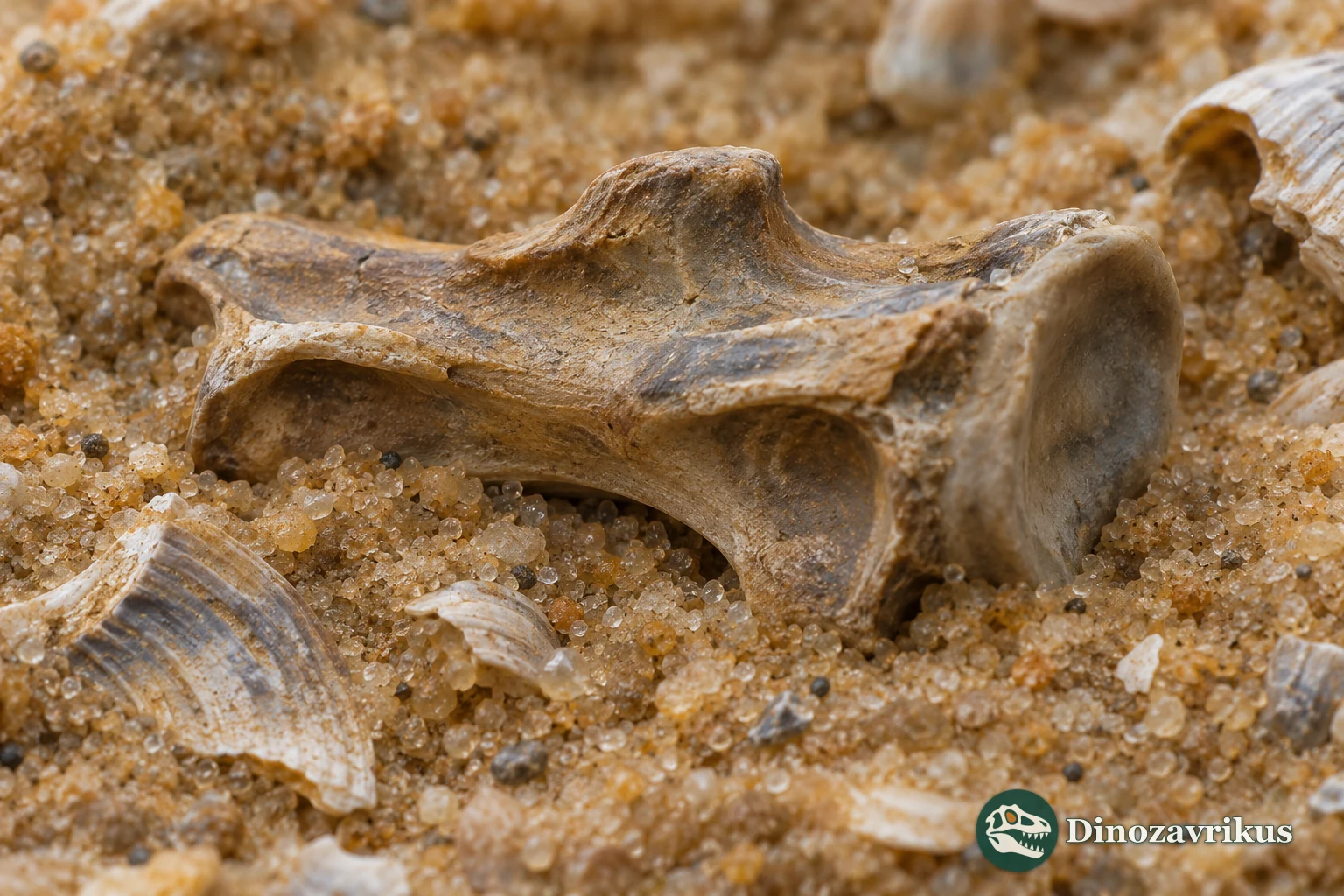
The vertebral body is elongate, the neural arch highly vaulted and the rib articulations low on the sides.
The isolated trunk bones leave the shape of the tail, swimming mechanics and exact family affinities open to interpretation.
A snake from the Brussels sands
Jean-Claude Rage named Woutersophis novus in 1980. The holotype comes from the Van Pachtenbeke sand pit at Zaventem and entered the Paris museum from the collection of Georges Wouters. Rage also examined trunk vertebrae from other Lutetian sites in the North Sea Basin around Brussels.
Where to look on the vertebra
The narrow centrum is longer than it is wide. A short process projects below it. This process, the hypapophysis, is present in the middle of the trunk as well as nearer the head. The surfaces that met the ribs are low on the sides of the vertebra. The shape varies along the backbone, so researchers compare equivalent regions when identifying isolated bones.
What the marine deposits tell us
Rage described Woutersophis as a marine snake and assigned it to Nigerophiidae. Later studies noted differences from Nigerophis and treated the exact family referral cautiously. Woutersophis is among several extinct kinds of snakes documented in Eocene marine deposits. Palaeophis is another example, belonging to a separate family. With the head and tail unknown, the fossils offer little direct evidence for swimming mechanics or diet.
Frequently asked questions
Where was the type vertebra found?
It comes from the Van Pachtenbeke sand pit at Zaventem, near Brussels.
When did Woutersophis live?
Secure records come from Lutetian deposits of the middle Eocene.
What distinguishes its vertebrae?
They are elongate and narrow, with a strongly vaulted arch and a short downward process on the middle trunk vertebrae.
Can its appearance be reconstructed?
Only isolated trunk vertebrae are known. Those do not establish head or tail proportions or the total length.